South Korea Freezes Oil Price Cap for Third Time Amid Economic Concerns
by Kim SeongSeoPosted : May 7, 2026, 23:43Updated : May 7, 2026, 23:43
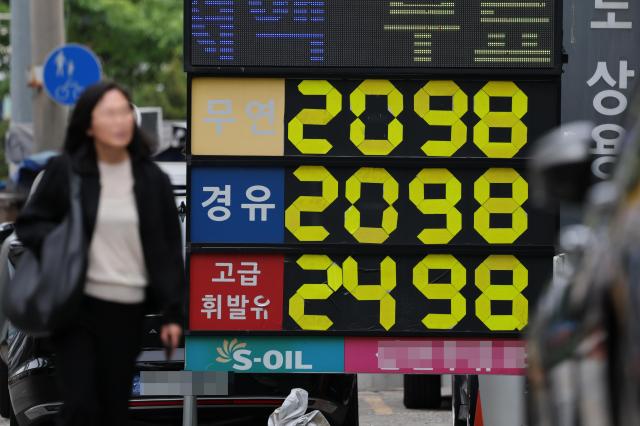
A gas station in Seoul. [Photo=Yonhap News]
The South Korean government has decided to freeze the fifth oil price cap, marking the third freeze since the second increase. Despite rising international oil prices and accumulated factors for further increases, the government is prioritizing inflation concerns.
However, the ongoing freeze amid rising price pressures suggests that future fiscal burdens may increase. Concerns about the prolonged situation are also growing as the government lacks a clear exit strategy.
The Ministry of Trade, Industry and Energy announced on May 7 that the fifth oil price cap, effective from midnight on May 8, will maintain regular gasoline at 1,934 won per liter, diesel at 1,923 won, and kerosene at 1,530 won.
The price cap system was implemented on March 13 due to rising international oil prices exceeding $100 per barrel, which has increased inflationary pressures. The initial price cap set regular gasoline at 1,724 won, diesel at 1,713 won, and kerosene at 1,320 won.
The second price cap, effective March 27, set the same prices as the current freeze. Subsequent price caps were also frozen every two weeks, continuing this trend.
Moon Sin-hak, Deputy Minister of Industry, noted that while international oil prices fluctuate around $100 per barrel, recent peace talks between the U.S. and Iran have led to a decline. He emphasized that uncertainty remains, and the cumulative factors for price increases have not been fully addressed.
He added that consumer price inflation, which had stabilized earlier this year, has risen since the outbreak of conflict in the Middle East, with oil product prices increasing by 22% compared to the previous year. Given the overall inflationary environment, the government decided to freeze the price cap to prioritize public welfare.
Without the price cap, gasoline prices would be around 2,200 won, and diesel would be about 2,500 won. Yang Gi-wook, head of the Ministry's Resource Security Office, indicated that gasoline prices have remained stable compared to April, with cumulative price increase factors estimated at 200 won for gasoline and 400 won for diesel.
However, diesel drivers may face a greater burden due to higher remaining price increase factors. Deputy Minister Moon explained that diesel is linked to public welfare, while gasoline is tied to inflation concerns. Although there were discussions about adjusting cumulative increase factors, the decision was made to maintain the freeze after extensive deliberation.
The government acknowledges the growing fiscal burden but lacks a clear exit strategy for the price cap. An additional budget of 4.2 trillion won has been allocated for the price cap, but increasing fiscal pressures may necessitate further budget adjustments.
The government stated that both physical and price factors must stabilize. Deputy Minister Moon remarked that the free passage through the Strait of Hormuz and price volatility must be monitored, emphasizing the need to consider both factors alongside public welfare and inflation.
Meanwhile, the government anticipates oil supply exceeding 210 million barrels from May to July, with May's supply expected to be 7.5 million barrels, June's at 6 million barrels, and July's at 7 million barrels, representing over 80% of normal import levels. The naphtha secured in May is expected to stabilize at around 90% of normal levels, with Deputy Minister Moon confirming that May's oil quantities are mostly finalized, while June and July figures are considered minimum estimates.