
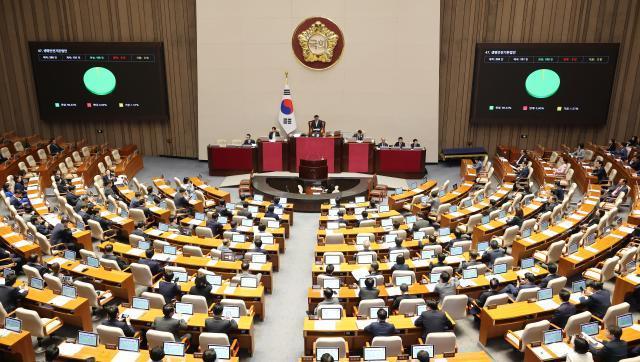
The National Assembly has passed a special law aimed at promoting the artificial intelligence data center industry. While the name is lengthy, its intent is clear: the government is stepping in to ensure South Korea does not fall behind in the competitive landscape of AI infrastructure. This legislation includes provisions for easing facility regulations, establishing special zones, and providing financial support, marking a significant step in redesigning the foundation of the digital economy.
Data centers are no longer just collections of servers. In the AI sector, they represent a complex infrastructure that integrates power, semiconductors, networks, and cooling technologies. As AI models grow larger, the demand for computational power and the physical space needed to accommodate this, along with energy requirements, also increase. Ultimately, a nation's AI competitiveness hinges not only on algorithms but also on how quickly and efficiently data centers can be built.
The global competition has already begun. The United States is expanding investments in massive data centers led by major tech companies, while Middle Eastern nations are emerging as new hubs by offering cheap electricity. Southeast Asia is also attracting global firms through regulatory easing and tax incentives. Data centers are no longer confined to specific countries; they are moving to regions with favorable power and regulatory conditions.
In this context, South Korea faces significant challenges. Electricity costs are high, and regulations on locations in the capital region remain stringent. The environmental permitting process is also complex, making the country less attractive for global investments. The introduction of this special law aims to address these issues by easing regulations and establishing special zones, recognizing that maintaining existing regulatory frameworks would hinder industry growth.
The special zone system is particularly significant. Data centers must be concentrated in specific areas due to the simultaneous need for power supply, communication networks, and cooling infrastructure. By easing location regulations and supporting infrastructure development through special zones, it is possible to create clusters centered around certain regions. This could lead to the formation of an industrial ecosystem beyond mere facility expansion.
Financial support is also a crucial element. Data centers require substantial initial investments, often amounting to trillions of won, with long payback periods. The structure is such that private capital alone cannot bear the burden. Without the government sharing some of the risks, investments could be delayed. The law's provision for financial support reflects this reality.
However, concerns remain. The most pressing issue is electricity. Data centers are known as "power-hungry industries." A single large facility can consume as much electricity as an entire small city. If data centers are expanded without a power supply plan, the burden on the power grid will inevitably increase, potentially leading to higher electricity prices and conflicts over energy policy.
Environmental issues cannot be overlooked either. Data centers generate significant heat and consume both water and energy for cooling. Carbon emissions are also a concern. Policies focused solely on industrial promotion could exacerbate environmental burdens in the long run. Conflicts with local residents could further complicate project implementation.
Thus, data center policies must not merely focus on regulatory easing but rather on balanced design. It is essential to consider both industrial competitiveness and environmental sustainability. Complementary policies, such as integrating renewable energy, utilizing waste heat, and adopting high-efficiency cooling technologies, must be pursued simultaneously. Otherwise, expanding the industry could lead to new conflicts.
Another variable is the reliance on global companies. The data center industry is inherently linked to major global tech firms. Without their investment, the market is unlikely to grow significantly. However, increased dependence on specific companies poses the risk of losing industry leadership. Therefore, strengthening the competitiveness of domestic firms alongside a strategy for technological independence is necessary.
The passage of this law alongside the defense semiconductor legislation is also noteworthy. Data centers and semiconductors are not separate industries; AI computations ultimately rely on semiconductors. As the number of data centers increases, so does the demand for high-performance semiconductors. This legislation demonstrates a commitment to simultaneously grow AI infrastructure and core component industries. It is important to note that industrial policies are being designed as interconnected structures rather than isolated sectors.
Ultimately, the key to this special law is speed. The global competition has already begun, and falling behind makes it difficult to catch up. However, speed alone is not sufficient. Without clear direction and standards, the industry cannot be sustainable. Four conditions—power, environment, local acceptance, and technological independence—must be met simultaneously.
The competition in the AI era will be determined in unseen ways. Algorithms are software, but the physical infrastructure that drives them is crucial. Data centers are at the heart of this. This law is the first step toward building that infrastructure.
The challenge begins now. While the law has been enacted, its significance will be lost if implementation does not follow. The success or failure will depend on whether special zones operate effectively, whether power infrastructure is built on time, and how environmental conflicts are managed. Policies do not end with declarations; competitiveness is determined by the details of execution.
South Korea possesses capabilities in semiconductors, communications, and IT. If data center infrastructure is integrated, the country can secure significant competitiveness in the AI industry. However, delays in preparation could quickly lead to lost opportunities.
This special law opens the door to opportunity. Whether that door can be passed through now depends on the law's completeness.
* This article has been translated by AI.
Copyright ⓒ Aju Press All rights reserved.