
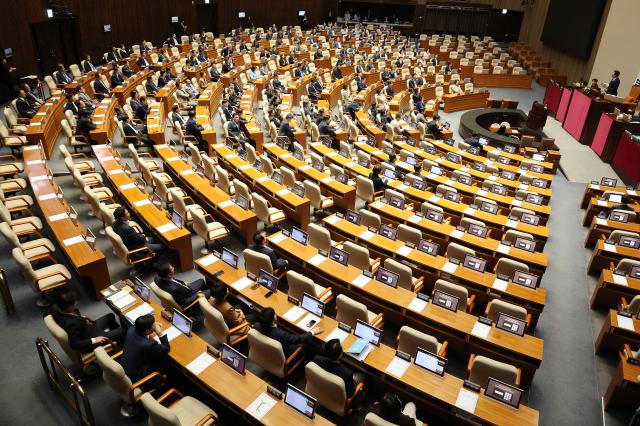
The second plenary session of the 435th National Assembly is held on May 8. [Photo: Yonhap News]
On May 8, National Assembly Speaker Woo Won-sik attempted to introduce a constitutional amendment and 51 other legislative items during a plenary session. However, the People Power Party (PPP) filed a filibuster on all bills, prompting Woo to withdraw the proposal. He criticized the PPP for abusing the filibuster process. After the session, PPP floor leader Song Eon-seok stated that amendments pushed through without bipartisan agreement are historically linked to dictatorship and misfortune.
Woo expressed his intention to hold the session to avoid derailing the long-awaited constitutional amendment, stating, "Seeing the response of a filibuster, I feel it is pointless to proceed with the agenda, and I will not present the amendment." He added that the proposed amendment included commitments previously made by the PPP, expressing strong regret towards the party for derailing the process with political maneuvering and unfounded claims.
In response to the PPP's objections to what they termed a 'hasty amendment,' Woo remarked, "The PPP has repeatedly rejected proposals I have made in the past without providing any answers. If illegal uprisings occur again in 20 or 30 years, the PPP will be seen as historical criminals."
During the filibuster, PPP lawmakers left the chamber around 2:18 PM as Woo's remarks extended. He declared the session adjourned five minutes later without presenting any bills. Following the adjournment, the PPP leadership criticized Woo for violating the principle of no simultaneous sessions.
Song stated, "The amendment was clearly rejected in the plenary session yesterday. Reintroducing a defeated bill contradicts the principle of no simultaneous sessions," adding that the failure to vote was appropriately reflected in the proposal to dismiss Minister of Unification Jeong Dong-young, which was not brought to the floor.
He further questioned the significance of amending the constitution if the National Assembly Speaker does not uphold the current constitution, warning that unilateral amendments without bipartisan agreement have historically led to dictatorship and misfortune.
Meanwhile, the National Assembly attempted to introduce the constitutional amendment the previous day, but only 178 lawmakers participated in the vote, leading to a declaration of failure to vote. For the amendment to pass, it requires the approval of at least two-thirds of the National Assembly's members.
The amendment must clear the plenary session within 60 days of its announcement, leaving about a month for action. However, to align with the government's plan to hold a national referendum on the amendment alongside the June 3 local elections, it must pass by May 10, effectively sidelining this attempt at constitutional reform. Woo emphasized the need to establish a special committee for constitutional amendments in the second half of the year, urging both parties to present a clear timetable for the amendment to the public.
Woo expressed his intention to hold the session to avoid derailing the long-awaited constitutional amendment, stating, "Seeing the response of a filibuster, I feel it is pointless to proceed with the agenda, and I will not present the amendment." He added that the proposed amendment included commitments previously made by the PPP, expressing strong regret towards the party for derailing the process with political maneuvering and unfounded claims.
In response to the PPP's objections to what they termed a 'hasty amendment,' Woo remarked, "The PPP has repeatedly rejected proposals I have made in the past without providing any answers. If illegal uprisings occur again in 20 or 30 years, the PPP will be seen as historical criminals."
During the filibuster, PPP lawmakers left the chamber around 2:18 PM as Woo's remarks extended. He declared the session adjourned five minutes later without presenting any bills. Following the adjournment, the PPP leadership criticized Woo for violating the principle of no simultaneous sessions.
Song stated, "The amendment was clearly rejected in the plenary session yesterday. Reintroducing a defeated bill contradicts the principle of no simultaneous sessions," adding that the failure to vote was appropriately reflected in the proposal to dismiss Minister of Unification Jeong Dong-young, which was not brought to the floor.
He further questioned the significance of amending the constitution if the National Assembly Speaker does not uphold the current constitution, warning that unilateral amendments without bipartisan agreement have historically led to dictatorship and misfortune.
Meanwhile, the National Assembly attempted to introduce the constitutional amendment the previous day, but only 178 lawmakers participated in the vote, leading to a declaration of failure to vote. For the amendment to pass, it requires the approval of at least two-thirds of the National Assembly's members.
The amendment must clear the plenary session within 60 days of its announcement, leaving about a month for action. However, to align with the government's plan to hold a national referendum on the amendment alongside the June 3 local elections, it must pass by May 10, effectively sidelining this attempt at constitutional reform. Woo emphasized the need to establish a special committee for constitutional amendments in the second half of the year, urging both parties to present a clear timetable for the amendment to the public.
* This article has been translated by AI.
Copyright ⓒ Aju Press All rights reserved.