
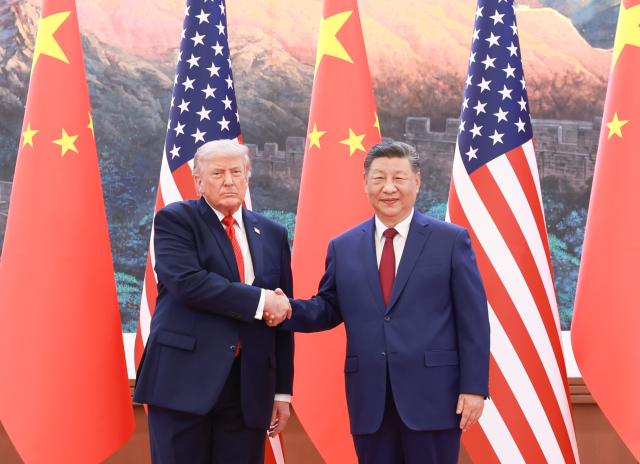
Chinese President Xi Jinping issued a strong warning regarding Taiwan during a meeting with U.S. President Donald Trump, stating that mishandling the issue could lead to conflict between the two nations. This meeting marked their first encounter in seven months since the summit in Busan last October.
According to China Central Television (CCTV) on May 14, Xi emphasized that the Taiwan issue is the most critical matter in U.S.-China relations during their talks at the Great Hall of the People in Beijing. He noted, "If the Taiwan issue is handled well, U.S.-China relations can maintain overall stability. However, if mishandled, the two countries could collide and even enter a state of conflict, pushing U.S.-China relations into a very dangerous situation." He added, "'Taiwan independence' and peace in the Taiwan Strait cannot coexist like water and fire," underscoring that safeguarding peace and stability in the Taiwan Strait is the greatest common interest of both nations.
Xi's remarks on Taiwan were highlighted in a breaking news format by CCTV even before the conclusion of the summit, indicating the importance China places on the Taiwan issue. Analysts suggest that Xi's comments represented a heightened level of concern compared to previous statements.
Prior to Trump's visit, China had already defined the Taiwan issue as "the core of China's core interests" and "the first red line in U.S.-China relations," reiterating its sensitivity. An article by Chinese Ambassador to the U.S. Xie Feng, published in the People's Daily, also listed the Taiwan issue first among four red lines, which included democracy, human rights, development paths, and China's right to develop.
On the first day of Trump's visit on May 13, the Taiwan Affairs Office of the State Council reiterated its opposition to arms sales between the U.S. and Taiwan, further pressuring the U.S.
Shiu Yuren, a senior researcher at the Hudson Institute, interpreted through the Singapore United Daily News that Trump might be testing whether he intends to use the Taiwan issue as a bargaining chip. Trump had previously indicated that he would discuss the Taiwan issue and U.S. arms sales to Taiwan during his meeting with Xi. Given that U.S. arms sales to Taiwan have long been a source of tension in U.S.-China relations, it is expected to be a key agenda item in this summit. Observers are particularly interested in whether Trump will maintain the previous U.S. government's stance of "not supporting" Taiwan independence or adopt the Chinese-preferred phrasing of "opposing it" during his visit.
However, after the summit, Trump did not respond to reporters' questions about whether the Taiwan issue was discussed. Experts believe that the likelihood of changes in U.S. policy toward Taiwan, solely based on China's purchases of U.S. soybeans or Boeing aircraft, remains low.
* This article has been translated by AI.
Copyright ⓒ Aju Press All rights reserved.