
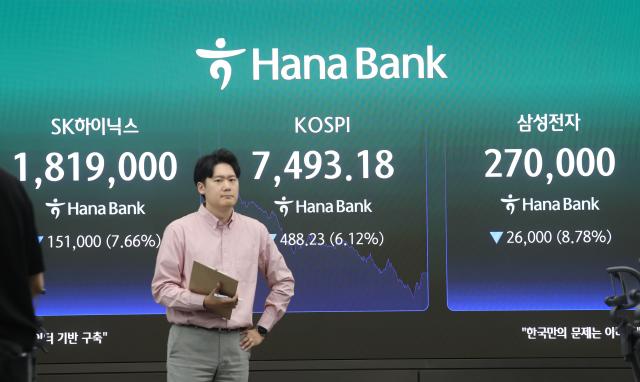
The KOSPI index briefly surpassed the 8,000 mark for the first time but then plummeted due to a wave of profit-taking. The selling pressure in the stock market intensified, triggering a trading halt for the first time in about a month due to a rapid decline in prices.
On May 15, the Korea Exchange reported that the KOSPI closed at 7,493.18, down 488.23 points (-6.12%) from the previous trading day.
The index opened at 7,951.75, down 29.66 points (-0.37%) from the previous day but managed to rise to an all-time high of 8,046.78 early in the session. However, a surge in profit-taking, primarily by foreign investors, quickly erased those gains, leading to a significant drop as the session progressed.
At approximately 1:28:49 PM, a trading halt was implemented for five minutes due to a sudden fluctuation in the KOSPI 200 futures index. This was the first trading halt in the KOSPI market since April 2.
Lee Kyung-min, a researcher at Daishin Securities, stated, "The sharp decline in the KOSPI today was triggered by concerns over overheating following a short-term surge, along with heightened anxiety over interest rate hikes, which led to rising bond yields and a reversal in market sentiment. The end of the first-quarter earnings season also contributed to profit-taking as expectations peaked."
Han Ji-young, a researcher at Kiwoom Securities, noted, "After the conclusion of the U.S.-China summit, attention has shifted to ongoing noise in the U.S.-Iran negotiations, while the U.S. 10-year Treasury yield surpassed 4.5%. This week’s upcoming U.S. Consumer Price Index (CPI) and Producer Price Index (PPI) are also causing ripples in the market due to inflation concerns."
She added, "In a similar vein, Japan's inflation shock in April has led to rising interest rates there, which in turn has influenced rates in other countries. The surge in the dollar-won exchange rate, which has climbed back to around 1,500 won, has also contributed to increased foreign selling. Additionally, the KOSPI's 20.9% surge since May has raised concerns about the pace of growth and the extreme concentration in a few sectors."
In the stock market, individuals purchased a net 7.1943 trillion won, helping to defend the index. In contrast, foreign investors and institutions sold a net 5.6195 trillion won and 1.7396 trillion won, respectively, focusing on profit-taking.
Major stocks also experienced declines. Samsung Electronics fell 7.77%, SK Hynix dropped 6.65%, SK Square decreased 5.81%, Hyundai Motor declined 1.69%, LG Energy Solution fell 5.66%, Samsung Electro-Mechanics dropped 0.39%, Doosan Enerbility decreased 5.29%, HD Hyundai Heavy Industries fell 5.37%, and Kia dropped 5.17%.
The KOSDAQ index also closed sharply lower, finishing at 1,129.82, down 61.27 points (5.14%). The index started the day at 1,197.23 but quickly reversed course as investor sentiment weakened.
In the KOSDAQ market, foreign investors purchased a net 363.4 billion won, while individuals and institutions sold a net 144.6 billion won and 167.2 billion won, respectively.
Most major stocks in the KOSDAQ also showed weakness, including Alteogen (-3.90%), EcoPro BM (-8.52%), EcoPro (-8.92%), Rainbow Robotics (-3.80%), Kolon TissueGene (-2.36%), Samchundang Pharm (-4.44%), Rino Industry (-10.95%), Rigakem Bio (-2.35%), HLB (-2.44%), and ABL Bio (-5.10%).
* This article has been translated by AI.
Copyright ⓒ Aju Press All rights reserved.