
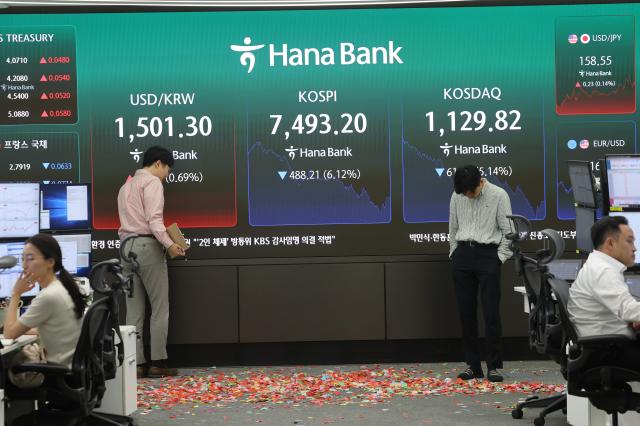
According to the Korea Exchange, the KOSPI index closed at 7493.18 on May 15, down 488.23 points (6.12%) from the previous trading day. Over the week from May 11 to 15, the KOSPI and KOSDAQ fell by 0.06% and 6.45%, respectively.
Despite external factors such as expectations for peace negotiations between the U.S. and Iran and a U.S.-China summit, domestic stocks maintained a strong trend, particularly in the semiconductor and automotive sectors. NVIDIA CEO Jensen Huang's visit to China and the anticipated resumption of H200 sales in China boosted investor sentiment in semiconductors, while optimism surrounding Hyundai Motor Group's robotics business contributed to gains in the automotive sector. Consequently, the automotive, semiconductor, and display sectors led the weekly gains.
Expectations for increased AI investment and upward revisions in profit estimates for the global IT sector were also seen as driving forces behind the rise in domestic stocks. Major semiconductor firms like Samsung Electronics and SK Hynix continued to perform well, with individual investors absorbing foreign profit-taking, sustaining the upward trend. However, some cyclical sectors, including securities, utilities, and steel, showed relatively weak performance.
Next week is expected to bring significant global events that could heighten market volatility. Starting with China's industrial production report on May 18, NVIDIA's earnings report is scheduled for May 21, followed by the launch of a public growth fund on May 22. Market observers believe that NVIDIA's earnings will be a key event to assess the sustainability of AI infrastructure investments.
The anticipated strike by Samsung Electronics' union is also a major variable. The union and management are in negotiations over special bonuses and performance pay, but the union has announced plans to strike starting May 21. Concerns are growing that a prolonged strike could disrupt semiconductor production.
Na Jeong-hwan, a researcher at NH Investment & Securities, noted, "The approval of H200 sales in China is emerging as a positive factor for NVIDIA. Key points to watch include whether guidance for sales in China is reflected, the sustainability of demand for Blackwell, and whether supply bottlenecks are alleviated." He added, "If the strike at Samsung Electronics leads to increased stock volatility, it may be necessary to diversify portfolios with high-quality stocks that have performance momentum."
Short-term analyses suggest that the KOSPI has entered a phase of technical pressure. The concentration of supply and demand in semiconductor and AI infrastructure-related sectors has increased valuation pressures on some stocks. However, the ongoing AI investment cycle and improving corporate earnings suggest that the long-term upward trend is likely to be maintained.
Shin Han-gil, a researcher at Shinhan Investment Corp., stated, "As the KOSPI reaches 8000 points, technical pressures are also increasing. Following revisions to semiconductor earnings forecasts, additional upward catalysts are gradually weakening, which may slow the pace of increases."
Experts advise maintaining focus on existing leading sectors centered on semiconductors while also considering sectors that have not fully reflected earnings improvements. Alternative sectors mentioned include secondary batteries, consumer goods, defense, shipbuilding, and department stores.
Jo Byeong-hyeon, a researcher at Daol Investment & Securities, emphasized the need to explore potential in communication equipment, secondary batteries, and renewable energy within the AI value chain rather than seeking alternatives to semiconductor declines. He also noted that expectations for domestic demand have strengthened compared to previous levels, suggesting that retail and distribution sectors should also be monitored.
* This article has been translated by AI.
Copyright ⓒ Aju Press All rights reserved.