
As regulations in Seoul tightened this year, demand has shifted to the Gyeonggi and Incheon apartment markets, resulting in a more than 30% increase in transaction volume compared to last year.
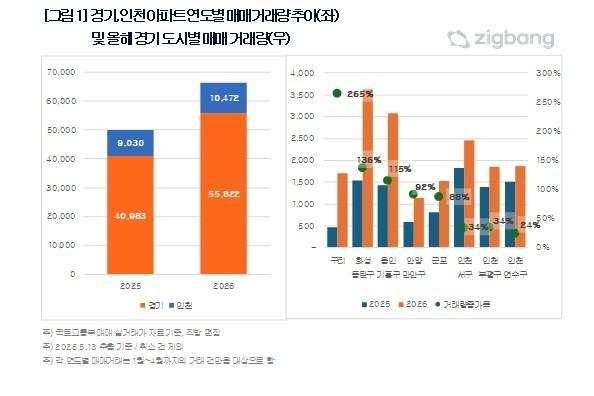
According to Zigbang, from January to April 2026, the number of apartment transactions in Gyeonggi and Incheon reached 66,294, a 33% increase from 50,013 during the same period last year. This surge is attributed to buyers dispersing to areas with relatively fewer regulations as land transaction permission zones were expanded across Seoul.
In Gyeonggi Province, apartment transactions rose from 40,983 in the first four months of 2025 to 55,822 in the same period this year, marking a 36% increase. Notably, Guri City saw the largest increase, with transactions soaring 265% from 486 last year to 1,708 this year.
Industry experts believe that the anticipated GTX-B line and the extension of Subway Line 6, along with expectations for redevelopment, have driven this increase. The exclusion of certain areas from land transaction permission zones and regulatory regions has also played a role.
In particular, transaction volume in Inchang-dong, Guri City, jumped more than fourfold from 186 last year to 778 this year. The Inchang Jugong Complex 2 and Inchang Jugong Complex 6, both with redevelopment potential, recorded 64 transactions each, reflecting the most active trading.
Other areas also showed significant increases, including Dongtan in Hwaseong (136%), Giheung in Yongin (115%), and Manan in Anyang (92%). Analysts suggest that the expansion of transportation networks, the establishment of semiconductor industrial complexes, and ongoing redevelopment projects have stimulated buyer interest.
This trend indicates a clear movement toward areas like Guri and Anyang, which offer improved living conditions and proximity to workplaces. According to the real estate platform Asil, the Inchang 4 Complex in Guri City recorded a new high of 678 million won last month. Additionally, the Daelim Hansup in Su-taek-dong, Guri City, also set a new record at 694 million won in April.
In contrast, the transaction volumes in Bundang, Seongnam, and Gwacheon, both designated as land transaction permission zones and regulatory areas, decreased by 30% and 77%, respectively, during the same period.
Incheon also experienced an increase in transactions. From January to April 2026, the number of apartment transactions in Incheon reached 10,472, up 16% from 9,030 last year. Seo-gu and Bupyeong-gu saw increases of 34% each, while Yeonsu-gu rose by 24%, leading the transaction growth.
Kim Eun-sun, head of Zigbang's Big Data Lab, stated, "Amid recent instability in the rental market, some demand for leases is shifting toward purchases. With relatively lower loan thresholds and the ability to buy with jeonse (key money), demand is dispersing to Gyeonggi areas. Transactions are notably increasing in complexes with development prospects, such as improved transportation and redevelopment projects."
* This article has been translated by AI.
Copyright ⓒ Aju Press All rights reserved.