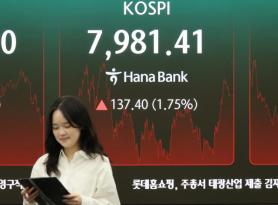
SEOUL, May 19 (AJP) - With memory giants Samsung Electronics and SK Hynix posting operating margins above 70 percent and quarterly chip profits of $25 billion to $35 billion, South Korea's AI-boom windfall has laid bare a compensation system still tethered to the industrial era — and the workers who built it want their share.
Marathon government-mediated labor talks, watched closely by the president, politicians and investors alike, underscore the national stakes: Samsung alone accounts for roughly 20 percent of Korea's outbound shipments, and any disruption to its chipmaking lines would reverberate far beyond the factory floor.
At the center of the dispute is the bonus cap. The National Samsung Electronics Union is demanding that 15 percent of operating profit be allocated to bonuses and that existing caps be abolished — a demand that has reignited a broader debate over whether South Korean companies need more transparent, equitable compensation systems.
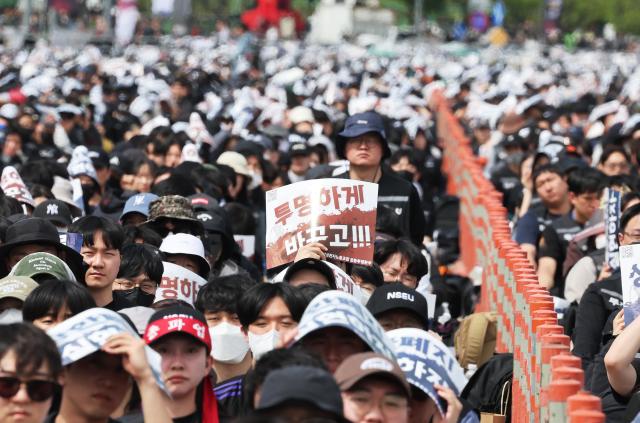
"The problem isn't the money. There just aren't clear and transparent standards," said a 31-year-old employee at a large Seoul-based company.
The tension reflects a structural divergence from the United States, where AI-driven growth has largely translated into intensified talent competition and equity-based rewards. In Korea, the same boom has triggered recurring labor conflict.
Wage data illustrate how much Korean pay growth depends on bonuses. According to the Ministry of Employment and Labor's Labor Force Survey, special payments — including performance bonuses — rose 8.1 percent in the first half of 2025, far outpacing the 2.9 percent increase in fixed wages.
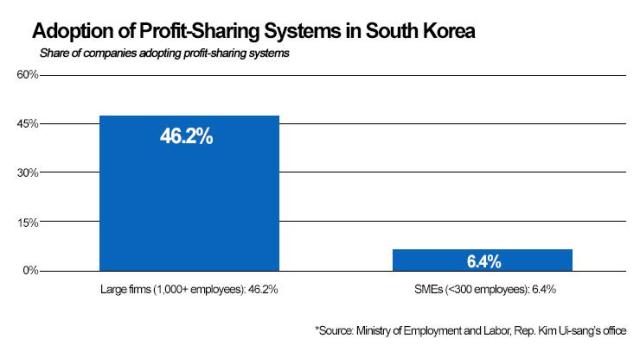
Yet profit-sharing has been uneven in application. Ministry data submitted to lawmaker Kim Ui-sang of the People Power Party on May 8 show that 43.8 percent of employers with 300 or more workers and 46.2 percent of those with over 1,000 employees pay bonuses based on annual income — compared with just 6.4 percent of companies with fewer than 300 staff.
Korea's so-called performance-sharing system distributes bonuses based on overall corporate results rather than individual contribution, in contrast to the more individualized, equity-driven models common at U.S. tech firms.
And even within the chip sector, the rewards remain concentrated at the top. Samsung works with roughly 150 suppliers and some 35,000 subcontracted workers — none of whom are party to the bonus dispute.
"In the U.S., compensation is increasingly treated as a function of measurable contribution and strategic importance rather than role equivalence," said Erik Cambria, a professor of artificial intelligence at Nanyang Technological University in Singapore.
He said major U.S. tech companies are rapidly shifting toward selective compensation structures, concentrating equity and long-term incentives on engineers and researchers viewed as critical to AI development.
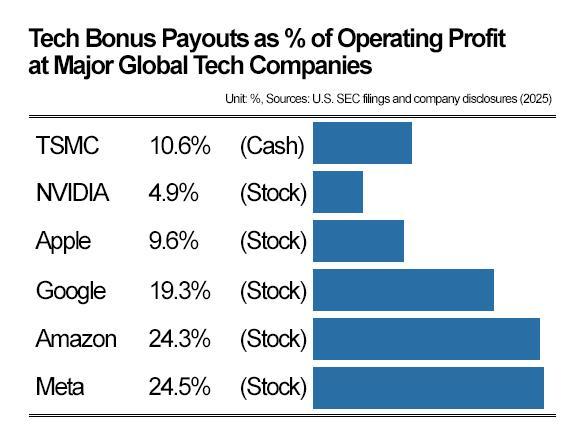
The scale is striking. OpenAI's average stock-based compensation reached approximately $1.5 million per employee in 2025, among the highest levels in the industry, according to financial data reviewed by The Wall Street Journal. Meta reported $20.4 billion in share-based compensation that year, while Alphabet reported $27.1 billion.
The demand for high-impact AI talent is also surging. U.S. job postings for "forward-deployed engineers" — specialists who integrate AI systems directly into enterprise operations — jumped roughly 729 percent over the past year, rising from 643 openings in April 2025 to 5,330 in April 2026, according to Indeed.
"While AI is standardizing routine execution, the ability to create strategic value is becoming increasingly concentrated among a small group of 'superstar' talent," said Choi Jae-pil, a management professor at Sungkyunkwan University Graduate School of Business.
Choi noted that AI could make performance assessments more quantifiable and transparent, potentially making differentiated pay structures more palatable to workers — but cautioned that the shift would be harder to implement in Korea, where cash bonuses and group-based compensation remain the norm.
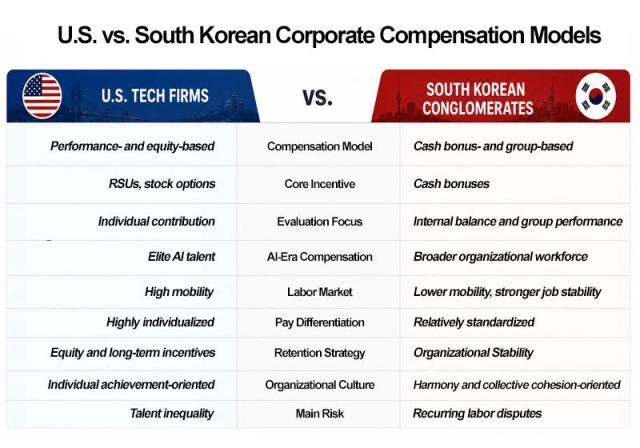
Structural differences in the labor market compound the problem, analysts say.
"Dissatisfied workers in the U.S. can easily move to other firms, pushing companies to offer better compensation to retain talent," said Shin Hyun-han, a finance professor at Yonsei University. In Korea, changing jobs carries greater risks — income loss, social stigma and career uncertainty — leaving workers with fewer exit options and more internal grievance.
"Even higher bonuses may not fully resolve the frustrations of workers who feel they cannot leave," Shin said.
Korean firms also tend to rely on managers' subjective judgment, often informing employees of evaluation standards only after assessments are completed — partly, Shin said, out of concern that explicit criteria could expose companies to legal challenges. U.S. companies, by contrast, tend to disclose KPIs and OKRs upfront, driven by greater labor mobility and competition for talent.
The simmering tensions within Samsung — spanning both its chip and non-chip divisions — reflect a broader sense of exclusion among workers who see record-breaking profits celebrated at the top while little trickles down.
"We can only watch with envy," said an employee at a parts manufacturer, who said bonuses flow mainly to flagship companies while suppliers and subcontractors are left out. "The problem is that the standards constantly change or remain unclear."
Yet experts warn that importing the U.S. model wholesale carries its own risks.
"Higher rewards in the U.S. also come with greater risks, including layoffs and income volatility," said Kim Jin-young, an economics professor at Korea University. "If workers expect to share in profits, they must also be willing to share the risks when business conditions deteriorate."

Copyright ⓒ Aju Press All rights reserved.