
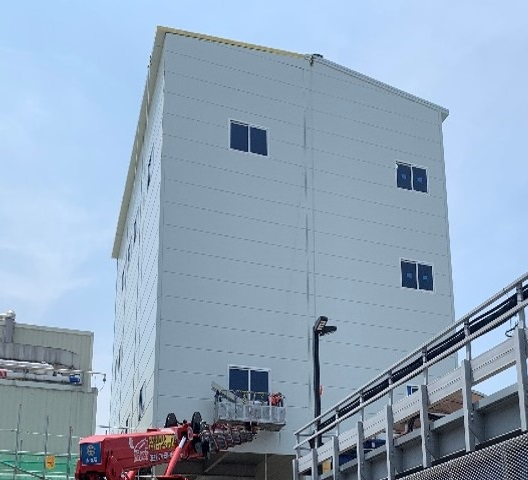
The Ministry of Climate Energy and Environment announced on May 19 that it will hold a performance utilization agreement ceremony for the "High-Purity Industrial Water (Ultra-Pure Water) Production Localization Technology Development Project" at SK Siltron's Gumi facility in North Gyeongsang Province.
Ultra-pure water is industrial water with impurities removed to extremely low levels, essential for cleaning contaminants from semiconductor surfaces. This requires advanced technology to manage ion concentrations in water below 1 ppt (parts per trillion) and gas concentrations, such as dissolved oxygen, below 1 ppb (parts per billion).
Until now, foreign companies from Japan and the United States have dominated the production technology, leaving South Korea's semiconductor, display, secondary battery, and bio industries heavily reliant on overseas technology.
In response, the Ministry has been promoting the localization of ultra-pure water production technology since 2021 to reduce this dependency and strengthen the competitiveness of the domestic water industry.
The demonstration facility features domestic technology applied throughout the entire process, from design to construction and operation. It has been installed at SK Siltron's Gumi facility, where it has successfully undergone performance verification in an actual manufacturing environment.
Notably, key devices and materials developed by domestic companies for ultra-pure water production, including organic matter removal (UV oxidation equipment), dissolved oxygen removal (degasification membrane), ion removal, and water quality enhancement (ion exchange resin), have been utilized. The Ministry reports that long-term operational results have also been secured.
The ultra-pure water produced through this technology transfer will supply SK Siltron's semiconductor wafer production process in Gumi. This marks the first time ultra-pure water produced using domestic design technology will be supplied to an actual semiconductor manufacturing process.
Industry experts view this development as significant for establishing a foundation for domestic companies to enter the ultra-pure water market, as semiconductor wafers are highly sensitive to even trace amounts of impurities, making a stable supply of ultra-pure water essential.
The government expects that this achievement will enhance the stability of the supply chain in the ultra-pure water sector, which has long relied on foreign technology, and contribute to the technological competitiveness and industrial ecosystem expansion of domestic water companies.
Additionally, to proactively address the shortage of industrial water due to climate change and establish a stable ultra-pure water supply system, the government plans to promote the localization of the entire ultra-pure water production process and develop technology for diversifying raw water sources through wastewater reuse.
Kim Ji-young, Director of Water Utilization Policy at the Ministry, stated, "This technology transfer is an important achievement that goes beyond the localization of ultra-pure water technology to actual industrial application. Large-scale investments in advanced industries, such as semiconductors, will lead to the development of the domestic water industry, including ultra-pure water."
* This article has been translated by AI.
Copyright ⓒ Aju Press All rights reserved.