
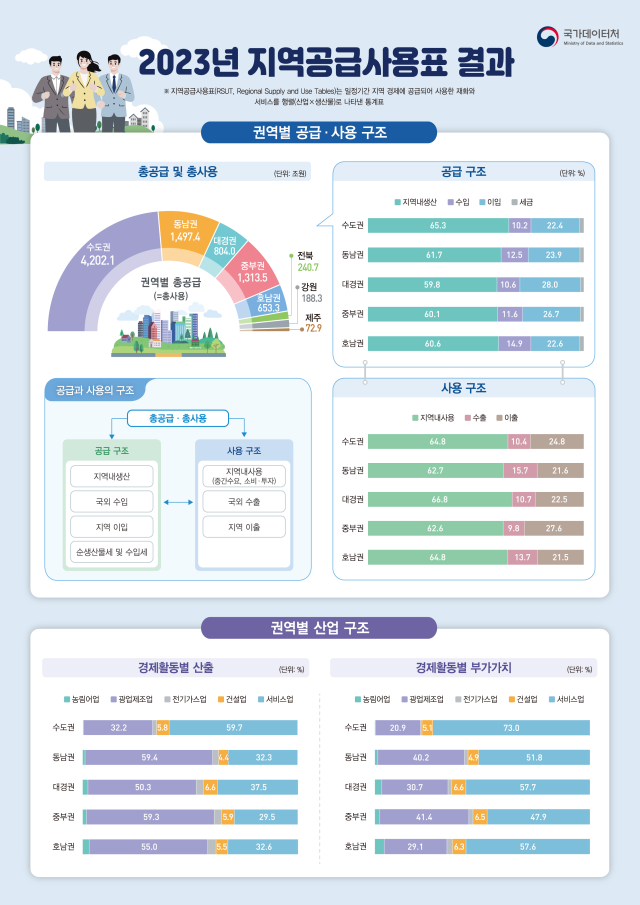
The capital area accounts for 48.6% of the total supply and use of goods and services in South Korea, highlighting its central role in the national economy. A recent study found that Seoul, which is service-oriented, and Gyeonggi Province, which focuses on manufacturing, form a closely complementary industrial structure. Additionally, Chungcheongnam-do and Gyeonggi-do are increasingly interconnected through the semiconductor industry.
On May 18, the National Data Office unveiled the "2023 Regional Supply and Use Table," which details the goods and services supplied and consumed in the regional economy over a specific period. This table illustrates the flow of supply chains, showing where products produced in specific regions are primarily consumed.
As of 2023, the total output of regional production was 5,646.6 trillion won, with the capital area contributing the highest share at 48.6%. Gyeonggi Province led in exports at 25.8% and imports at 23.7%, while Seoul, Gyeonggi, and Chungcheongnam-do were the top regions for inter-regional exports.
During the survey period, the southeastern region accounted for 16.7% of total supply and use, emerging as an export-oriented area centered around Ulsan and Gyeongsangnam-do, exporting machinery, transportation equipment, and petrochemical products.
The central region, excluding the capital area, ranked third in total supply and use, identified as a key manufacturing hub. It recorded the highest volume of goods entering and leaving the region, with electrical, electronic, and precision instruments, as well as petrochemical products from Chungcheongnam-do and Chungcheongbuk-do, moving throughout the domestic supply chain.
Lim Kyung-eun, head of the Economic Statistics Planning Division at the Data Office, stated, "The flow of goods is actively occurring between regions with a high manufacturing share centered around Gyeonggi Province. In terms of services, the flow is concentrated in Seoul and Gyeonggi, while in non-capital areas, exports are made from regional hubs to surrounding areas."
The share of regional production compared to total supply was highest in Seoul at 68.4%, followed by Jeju at 65.3% and Gyeonggi at 64.4%. Ulsan, Jeollanam-do, and Chungcheongnam-do ranked highest in imports, particularly for raw materials like crude oil.
Analysis of regional specialization revealed that Gangwon Province excels in mining, Jeju in agriculture and fisheries, and Sejong in public administration. By region, the capital area leads in information and communication technology, while the southeastern region excels in machinery, transportation equipment, and other sectors.
Trade patterns indicate that Seoul has a high volume of exports to other regions, while Ulsan's exports drive a net outflow, resulting in a trade surplus of 106.3 trillion won for the capital area and 12.1 trillion won for the southeastern region.
* This article has been translated by AI.
Copyright ⓒ Aju Press All rights reserved.