
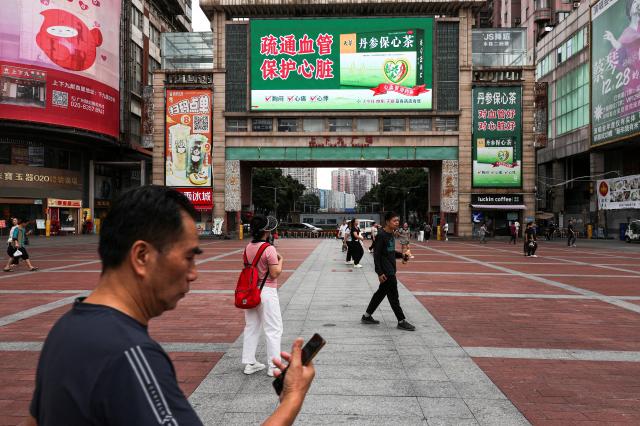
China's economy has shown signs of significant deterioration in consumption, production, and investment due to a surge in energy prices and raw materials stemming from the crisis in the Middle East.
April retail sales growth hits lowest level since zero-COVID policy ended
Retail sales, a key indicator of domestic economic activity, recorded a mere 0.2% increase in April, reaching 3.7247 trillion yuan. This figure is the lowest since the end of China's strict zero-COVID policy in December 2022, when retail sales fell by 1.8%. The growth rate fell short of March's 1.7% increase and the market expectation of 2%. After a decline that began in May of last year, retail sales growth had shown signs of recovery earlier this year but has now slowed again due to the Middle East crisis.
Production and investment indicators also showed a uniform decline. Industrial production increased by 4.1% year-on-year, significantly lower than March's 5.7% growth and below the 5.5% forecast by Trading Economics.
Fixed asset investment, another key driver of China's growth alongside exports and consumption, fell by 1.6% year-on-year for the January to April period, marking a return to negative growth for the first time in four months since December. Notably, investment in real estate development dropped by 13.7% compared to the same period last year, worsening from an 11.2% decline in the first quarter.
However, the urban unemployment rate improved slightly to 5.2% in April, down from 5.4% in March.
The National Bureau of Statistics of China stated, "The external environment remains complex and volatile, while domestic supply is relatively strong but demand is weak, causing operational difficulties for some businesses. We must further solidify a stable and positive foundation for economic recovery."
Middle East energy shock tests domestic stimulus strategy
Following the release of the April economic indicators, Bloomberg reported that none of the economists surveyed had anticipated such pessimistic data on consumption, production, and investment.
Zhang Zhiwei, chief economist at Pinpoint Asset Management, noted, "Economic activity in April was weaker than market expectations. While strong performance from exporters somewhat mitigated domestic weakness, it was not enough to fully offset it."
The shadow of the Middle East crisis was also evident in April's inflation data. The producer price index (PPI) rose to its highest level in 45 months due to energy price shocks, raising concerns about increased cost burdens for businesses that could lead to declining profitability in manufacturing and further contraction in domestic demand.
Conversely, China's exports in April significantly exceeded market expectations despite the Middle East crisis. A surge in global demand for artificial intelligence-related products and stockpiling orders in response to rising costs due to the war contributed to this rebound. Furthermore, with U.S. President Donald Trump's upcoming visit to China this month, stable trade relations between the two countries are anticipated, suggesting that China's exports may continue to perform well this year.
While China's strong export performance has partially offset the direct impact of the war in Iran, the pressure on manufacturing costs due to rising oil prices is becoming increasingly significant. As a result, the Chinese leadership's strategy to shift from an export-driven growth model to one focused on domestic consumption is now being tested in light of these Middle Eastern developments.
* This article has been translated by AI.
Copyright ⓒ Aju Press All rights reserved.