
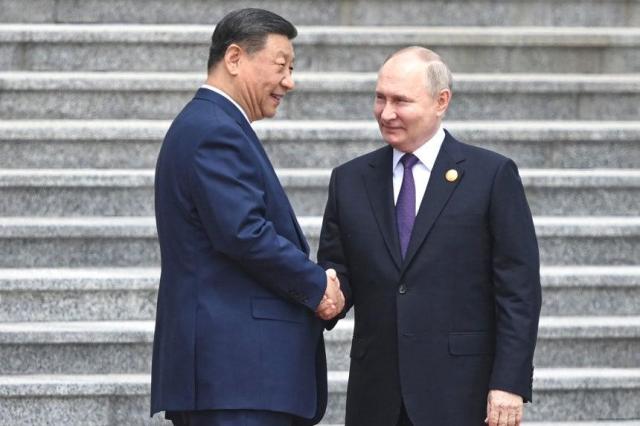
Russian President Vladimir Putin is set to visit China for a state visit and hold talks with Chinese President Xi Jinping. This meeting follows U.S. President Donald Trump's recent trip to China, highlighting the ongoing diplomatic engagement among the U.S., China, and Russia.
According to the Chinese Foreign Ministry and the Kremlin, President Putin will be in China for two days starting today, at the invitation of President Xi. The two leaders are scheduled to meet on May 20 in Beijing to discuss strategic cooperation, economic collaboration, and key international and regional issues.
This summit coincides with the 25th anniversary of the signing of the China-Russia Treaty of Good-Neighborliness and Friendly Cooperation. The Kremlin stated that a joint declaration and several agreements are expected to be signed following the talks. President Putin will also meet with Chinese Premier Li Qiang to discuss trade and economic cooperation.
Putin's visit is noteworthy as it comes immediately after Trump's trip to China. This indicates China's strategy of maintaining a balance between improving relations with the U.S. while also strengthening its strategic partnership with Russia. Analysts view this as an effort to expand diplomatic options in the face of Western pressures.
The backdrop to this meeting is the ongoing war in Ukraine. Russia has increasingly relied on economic and diplomatic cooperation with China amid the protracted conflict and Western sanctions. While China has publicly maintained a neutral stance, it has continued to foster its strategic relationship with Russia. This summit is likely to reaffirm their cooperative stance against Western pressure.
Energy cooperation is also a significant agenda item. Following Western sanctions, Russia has heightened its dependence on energy exports to China. The Kremlin noted that the discussions will cover a broad range of economic topics, including the potential for the 'Power of Siberia 2' gas pipeline, which would connect Russian Arctic gas fields to China via Mongolia.
The Taiwan issue and U.S.-China relations also play a role in this context. President Xi recently highlighted the Taiwan issue as a major risk factor in U.S.-China relations during his talks with President Trump. China is navigating the need to manage tensions with the U.S. while maintaining its partnership with Russia.
This summit is more about solidifying the existing China-Russia cooperation framework rather than declaring a new alliance. The sequence of meetings, first with Trump and then with Putin, underscores China's emerging role as a key player in the diplomatic landscape involving the U.S., China, and Russia, signaling its intent to manage U.S.-China relations while maintaining its anti-Western collaboration with Russia.
* This article has been translated by AI.
Copyright ⓒ Aju Press All rights reserved.