
In the 2022 presidential election, former President Yoon Suk Yeol captured 75.14 percent of the vote in the southeastern city. A decade earlier, former conservative President Park Geun-hye had also dominated the region.
The city did not abandon conservatives even after Yoon’s impeachment following his December 2024 martial law debacle. In last year’s snap presidential election, PPP candidate Kim Moon-soo defeated President Lee Jae Myung by 67.6 percent to 23.2 percent in Daegu.
Whether Lee’s approval rating hovering around 60 percent, combined with a divided conservative front, can crack that decades-old political tradition in the June 3 local elections is now one of the country’s most closely watched political questions.
The matchup itself is heavyweight politics.
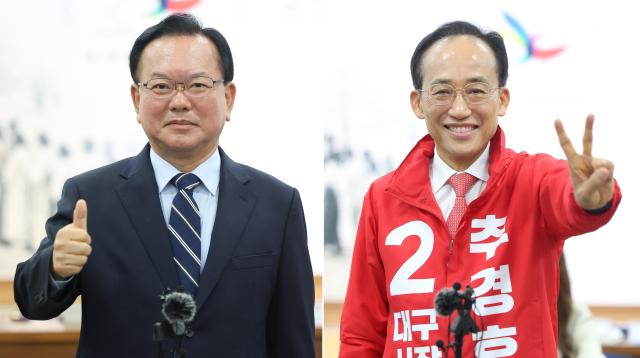
Representing the ruling Democratic Party (DP) is former Prime Minister Kim Boo-kyum, a four-term lawmaker under the administration of former liberal President Moon Jae-in. Facing him is PPP Rep. Choo Kyung-ho, a three-term lawmaker who last served as deputy prime minister for economy and finance minister under Yoon.
Daegu has never elected a liberal mayor since local elections were institutionalized in 1995.
Kim nevertheless has entered the race emboldened by his breakthrough victory in Daegu’s Suseong A district in 2016, when he became the only Democratic Party lawmaker elected from the city. This time, his chances may not be as slim.
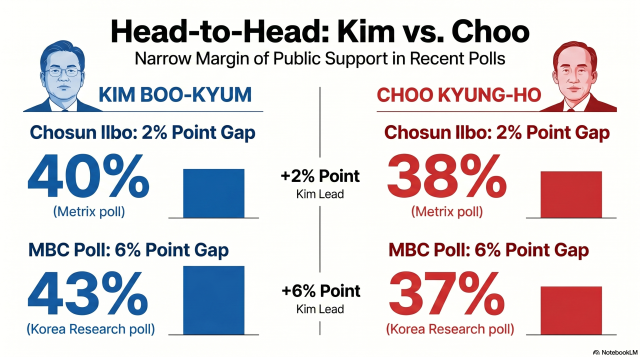
A Metavoice-Research Lab survey commissioned by JTBC and conducted May 5–6 showed Choo at 41 percent and Kim at 40 percent — a one-point gap within the margin of error.
At the center of the race is the economy.
According to latest government data on Korea’s regional GDP, Daegu posted a 3.9 percent contraction — the steepest decline among all metropolitan cities and provinces nationwide in the first quarter of 2025.
Both candidates are framing themselves as crisis managers with the bureaucratic credentials to revive the city’s stagnant economy.
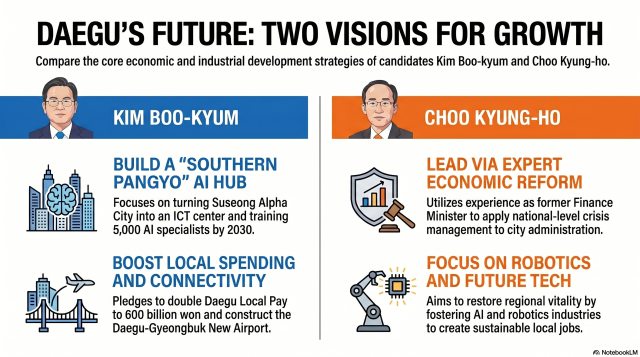
Kim is pitching a vision to transform Daegu into “the Pangyo of the South,” referencing the technology hub often dubbed Korea’s Silicon Valley.
“To revive Daegu’s economy, we have to change the industrial structure itself,” Kim told AJP in written interview.
He argued that Daegu should combine its traditional industrial base — machinery, metals, auto parts and textiles — with artificial intelligence technologies to modernize “design, manufacturing processes, quality control and logistics.”
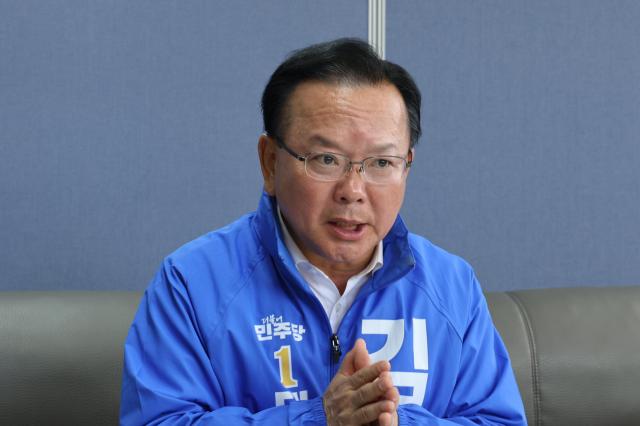
“We will create a structure in which young people can learn, find jobs and grow in Daegu,” Kim said.
He also pledged to establish an “Asian global youth startup and culture convergence special zone” along with a 100 billion won ($66.3 million) youth startup fund aimed at helping young entrepreneurs commercialize ideas and expand globally.
Choo is also pitching economic restructuring — but from the perspective of a veteran economic technocrat.
“The biggest reason Daegu’s economy is struggling is that it has not sufficiently responded to changes in the industrial structure,” Choo told AJP separately in his election office in Daegu.
“Daegu once led Korea’s industrialization with textiles and manufacturing, but it failed to secure enough growth engines as the industrial paradigm shifted toward AI, semiconductors and digital industries.”
Choo proposes fostering five future industries — AI, robotics, future mobility, bio and semiconductors — while simultaneously upgrading traditional sectors such as machinery and textiles. He is also emphasizing service industries favored by younger workers, including medical services, culture, tourism, gaming and digital content.
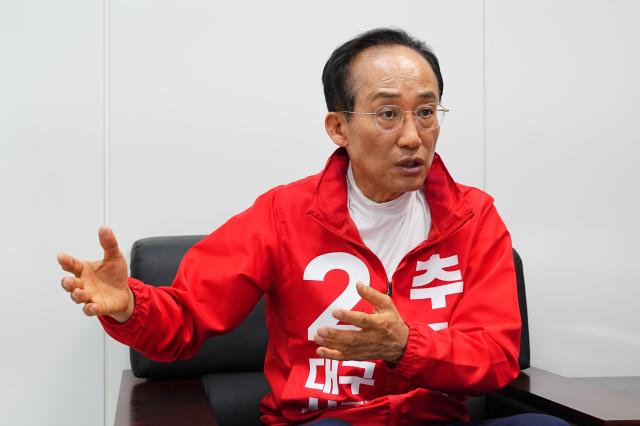
Rather than offering “mere slogans,” he says he is proposing “actual implementation structures,” including emergency economic task force meetings, a supplementary livelihood budget, a foreign investment attraction team, an AI transformation committee, a startup growth fund and “Daegu-style” university-industry contract departments.
The political logic behind Kim’s campaign is straightforward: leverage the power of the ruling party.
The next four-year mayoral term will overlap almost entirely with the remaining four years of Lee’s presidency and the DP-controlled National Assembly.
“At this time, the success or failure of key issues such as the TK new airport depends on who can better draw support and cooperation from the central government and the ruling party, which holds a majority in the National Assembly,” Kim said.
“My strength is the political power and execution ability to turn Daegu’s demands into reality.”
Kim also directly challenged Choo’s claim to economic expertise.
He pointed out that Daegu’s national budget allocations increased by 10.94 percent in 2021 and 15.47 percent in 2022 during his premiership, while increases slowed sharply to just 0.59 percent in 2023 and 0.94 percent in 2024 when Choo served as finance minister.
“‘Finance minister’ is a title, not performance itself,” Kim said. “What Daegu needs now is not a mayor who talks, but a mayor who produces results.”
Choo rejects the notion that a PPP mayor would be disadvantaged under a Democratic administration.
“The Daegu mayor is an administrator responsible for citizens’ lives,” Choo said. “I have no intention of becoming a mayor who clashes with the central government just because our parties are different.”
He argued that his 35 years as an economic bureaucrat, along with his experience as deputy prime minister and finance minister, provide practical leverage.
“I know very well how budgets are made,” Choo said. “I have networks across all areas of government ministries. I can communicate directly with working-level officials who design policies and managers who make decisions.”
Kim said many young residents have told him: “Starting salaries in Daegu’s IT industry are about 70 percent of those in Pangyo,” and “I don’t want to leave my family, but I have no choice.”
“This problem cannot be solved with short-term support alone,” Kim said. “Through industrial transformation, major company attraction and future industry development, we will create a structure in which good jobs and better wages are possible within the region.”
He is also proposing a “Youth Dandi Chaeum” savings program that would help young workers accumulate up to 30 million won in assets over five years.
Choo’s youth strategy focuses on attracting young people back through industrial growth, startup support and stronger university-industry ties. He has proposed “youth reshoring,” Daegu-style contract departments and a 1 trillion won startup fund to cultivate unicorn companies.
“We will make Daegu a city where young people return,” Choo said, arguing that future industries and high-value service sectors can reverse the city’s demographic decline.
The next mayor will also inherit several major regional development projects, most notably the relocation of Daegu’s military airport and construction of the new TK airport.
The project is viewed not merely as an aviation issue, but as a broader test of Daegu’s ability to integrate economically with North Gyeongsang Province, expand logistics networks and attract new industries.
Kim frames the airport initiative as an issue requiring political leverage at the national level. Choo frames it as an administrative and fiscal challenge demanding deep experience within the central government bureaucracy.
“Cooperation is not achieved through vague requests or begging,” Choo said. “I have learned over decades how work actually gets done.”
He added that projects such as the TK new airport and Daegu–North Gyeongsang administrative integration “must be pursued beyond party lines.”
Kim, meanwhile, insists Daegu needs a mayor capable of extracting concrete support from the current national power structure.
“The new mayor will work on the same timetable as the remaining four years of the president’s term,” Kim said. “Who can better bring in support from the central government and the ruling party will decide the fate of key pending issues.”
For decades, Daegu mayoral elections were viewed as predictable contests in conservative territory. This year, however, the race has evolved into a direct showdown between two nationally recognized political heavyweights who agree Daegu must reinvent itself, but disagree sharply on who is best equipped to deliver that transformation.
Kim is asking voters to break with Daegu’s political history and use the ruling party’s national power to bring investment, budgets and jobs into the city. Choo is asking voters to trust a veteran conservative economic bureaucrat who says he can rebuild Daegu’s economy “from day one.”
“This election is ultimately about who can revive Daegu’s economy,” Choo said. “Choo Kyung-ho will become a professional economic mayor who works skillfully from the first day.”
Kim’s closing message is equally blunt.
“Daegu now needs a mayor who can produce results, not just words,” he said.
Copyright ⓒ Aju Press All rights reserved.
