SEOUL, May 20 (AJP) - The world is passing through one of the great transitional eras of modern history. The global contest over artificial intelligence between the United States and China, the prolonged devastation of the war in Ukraine, and the widening instability caused by the conflict involving Iran and the Strait of Hormuz have together accelerated the restructuring of the international order.
Political uncertainty, energy insecurity, technological rivalry, and financial fragmentation are no longer isolated phenomena. They are converging into a single historical transformation.
The world emerging before us is neither the unipolar order that followed the Cold War nor a fully stabilized multipolar system. The United States remains the dominant military and financial power, sustained by the dollar-centered global system and unmatched strategic reach. China, however, is rapidly advancing through manufacturing capacity, demographic scale, digital infrastructure, and artificial intelligence.
Meanwhile, Europe, which once stood at the center of global civilization, is increasingly burdened by aging populations, energy vulnerability, industrial fatigue, and strategic hesitation. Russia, weakened by the enormous costs of war and isolation, is gradually losing both economic momentum and geopolitical flexibility.
And amid this shifting landscape, a new historical center of gravity is emerging: Northeast Asia. For more than two centuries, the axis of global power moved from the western edge of Eurasia — Britain, France, and Germany — across the Atlantic to the United States. The Industrial Revolution, maritime supremacy, financial capitalism, and military innovation established Western civilization as the dominant force of the modern era.
But the geography of power is changing once again. Manufacturing, semiconductors, batteries, artificial intelligence, shipbuilding, digital infrastructure, and advanced supply chains are increasingly concentrated in East Asia. Capital, technology, and industrial energy are flowing toward the Pacific basin. The twenty-first century may ultimately be remembered as the era in which the center of world civilization shifted from the Atlantic to the Indo-Pacific.
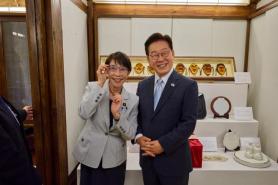
Within that transformation, few developments are more strategically significant than the gradual reconciliation and convergence of South Korea and Japan. The summit held in Andong between South Korean President Lee Jae Myung and Japanese Prime Minister Sanae Takaichi was not merely another diplomatic meeting.
It reflected something larger and more consequential: the recognition that the future security and prosperity of Northeast Asia may depend increasingly on the ability of Seoul and Tokyo to move beyond the paralysis of history and toward strategic cooperation.
The two leaders discussed joint responses to energy insecurity, expanded LNG and oil cooperation, supply-chain resilience, and the possibility of oil and petroleum product swap arrangements. These are not symbolic gestures. They are the building blocks of an emerging economic and strategic framework.
More importantly, shuttle diplomacy between the two nations has entered a new phase of normalization and emotional trust. Diplomatic engagement is no longer confined to Seoul and Tokyo. It now extends to regional cities such as Busan, Nara, Gyeongju, and Andong — places rich with historical memory and cultural identity.
That evolution matters. Genuine diplomacy does not endure through official communiqués alone. It survives through human familiarity, regional exchange, shared experience, and mutual recognition.
Only a few years ago, relations between South Korea and Japan were dominated by bitter disputes over wartime history, forced labor, export restrictions, and unresolved emotional wounds. Yet geopolitical reality has slowly pushed both countries toward a more sober understanding of their shared circumstances.
China's rise, North Korea's nuclear ambitions, instability in global energy markets, and shifts in American strategic priorities have all forced Seoul and Tokyo to confront a difficult truth: neither country can fully secure its future alone.
Economically, the logic of cooperation is becoming increasingly compelling. Japan possesses extraordinary strengths in precision manufacturing, industrial materials, and foundational technologies. South Korea has emerged as a global leader in semiconductors, batteries, shipbuilding, digital infrastructure, and applied industrial innovation.
Japanese industrial depth combined with Korean speed and adaptability could create one of the most formidable technological ecosystems in the world. The age of artificial intelligence makes such collaboration even more essential. Modern supply chains are no longer linear or national. Semiconductor production alone requires integrated systems involving design, materials, equipment, manufacturing, packaging, energy, cooling technologies, and massive data infrastructure.
No single nation can dominate such systems entirely by itself. In that sense, South Korea and Japan are gradually becoming not merely neighbors, but strategic partners bound by technological interdependence. This is why the concept of a Korea–Japan economic community, previously discussed by SK Group Chairman Chey Tae-won, deserves far greater international attention than it has received.
Such a community would not mean economic integration alone. It could evolve into a broader framework encompassing finance, tourism, sports, youth exchanges, cultural industries, energy security, AI cooperation, advanced manufacturing, and maritime logistics. Economics creates systems. Culture creates emotional trust. Tourism and sports create familiarity between peoples. A genuine regional community requires all three.
The international community naturally views this emerging Korea–Japan alignment with a mixture of hope, caution, and strategic anxiety. The United States strongly supports closer cooperation between Seoul and Tokyo because such cooperation strengthens the broader democratic alliance structure in Asia. Yet Washington may also quietly recognize that a deeply integrated South Korea–Japan technological bloc could eventually operate with greater strategic autonomy.
China, meanwhile, supports regional economic integration in principle but remains wary of a closer alignment between two liberal democracies closely tied to the American alliance system. Russia, increasingly constrained by war and economic exhaustion, finds itself less capable than ever of shaping developments in Northeast Asia.
Europe, too, watches carefully. For decades, Europe represented the intellectual and industrial center of modern civilization. Today, however, East Asia increasingly defines the pace of manufacturing innovation, digital commerce, consumer technology, and cultural influence.
South Korean popular culture and Japanese creative industries together already possess immense global reach. Korean film, music, television, and digital culture, combined with Japanese animation, literature, gaming, and design, could form one of the most influential cultural spheres of the century.
And culture matters. In the modern world, cultural influence is no longer secondary to economic power. It shapes tourism, consumer behavior, national identity, and geopolitical soft power itself. Sports may prove equally important.
Youth football exchanges, baseball cooperation, e-sports leagues, academic partnerships, and regional tourism networks can often accomplish what formal diplomacy cannot. Political treaties may open doors, but human relationships sustain civilizations.
None of this erases history. The wounds between Korea and Japan remain real. Forced labor, wartime memory, territorial disputes, and unresolved historical grievances continue to carry emotional and political weight in both societies.
Those wounds should neither be denied nor trivialized. But there is a profound difference between remembering history and becoming imprisoned by it. The challenge for both nations is not to forget the past, but to prevent the past from destroying the future. That requires strategic maturity, historical empathy, and what classical East Asian philosophy once described as seeking common ground while respecting differences.
The future of South Korea–Japan relations cannot remain limited to summit meetings alone. Businesses must connect supply chains and innovation networks. Universities must connect young people and knowledge systems.
Local governments must expand tourism and cultural cooperation. Media institutions must move beyond perpetual conflict narratives and help societies imagine the possibilities of coexistence. Ultimately, governments may open the door, but ordinary citizens must walk through it.
Politics can create frameworks. Economics can build roads. Culture can connect hearts. Younger generations can transform historical rivalry into shared destiny.
The center of global power is slowly moving eastward. The Atlantic age that dominated the world since the eighteenth century is gradually giving way to a Pacific and Indo-Pacific era. Within that transition, the partnership between South Korea and Japan may become one of the defining forces shaping the future of East Asia.
The summit in Andong was not simply a diplomatic event. It may one day be remembered as a quiet but decisive signal of historical realignment. History is not shaped only by wars and empires. Sometimes it is reshaped by nations choosing cooperation over resentment, strategy over emotion, and the future over the burdens of the past. And if South Korea and Japan can truly move forward together, they may yet become standard-bearers for global peace and prosperity in the twenty-first century.
Political uncertainty, energy insecurity, technological rivalry, and financial fragmentation are no longer isolated phenomena. They are converging into a single historical transformation.
The world emerging before us is neither the unipolar order that followed the Cold War nor a fully stabilized multipolar system. The United States remains the dominant military and financial power, sustained by the dollar-centered global system and unmatched strategic reach. China, however, is rapidly advancing through manufacturing capacity, demographic scale, digital infrastructure, and artificial intelligence.
Meanwhile, Europe, which once stood at the center of global civilization, is increasingly burdened by aging populations, energy vulnerability, industrial fatigue, and strategic hesitation. Russia, weakened by the enormous costs of war and isolation, is gradually losing both economic momentum and geopolitical flexibility.
And amid this shifting landscape, a new historical center of gravity is emerging: Northeast Asia. For more than two centuries, the axis of global power moved from the western edge of Eurasia — Britain, France, and Germany — across the Atlantic to the United States. The Industrial Revolution, maritime supremacy, financial capitalism, and military innovation established Western civilization as the dominant force of the modern era.
But the geography of power is changing once again. Manufacturing, semiconductors, batteries, artificial intelligence, shipbuilding, digital infrastructure, and advanced supply chains are increasingly concentrated in East Asia. Capital, technology, and industrial energy are flowing toward the Pacific basin. The twenty-first century may ultimately be remembered as the era in which the center of world civilization shifted from the Atlantic to the Indo-Pacific.
Within that transformation, few developments are more strategically significant than the gradual reconciliation and convergence of South Korea and Japan. The summit held in Andong between South Korean President Lee Jae Myung and Japanese Prime Minister Sanae Takaichi was not merely another diplomatic meeting.
It reflected something larger and more consequential: the recognition that the future security and prosperity of Northeast Asia may depend increasingly on the ability of Seoul and Tokyo to move beyond the paralysis of history and toward strategic cooperation.
The two leaders discussed joint responses to energy insecurity, expanded LNG and oil cooperation, supply-chain resilience, and the possibility of oil and petroleum product swap arrangements. These are not symbolic gestures. They are the building blocks of an emerging economic and strategic framework.
More importantly, shuttle diplomacy between the two nations has entered a new phase of normalization and emotional trust. Diplomatic engagement is no longer confined to Seoul and Tokyo. It now extends to regional cities such as Busan, Nara, Gyeongju, and Andong — places rich with historical memory and cultural identity.
That evolution matters. Genuine diplomacy does not endure through official communiqués alone. It survives through human familiarity, regional exchange, shared experience, and mutual recognition.
Only a few years ago, relations between South Korea and Japan were dominated by bitter disputes over wartime history, forced labor, export restrictions, and unresolved emotional wounds. Yet geopolitical reality has slowly pushed both countries toward a more sober understanding of their shared circumstances.
China's rise, North Korea's nuclear ambitions, instability in global energy markets, and shifts in American strategic priorities have all forced Seoul and Tokyo to confront a difficult truth: neither country can fully secure its future alone.
Economically, the logic of cooperation is becoming increasingly compelling. Japan possesses extraordinary strengths in precision manufacturing, industrial materials, and foundational technologies. South Korea has emerged as a global leader in semiconductors, batteries, shipbuilding, digital infrastructure, and applied industrial innovation.
Japanese industrial depth combined with Korean speed and adaptability could create one of the most formidable technological ecosystems in the world. The age of artificial intelligence makes such collaboration even more essential. Modern supply chains are no longer linear or national. Semiconductor production alone requires integrated systems involving design, materials, equipment, manufacturing, packaging, energy, cooling technologies, and massive data infrastructure.
No single nation can dominate such systems entirely by itself. In that sense, South Korea and Japan are gradually becoming not merely neighbors, but strategic partners bound by technological interdependence. This is why the concept of a Korea–Japan economic community, previously discussed by SK Group Chairman Chey Tae-won, deserves far greater international attention than it has received.
Such a community would not mean economic integration alone. It could evolve into a broader framework encompassing finance, tourism, sports, youth exchanges, cultural industries, energy security, AI cooperation, advanced manufacturing, and maritime logistics. Economics creates systems. Culture creates emotional trust. Tourism and sports create familiarity between peoples. A genuine regional community requires all three.
The international community naturally views this emerging Korea–Japan alignment with a mixture of hope, caution, and strategic anxiety. The United States strongly supports closer cooperation between Seoul and Tokyo because such cooperation strengthens the broader democratic alliance structure in Asia. Yet Washington may also quietly recognize that a deeply integrated South Korea–Japan technological bloc could eventually operate with greater strategic autonomy.
China, meanwhile, supports regional economic integration in principle but remains wary of a closer alignment between two liberal democracies closely tied to the American alliance system. Russia, increasingly constrained by war and economic exhaustion, finds itself less capable than ever of shaping developments in Northeast Asia.
Europe, too, watches carefully. For decades, Europe represented the intellectual and industrial center of modern civilization. Today, however, East Asia increasingly defines the pace of manufacturing innovation, digital commerce, consumer technology, and cultural influence.
South Korean popular culture and Japanese creative industries together already possess immense global reach. Korean film, music, television, and digital culture, combined with Japanese animation, literature, gaming, and design, could form one of the most influential cultural spheres of the century.
And culture matters. In the modern world, cultural influence is no longer secondary to economic power. It shapes tourism, consumer behavior, national identity, and geopolitical soft power itself. Sports may prove equally important.
Youth football exchanges, baseball cooperation, e-sports leagues, academic partnerships, and regional tourism networks can often accomplish what formal diplomacy cannot. Political treaties may open doors, but human relationships sustain civilizations.
None of this erases history. The wounds between Korea and Japan remain real. Forced labor, wartime memory, territorial disputes, and unresolved historical grievances continue to carry emotional and political weight in both societies.
Those wounds should neither be denied nor trivialized. But there is a profound difference between remembering history and becoming imprisoned by it. The challenge for both nations is not to forget the past, but to prevent the past from destroying the future. That requires strategic maturity, historical empathy, and what classical East Asian philosophy once described as seeking common ground while respecting differences.
The future of South Korea–Japan relations cannot remain limited to summit meetings alone. Businesses must connect supply chains and innovation networks. Universities must connect young people and knowledge systems.
Local governments must expand tourism and cultural cooperation. Media institutions must move beyond perpetual conflict narratives and help societies imagine the possibilities of coexistence. Ultimately, governments may open the door, but ordinary citizens must walk through it.
Politics can create frameworks. Economics can build roads. Culture can connect hearts. Younger generations can transform historical rivalry into shared destiny.
The center of global power is slowly moving eastward. The Atlantic age that dominated the world since the eighteenth century is gradually giving way to a Pacific and Indo-Pacific era. Within that transition, the partnership between South Korea and Japan may become one of the defining forces shaping the future of East Asia.
The summit in Andong was not simply a diplomatic event. It may one day be remembered as a quiet but decisive signal of historical realignment. History is not shaped only by wars and empires. Sometimes it is reshaped by nations choosing cooperation over resentment, strategy over emotion, and the future over the burdens of the past. And if South Korea and Japan can truly move forward together, they may yet become standard-bearers for global peace and prosperity in the twenty-first century.
Copyright ⓒ Aju Press All rights reserved.