
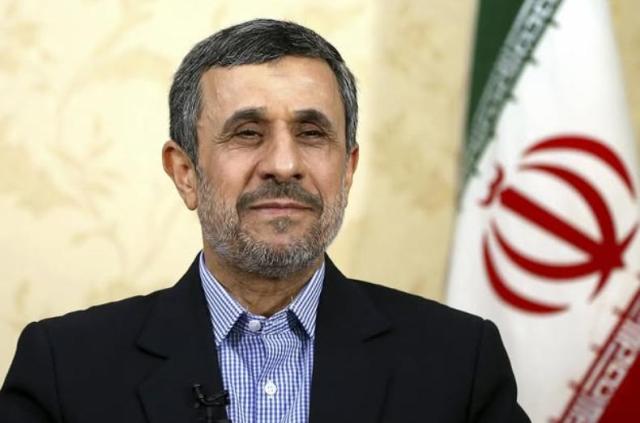
The New York Times reported on May 19 that the United States and Israel devised a plan to remove Iran's Supreme Leader Ayatollah Ali Khamenei and install former President Mahmoud Ahmadinejad, who had been under house arrest, as a leader in the early stages of the war. However, attempts to engage with Ahmadinejad, who had previously vowed to erase Israel from the map, ended in failure.
According to the newspaper, the U.S. and Israel considered Ahmadinejad a "pragmatist" who could lead Iran after the collapse of Khamenei's regime. U.S. officials described him as a figure within the regime who, while not a moderate, was open to cooperation with the U.S.
This plan resembled the earlier U.S. operation that brought former Venezuelan President Nicolás Maduro to New York. It involved replacing a dictator and allowing a moderate figure within the regime to take charge. The Times noted that President Trump seemed eager to replicate this model elsewhere after the successful operation against Maduro and the willingness of his temporary successor to cooperate with the White House.
For Ahmadinejad, the prospect of U.S. and Israeli support was appealing. In recent years, he had publicly accused the Iranian Islamic regime's leadership of corruption, leading to speculation about his loyalty. He was disqualified from running in presidential elections in 2017, 2021, and 2024. Reports indicated that his disqualification in 2017 followed his criticism of Khamenei and his expressions of respect for the monarchy. Recently, Ahmadinejad's activities have been restricted to his home in eastern Tehran.
The Times also pointed out Ahmadinejad's visits to Guatemala in 2023 and Hungary in 2024 and 2025, noting that both countries have good relations with Israel. In 2023, he attended a water management conference in Guatemala, where he mentioned on Instagram that Iranian security authorities had delayed the return of his passport.
On February 28, U.S. and Israeli airstrikes commenced. Following the strikes, Khamenei and several military leaders, including Ali Larijani, Secretary of the Supreme National Security Council, and Mohammad Pakpour, Commander of the Islamic Revolutionary Guard Corps, were killed. Khamenei's son, Mojtaba Khamenei, was injured. However, Ahmadinejad's home suffered little damage, and Revolutionary Guards monitoring his residence were killed in an explosion. Ahmadinejad and his family took refuge underground, leading to descriptions of the situation as a "virtual prison break." A close aide to Ahmadinejad confirmed to the Times that the U.S. and Israeli operation was an attempt to free him.
Three months into the conflict, Ahmadinejad's whereabouts remain elusive amid ongoing hostilities. Reports indicate that he has made a few public speeches congratulating Mojtaba Khamenei on his ascension as Supreme Leader through state media. Contrary to expectations, the Islamic Revolutionary Guard Corps, considered the heart of the Iranian regime, has demonstrated resilience, asserting control over the Strait of Hormuz. DPA reported that the semi-official Tasnim news agency stated the Revolutionary Guards approved the passage of 26 vessels, including South Korean ships, through the Strait in the past 24 hours. The Times noted that while Ahmadinejad survived the airstrikes, he felt disillusioned with the regime change plans following the experience.
Despite the failed initiative, the U.S. and Israel's consideration of the "Ahmadinejad card" is seen as an unexpected choice given his hardline stance during his presidency. He gained notoriety for inflammatory remarks, including claims that the U.S. orchestrated the 9/11 attacks to support Israel and calls to erase Israel from the map. Western media referred to him as "Mr. Evil." However, after Barack Obama was elected president, he sent a congratulatory message expressing a desire for "real and fundamental change." In a 2019 interview with the Times, he described President Trump as a "man of action and a businessman," suggesting a dialogue on the long-term benefits for both the U.S. and Iran.
* This article has been translated by AI.
Copyright ⓒ Aju Press All rights reserved.