
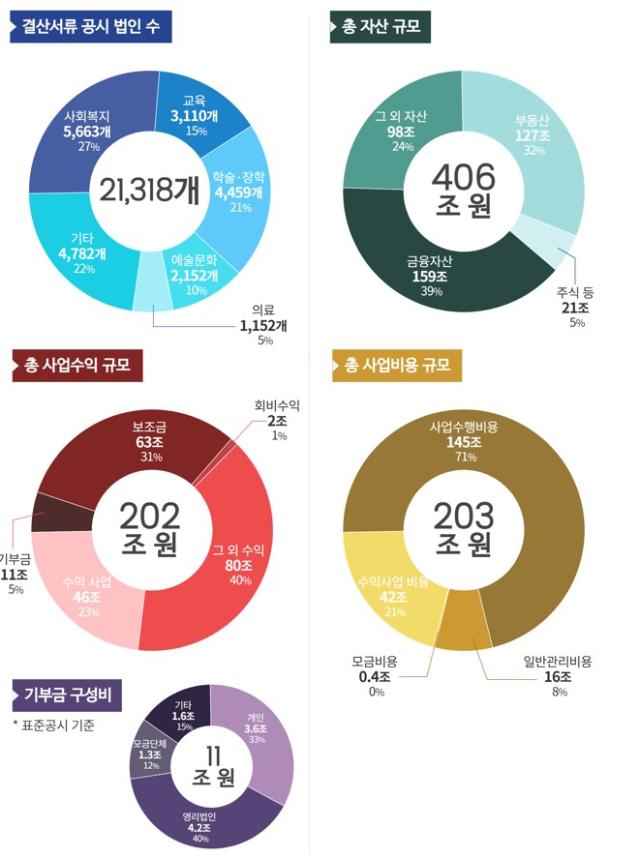
Last year, the total assets of public interest corporations in South Korea reached 406 trillion won, with entities holding over 100 billion won accounting for 78% of the total assets. Donations were also concentrated among a few large public interest corporations, highlighting a significant asset and donation concentration trend.
The National Tax Service announced on May 21 that it has published its first "2026 Annual Report on Public Interest Corporations," which provides a comprehensive analysis of the operational status and accounting information of these entities. The report was based on the financial statement disclosure data of public interest corporations.
According to the report, a total of 21,318 public interest corporations disclosed their financial statements last year. By region, Seoul had the highest number with 7,084 (33%), followed by Gyeonggi Province with 2,778 (13%) and Incheon with 578 (3%), indicating that nearly half (49%) of all public interest corporations are concentrated in the metropolitan area.
The total business revenue of all public interest corporations was recorded at 202 trillion won, with donation revenue amounting to 11 trillion won, representing about 5% of the total business revenue.
Donation revenue was heavily concentrated among a few large public interest corporations. The top 15 public interest corporations accounted for 4 trillion won in donation revenue, which is 38% of the total donations received by all public interest corporations. Notably, the Korea Community Chest received 847.7 billion won, making up approximately 8% of total donations.
The report also highlighted a significant concentration of assets. There were 473 public interest corporations with assets exceeding 100 billion won, representing only 2% of the total, yet they held 317 trillion won, or 78% of the total assets of all public interest corporations.
Among high-asset public interest corporations, those related to education made up the largest share, with 202 entities (43%) engaged in educational activities. There were 113 public interest corporations with more than 1,000 employees, most of which were large medical institutions and educational foundations.
For instance, Seoul National University reported that real estate constituted 4.6 trillion won, or 86% of its total assets. The total donation revenue for high-asset public interest corporations was 5 trillion won, with an average donation per corporation of 13.7 billion won, approximately 17 times higher than the overall average of 800 million won for all public interest corporations.
The report also included information on public interest corporations affiliated with corporate groups. A total of 231 public interest corporations were operated by 72 corporate groups with total assets exceeding 5 trillion won. While most corporate groups managed one or two public interest corporations, SK Group operated 25, Samsung Group 13, and HD Hyundai Group 11.
In terms of public interest activities, corporations focused on "academic and scholarship" accounted for the largest share, with 82 entities. The Samsung Cultural Foundation held the largest stock value at 1.7 trillion won, followed by the Hyundai Motor Chung Mong-koo Foundation at 464.5 billion won and the LG Yeonam Foundation at 310.5 billion won. All of these holdings were classified as related-party stocks.
The distribution costs paid directly to beneficiaries were highest for Doosan Group at 187.8 billion won, while Chung-Ang University reported spending 118.3 billion won on scholarships and other educational support.
The National Tax Service plans to publish the annual report every year to enhance transparency among public interest corporations and promote a culture of donations. The aim is to improve accounting transparency, creating an environment where the public can donate with confidence.
* This article has been translated by AI.
Copyright ⓒ Aju Press All rights reserved.