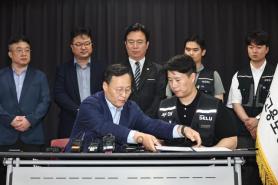
Samsung Electronics has reached a final labor-management agreement covering wage increases, adjustments to performance compensation, expanded welfare benefits and improvements in working conditions. The immediate confrontation has been contained. Yet the issue cannot be dismissed as a passing conflict inside one company.
Samsung Electronics and SK hynix are not ordinary domestic corporations. They are strategic global enterprises at the heart of the world's semiconductor supply chain. Their labor relations are now directly linked to international capital markets, national industrial strategy and the credibility of the South Korean economy.
The world is in the middle of an AI semiconductor war. Nvidia and AMD in the United States, TSMC in Taiwan, China's state-led semiconductor drive and Japan's attempt to rebuild its chip industry are all part of a vast global contest. Semiconductors are no longer just electronic components. They are the foundation of military power, national security, artificial intelligence, data centers, automobiles, aerospace and quantum computing.
In this environment, a strike at Samsung Electronics inevitably attracts global attention. What foreign investors and supply-chain partners fear most is not simply a rise in wages. Their deeper question is whether South Korea's advanced industrial supply chain remains stable and predictable.
Capital markets value stability and predictability above almost everything else. The semiconductor industry requires long-term investment on a scale of tens of trillions of won. Samsung's Pyeongtaek complex, its Taylor plant in Texas, next-generation HBM lines and AI memory facilities all demand extraordinary capital. The payback period is measured not in months but in years, often in decades. This is not an industry that can be governed by slogans, impulses or short-term emotion.
At the same time, labor in this industry is no longer what it once was. In the age of AI semiconductors, labor is not simple assembly work. Extreme ultraviolet processes, HBM design, advanced packaging and ultra-fine manufacturing require world-class engineers and highly skilled workers. In advanced industry, labor is not merely a cost. It is a strategic asset.
That is why the Samsung labor dispute should not be viewed as a contest in which one side must win and the other must lose. Labor must respect the sustainability of the enterprise. Management must recognize the dignity and contribution of labor. Both sides must operate within global rules.
Samsung Electronics and SK hynix are South Korean companies, but they are also world companies. Their labor relations must now be managed by international standards, with full awareness of investor confidence and supply-chain responsibility.
At the center of this controversy lies the idea of the "residual claimant." The question is simple but profound: Why do shareholders have the first claim on residual profits?
A modern corporation is built on the symmetry of risk and reward. Creditors receive contracted interest and give up the right to excess profit. Workers receive contracted wages and a degree of employment protection, while being shielded from the company's full downside risk. The state receives taxes in return for providing social infrastructure, education, public order and legal systems. After all these claims are settled, the party left to absorb the remaining profit or loss is the shareholder.
This is why shareholders are called residual claimants. When a company earns extraordinary profits, shareholders may benefit from what remains. But when a company collapses, or when its market value plunges, shareholders are the first to absorb the loss.
During the semiconductor downturn of 2023, Samsung Electronics' operating profit fell sharply. Workers' wages were not cut in proportion to that collapse. Suppliers were not asked to return payments already made. But the company's market capitalization fell, and shareholders — including ordinary retail investors and the National Pension Service — bore the loss. The true residual claimant is revealed not in moments of profit, but in moments of loss.
This does not mean the contribution of labor should be ignored. Quite the opposite. In the AI era, human creativity, collective expertise and accumulated organizational knowledge increasingly determine corporate value. The value of a semiconductor company does not come only from its factories. It comes from its research teams, process engineers, design capability, production discipline and decades of institutional experience.
The real question, therefore, is not who should take everything. The real question is how the gains of growth can be shared in a sustainable way. That is why global companies use stock options, long-term incentives, employee share ownership plans and performance-linked compensation systems. Labor is not merely a cost line. It is a partner in growth.
But labor, too, must face the harsh realities of global capital and global competition. Samsung Electronics and SK hynix are not competing primarily against domestic rivals. They are competing against the United States, Taiwan, China and Japan. China is mobilizing state capital on a massive scale to achieve semiconductor independence. The United States is pouring subsidies into its chip industry. Taiwan has built an entire national ecosystem around TSMC.

Here, one must understand the difference between CAPEX and OPEX. CAPEX, or capital expenditure, refers to investment for the future: new fabs, advanced equipment, next-generation technology, AI infrastructure and long-term industrial capacity. OPEX, or operating expenditure, refers to the costs of running the business: wages, maintenance, utilities, administration and day-to-day expenses.
The semiconductor industry is a CAPEX-heavy industry. Samsung Electronics and SK hynix invest tens of trillions of won every year in future facilities. A single EUV machine can cost hundreds of billions of won. Advanced packaging and AI memory production require immense capital.
If short-term compensation demands sharply raise OPEX, companies may reduce future CAPEX. That would weaken long-term competitiveness. The semiconductor industry is not an industry that merely distributes today's profit. It is an industry that reinvests today's profit to win tomorrow's technological sovereignty.
Japan's semiconductor decline was caused in part by the collapse of long-term investment discipline. By contrast, TSMC became the world's leading foundry by maintaining an almost religious commitment to capital investment. Nvidia, too, became the company it is today only after decades of investment in research, design and the AI ecosystem.
For that reason, the Samsung labor issue must not be reduced to a short-term wage dispute. Labor must understand the structure of future investment. Management must design more sophisticated systems for sharing success. The key is to preserve future competitiveness while ensuring that the people who create value share in its rewards.
President Lee Jae Myung's recent remarks at a Cabinet meeting offer an important guide. He did not deny the three basic labor rights. On the contrary, he affirmed that labor rights are constitutional protections designed to defend workers, who are often the weaker party in economic life. But he also emphasized that the exercise of rights must be accompanied by solidarity and responsibility.
That message matters. Lee's words carry particular weight because he himself was once a boy factory worker. He knows from personal experience the hardship of labor, the imbalance of power in the workplace and the pain of industrial society's lower rungs. He is therefore not speaking about labor from abstraction alone. He understands both the desperation of workers and the realities of enterprise.
Brazilian President Luiz Inácio Lula da Silva, who recently visited Seoul, also rose from the world of labor. Lula, too, came from poverty and factory work, and later became one of the world's most prominent labor leaders before entering national leadership. Though they come from different continents, Lee and Lula share a deep historical sympathy rooted in the lived experience of labor.
Yet neither man remained confined to narrow labor ideology. Lula, as president, sought to balance worker protection with industrial growth, investment and exports. Lee, in the Samsung case, likewise emphasized not confrontation for its own sake but the need for rights to remain within the bounds of responsibility.
The president's message may be summarized in three principles. First, labor rights are constitutional rights and must be respected. Second, the sustainability of companies and the competitiveness of national industry must also be protected. Third, the exercise of rights must be disciplined by responsibility, restraint and concern for the broader community.
This may become an important guideline for the future of South Korean labor relations. In the past, South Korean labor relations were too often defined by confrontation and collision. In the AI era, they must evolve toward shared growth and shared responsibility.
Artificial intelligence will dramatically raise productivity. It will also reshape human labor at its roots. Some jobs will disappear. Others will become far more valuable. In such an age, traditional wage struggles alone cannot provide a sustainable answer.
A new social compact is needed. Workers must be able to participate not only through wages, but through long-term gains tied to corporate growth. Companies must build innovation systems centered on human dignity, not merely cost reduction. The state must use taxation, welfare, education and retraining to cushion the shocks of industrial transformation.
The central task of the AI age is a harmonious productivity revolution. When labor and capital see each other as enemies, industry declines. When they recognize each other as partners in growth, innovation endures.
South Korea now stands at a decisive moment. Samsung Electronics and SK hynix are not merely corporations. They are strategic assets on the front line of South Korean industrial civilization. If they weaken, the damage will not be limited to one balance sheet. It will touch the future industrial order and national competitiveness of South Korea itself.
What is needed now is not agitation, nor emotion, nor easy populism. What is needed is clear realism and mature social wisdom. Labor must accept responsibility. Management must accept responsibility. The state must accept responsibility.
Freedom without responsibility cannot endure. Industry without hope cannot endure either. The philosophy of solidarity and responsibility emphasized by Lee may become the core of a new South Korean model of labor relations. The question is no longer how to defeat the other side. The question is how to build an order of innovation and coexistence.
Industry does not grow by struggle alone. Nor does it grow by capital alone. Technology and labor, investment and innovation, responsibility and trust must move together. What South Korea needs now is not a winner-takes-all doctrine, but a mature industrial community capable of competing with the world while growing together.
Copyright ⓒ Aju Press All rights reserved.