

According to industry sources, defense startup MakinaRax recorded a 'double' on its initial public offering (IPO) on May 20, quadrupling its offering price and surpassing a market capitalization of 1 trillion won. Known as the Korean version of Palantir, MakinaRax is an AI-driven industrial defense platform that attracted significant investor interest even before its listing.
Particularly in the defense sector, attention has focused on its self-developed AI enterprise operating system (OS) that supports decision-making in combat situations. This system is designed to maintain high security even in closed network environments and is reportedly supplying related technologies to the Agency for Defense Development (ADD).
Human Technology, which holds the top market share in South Korea's anti-drone sector, is developing next-generation integrated defense solutions that combine AI with aviation, robotics, and electronics. On May 15, the company changed its name to 'Agos' to strengthen its identity as an AI defense firm. It is currently preparing to enter the European defense market in collaboration with five companies, including Rainbow Robotics.
The rise of AI-based battlefield platform companies in South Korea is rooted in the recent changes in warfare dynamics. The conflicts involving the U.S. and Iran, as well as Russia and Ukraine, have highlighted the importance of real-time information connectivity using relatively inexpensive drones over costly advanced weaponry. The ability to quickly assess battlefield situations and find optimal responses has emerged as a key competitive advantage.
At the center of this 'battlefield brain war' is the U.S. defense company Palantir. Palantir analyzes drone, satellite, and reconnaissance data in real-time, connecting it to command systems through its AI-based battlefield platform. It has reportedly supported the U.S. Department of Defense's strategic decisions during the ongoing conflict in Iran, establishing itself as a leading defense tech company in the U.S.
Palantir's growth has been remarkable. In the first quarter of this year, its revenue reached $1.633 billion, an 85% increase compared to the same period last year. This growth was largely driven by an expansion in its defense and public sector business with the U.S. government, which generated $687 million. Its net income soared to $871 million, more than quadrupling.
In terms of revenue, Palantir is on par with traditional South Korean defense manufacturers. Its first-quarter revenue is comparable to Hanwha Aerospace's reported 5.751 trillion won, excluding Hanwha Ocean's 3.2099 trillion won. It is more than double the first-quarter revenue of LIG Defense and Aerospace, which stood at 1.1679 trillion won.
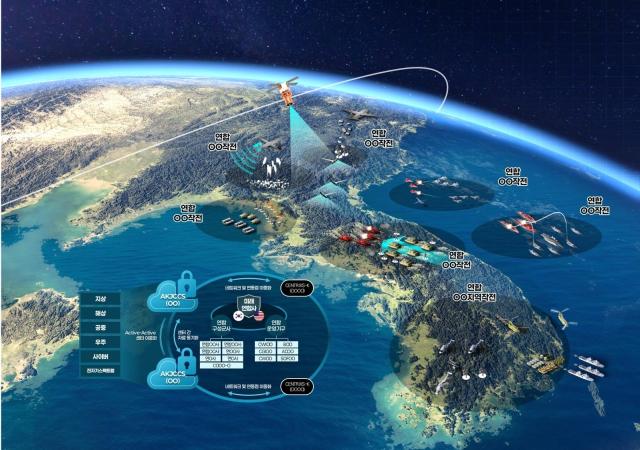
Industry experts believe that AI battlefield operating systems and platforms are likely to become a new revenue stream in South Korea's defense market. Professor Park Joo-hong from POSTECH's Department of IT Convergence Engineering stated, "There is a growing consensus within the military on the necessity of AI-based battlefield systems," but emphasized that AI should evolve into a platform that explains situations considering the decision-making structure of defense organizations rather than autonomously judging wartime scenarios.
* This article has been translated by AI.
Copyright ⓒ Aju Press All rights reserved.