
Following an agreement between Samsung Electronics and its labor union to link bonuses to operating profits, demands for profit-sharing bonuses based on a percentage of operating income are expected to grow louder. Concerns are rising that escalating labor disputes and feelings of relative deprivation could undermine the competitiveness of South Korea's industries.
On May 21, industry sources indicated that the tentative agreement on bonuses at Samsung Electronics could signal a new phase in labor relations. The focus of negotiations has shifted from wage increases and job security to the previously secondary issue of profit-linked bonuses.
Professor Hwang Yong-sik of Sejong University expressed concern that the Samsung union's approach, which mirrors that of SK Hynix, may encourage other unions to adopt a similarly hardline stance. He stated, "This has essentially ignited a new spark of labor conflict in the industry."
The demand for profit-linked bonuses is already spreading across various sectors. Industries entering a so-called supercycle, such as shipbuilding, power equipment, and defense, are particularly vocal about these demands.
The integrated union of HD Hyundai Heavy Industries has proposed that over 30% of operating profits be allocated for bonuses. Similarly, unions at Hyundai Motor and LG Uplus plan to prioritize profit-sharing bonuses in their collective bargaining agreements. The union at Samsung Biologics is requesting 20% of operating profits, while Kakao's subsidiaries are asking for 13-15%.
Emeritus Professor Choi Jun-sun of Sungkyunkwan University Law School explained, "The original intent of profit-sharing bonuses was to provide a flexible compensation mechanism that could reduce labor costs during downturns. However, the current discussions lack any consideration of shared responsibility when operating losses occur."
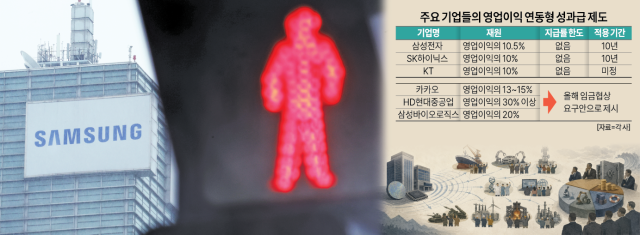
Currently, among South Korea's top 30 companies, only Samsung Electronics, SK Hynix, and KT are operating or planning to implement profit-linked bonus systems. SK Hynix agreed in 2021 to allocate 10% of its operating profits for bonuses and decided to distribute the full amount of that percentage last September, coinciding with the onset of a semiconductor supercycle. KT also reached an agreement in 2021 to allocate 10% of its operating profits for bonuses.
Experts widely agree that a profit-based bonus system is not suitable for South Korea's manufacturing sector, which is characterized by cyclical booms and busts.
A CFO from a mid-sized company remarked, "From a financial perspective, a profit-based bonus system is only applicable in industries like telecommunications, where annual revenue and operating profit can be accurately predicted based on ARPU (average revenue per user). In cyclical industries like semiconductors, automobiles, shipbuilding, steel, petrochemicals, and shipping, this system could severely diminish funds for research and development, mergers and acquisitions, shareholder returns, and crisis management during downturns."
Previous implementations of such systems at SK Hynix and KT have faced criticism for lacking sophisticated financial modeling. In fact, SK Hynix introduced its system in response to employee dissatisfaction over lower bonuses during semiconductor downturns, while KT's decision was influenced by employee grievances regarding lower compensation compared to competitors and issues surrounding executive reappointments. In contrast, Samsung Electronics has set a financial safety net, stipulating that bonuses linked to operating profits will only be paid if profits exceed a specific threshold (100 trillion to 200 trillion won).
As industries entering a boom period receive bonuses in the hundreds of millions, feelings of deprivation among workers in struggling sectors like steel and petrochemicals are likely to intensify. These sectors have reported little to no bonuses or only minimal consolation payments in the past year due to oversupply issues stemming from China. Employees at Yeocheon NCC, once known for its high salaries, now face large-scale layoffs due to restructuring in its naphtha cracking facility.
* This article has been translated by AI.
Copyright ⓒ Aju Press All rights reserved.