
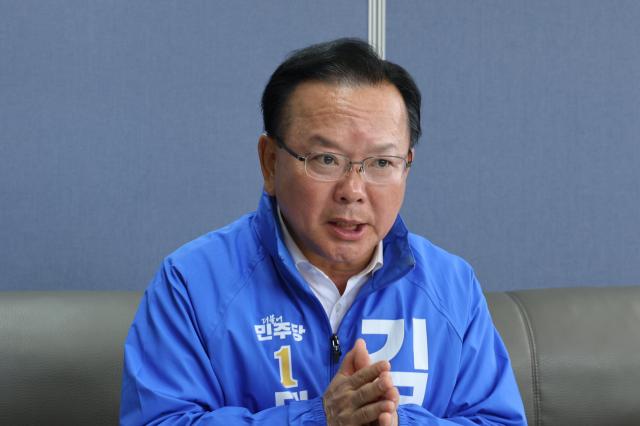
Kim Boo-kyum, the Democratic Party's candidate for mayor of Daegu, stated that to revive the city's economy, a fundamental change in its industrial structure is necessary. He plans to integrate artificial intelligence (AI) into Daegu's traditional manufacturing sectors, including machinery, metals, automotive parts, and textiles, while positioning AI robotics, future mobility, healthcare, and quantum technology as new growth engines.
In an interview with Aju Economy, Kim described his top campaign promise, 'Industrial Transformation,' asserting, "I will make Daegu the southern region's version of Pangyo," a reference to the tech hub near Seoul.
On April 19, Kim held his first campaign promise announcement at his election office in Daegu's Dalseo District, where he outlined 'Industrial Transformation and Job Creation' as his core pledge. He aims to double Daegu's Gross Regional Domestic Product (GRDP) to 150 trillion won by 2035 and create 100,000 quality jobs.
The starting point for Kim's industrial transformation is the advancement of existing manufacturing. He stated, "We will innovate design, processes, quality, and logistics by integrating AI into Daegu's robust manufacturing base." He envisions connecting the Su-seong Alpha City, Technopolis, DGIST, local universities, research institutions, and businesses to create an environment where young people can learn, work, and grow in Daegu.
Kim also emphasized the importance of fostering youth entrepreneurship and cultural industries. He plans to establish an Asian Global Youth Entrepreneurship and Cultural Convergence Special Zone and create a 100 billion won youth entrepreneurship fund to help turn ideas into businesses and facilitate global expansion. He stressed, "We will create a city where young people can learn about future industries and challenge themselves to start businesses without leaving for the metropolitan area."
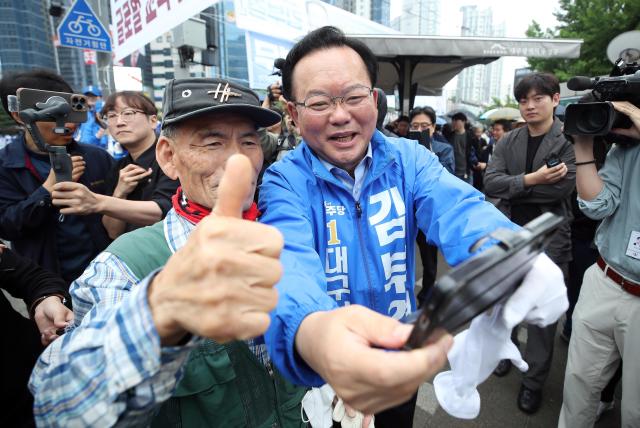
"GRDP 150 trillion is not just a numerical promise"
Kim has committed to achieving a GRDP of 150 trillion won and creating 100,000 quality jobs by 2035. He emphasized, "This is not just a numerical promise; it is a goal to change the industrial structure of Daegu and attract corporate investment."
As part of his plan, he proposed a 'Five-Year Industrial Transformation Plan' that will be established immediately upon taking office, with annual goals that the mayor will personally oversee. Kim stated, "I will form a large company attraction team to directly engage with key firms in AI semiconductors, robotics, future mobility, and healthcare."
He also revealed plans to expand investment cooperation with major companies in future industries, such as Samsung Electronics, SK Hynix, and Hyundai Motor. His aim is to create an ecosystem that connects not only production facilities but also partner companies, research and development functions, and local mid-sized enterprises. To achieve this, he plans to create a 'Daegu Support Package' that integrates industrial land, talent, finance, and regulatory improvements.
Recent economic conditions in the region underscore Kim's concerns. According to data released by the National Statistical Office on June 26 last year, Daegu's GRDP decreased by 3.9%, the largest decline among cities and provinces nationwide.
Kim stated, "I will personally meet with CEOs of companies and actively engage with them. We need to make Daegu an attractive destination for businesses," adding that he would shift from an administrative approach that waits for investment to one that actively attracts it.
"Daegu's strength lies in directly applying advanced technology to manufacturing"
As regions like the metropolitan area, Chungcheong, and Busan-Ulsan-Gyeongnam compete to attract advanced industries, Kim identified Daegu's comparative advantage. He said, "Daegu's strength is its ability to directly connect advanced technology with actual manufacturing sites."
He believes that by combining the digital capabilities of Su-seong Alpha City with the manufacturing base in Seongseo and West Daegu, practical applications of AI in design, processes, quality control, and logistics can be achieved. In the robotics sector, he highlighted the strengths of the Korea Robot Industry Promotion Agency, the National Robot Test Field, and the Outdoor Mobile Robot Performance Evaluation Center.
Regarding the quantum industry, he mentioned DGIST and the Daegu Digital Innovation Promotion Agency. Kim stated, "We will focus on quantum sensing, devices, equipment, optoelectronics, and sensors first," indicating a phased approach to developing Daegu as a hub for all advanced industries, starting with areas that can be connected to manufacturing.
Kim also plans to adopt a different approach to attracting anchor companies. He noted, "Relying solely on demands for headquarters relocation has its limits," and proposed a package approach that combines testing, certification, talent, demand companies, funds, land, and tax incentives. He added, "We will create a structure where companies can validate and commercialize their products more quickly by coming to Daegu."
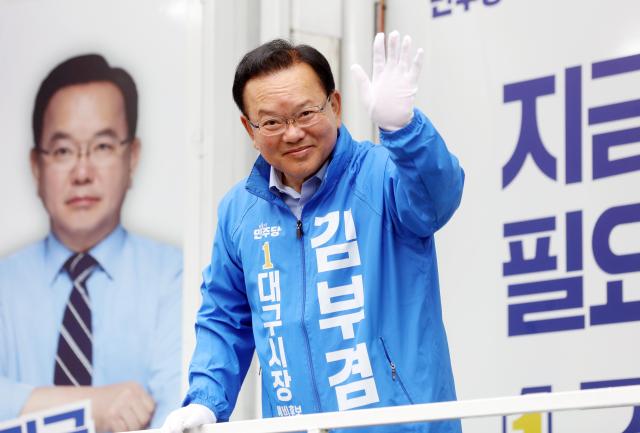
"The key to youth outflow is jobs and wages"
Addressing the issue of youth outflow from Daegu, Kim diagnosed it as fundamentally a matter of jobs and wages. He reported that young people he met expressed concerns that "the starting salary for new IT employees in Daegu is only 70% of that in Pangyo," and that they feel compelled to leave despite not wanting to be away from their families.
Kim believes that supporting entrepreneurship alone will not solve the youth issue. His strategy includes opening opportunities for aspiring young entrepreneurs through a 100 billion won youth entrepreneurship fund and a youth entrepreneurship and cultural convergence special zone, while also creating stable jobs through corporate attraction and industrial advancement for those seeking employment.
Nationally, the employment conditions for youth are challenging. According to the employment trends released by the National Data Portal last month, the number of employed youth decreased by 147,000 compared to the previous year, marking a continuous decline for 41 months since November 2022. The youth employment rate fell to 43.6%, down 0.9 percentage points, while the unemployment rate rose to 7.6%, up 0.1 percentage points.
Kim asserted, "Youth outflow cannot be resolved with short-term support alone. We need to create a structure that allows for good jobs and better wages within the region through industrial transformation, attracting large companies, and nurturing future industries."
He also proposed asset formation support measures, stating, "We will support asset formation of up to 30 million won for a maximum of five years through the 'Youth Dan-di-Chaeum Fund,'" adding, "We want our sons and daughters to be able to work and prepare for their futures in their hometowns."
"Results matter more than the title of Deputy Prime Minister of Economy"
In response to rival candidate Choo Kyung-ho's emphasis on his experience as a former Deputy Prime Minister of Economy, Kim directly countered, saying, "The title of Deputy Prime Minister is just a title, not an achievement in itself."
He claimed that during his tenure as Prime Minister, Daegu's national funding growth rate was 10.94% in 2021 and 15.47% in 2022. In contrast, he noted that during Choo's time as Deputy Prime Minister, the growth rates were only 0.59% in 2023 and 0.94% in 2024.
Kim also raised concerns about revenue shortfalls, stating, "In 2023, there was a revenue shortfall of about 56 trillion won, and in 2024, about 30 trillion won, which were passed on to local governments through cuts in local allocation taxes."
Regarding the dynamics of the Daegu mayoral election, he emphasized the importance of cooperation with the central government and the National Assembly. Kim stated, "The new mayor will work on the same timeline as the remaining four years of the president's term, and the success of key issues like the TK New Airport will depend on who can better attract support and cooperation from the ruling party in the central government and the National Assembly."
He concluded, "My strength lies in the political power and execution ability to turn Daegu's demands into reality. What Daegu needs now is a mayor who can deliver results, not just talk."
* This article has been translated by AI.
Copyright ⓒ Aju Press All rights reserved.