
“I want to receive performance bonuses based on my results, but it feels like I’m playing a game where the outcome is already decided,” said Yoo, a 31-year-old employee at a major South Korean corporation. “The criteria for performance bonuses change every year, making it hard to predict. The issue isn’t the money; it’s that the standards keep changing and aren’t clearly defined.”
As Samsung Electronics and SK Hynix, leaders in the domestic semiconductor industry, continue to achieve record-breaking results thanks to the AI semiconductor boom, conflicts surrounding performance bonuses and compensation systems are intensifying in the workplace.
While U.S. tech giants are significantly increasing stock options and equity compensation to attract key AI talent, South Korea is witnessing repeated labor disputes over the criteria and distribution methods for performance bonuses.
Samsung Electronics and its labor union signed a tentative agreement following a government mediation process, temporarily postponing a planned general strike. However, the potential for renewed conflict remains, depending on the results of a member vote on the tentative agreement scheduled for the 27th. As a key player accounting for about 20% of South Korea's total exports, any production disruptions at Samsung could significantly impact the domestic industry and financial markets.
The core of the tentative agreement at Samsung Electronics is to fix the performance bonus pool for the semiconductor (DS) division at 10.5% of agreed business performance and to eliminate the payment cap, introducing an unprecedented compensation system. This change allows for substantial stock performance bonuses for employees, particularly in the memory division, marking a test of a new compensation model aligned with the AI semiconductor boom.
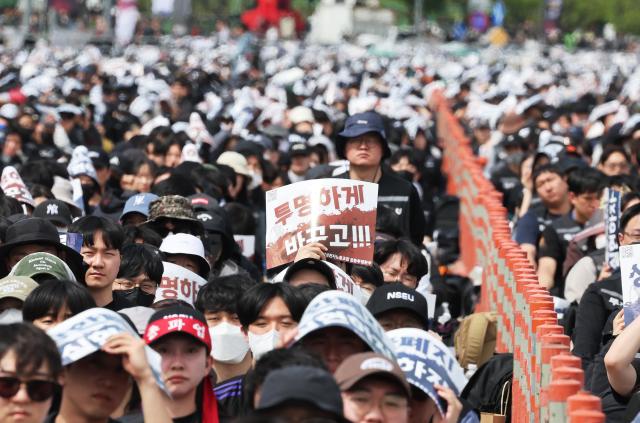
This situation has strengthened calls for more transparency and predictability in the criteria and decision-making processes for performance bonuses.
Industry experts argue that the unclear compensation system has exacerbated recurring labor disputes, and this agreement could serve as a new benchmark for performance distribution during the AI boom. This trend is expected to influence discussions on compensation systems at other ICT companies, including Kakao, which recently faced the possibility of its first headquarters strike after a vote in favor of a strike.
The differences in compensation systems between South Korean and U.S. companies have become more pronounced in the wake of the AI boom.
In South Korea, wage increases are primarily driven by performance bonuses rather than base salaries. An analysis of raw data from the Ministry of Employment and Labor's 'Business Labor Force Survey' by the Korea Employers Federation revealed that special payments (including performance bonuses) increased by 8.1% in the first half of 2025 compared to the same period the previous year, significantly outpacing the increase in fixed salaries (2.9%).
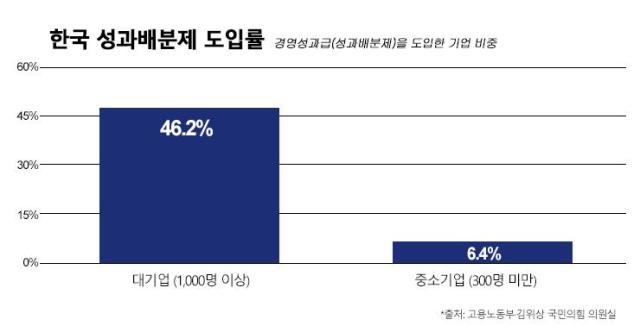
However, the distribution of performance bonuses is heavily skewed towards large corporations. According to data received by Kim Wi-sang, a member of the People Power Party, from the Ministry of Employment and Labor, as of June last year, 43.8% of workplaces with over 300 employees and 46.2% of those with over 1,000 employees operated performance bonus systems, compared to just 6.4% of small businesses with fewer than 300 employees. Performance distribution systems are collective performance reward systems based on whether a company meets its management goals, distinguishing them from individual performance bonuses based on personal evaluations.
South Korean companies tend to have a strong structure for distributing performance bonuses based on overall company performance. Cash bonuses and welfare benefits are predominant, often prioritizing organizational performance over individual contributions. This contrasts with the compensation systems of U.S. tech giants, which focus on securing key talent and individual contributions.
Experts analyze that the recurring conflicts over performance bonuses stem not just from corporate culture but also from structural differences in labor market flexibility, performance evaluation methods, and risk-sharing frameworks.
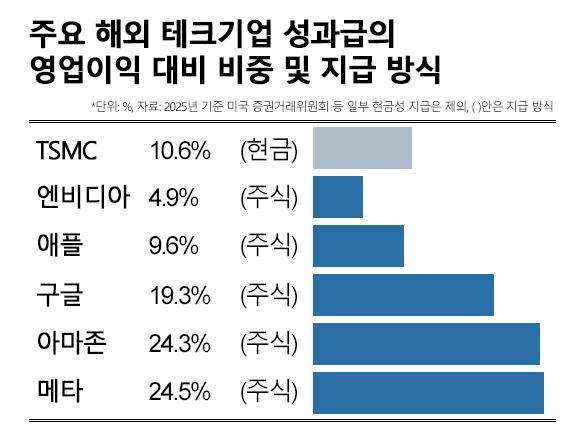
Eric Cambria, a professor at Nanyang Technological University, noted, “U.S. tech companies are intensely focused on securing key research personnel that will determine their AI competitiveness. The trend of concentrating stock options and long-term rewards on key developers is strengthening.”
Indeed, competition for top talent among U.S. tech giants has intensified following the AI boom. Financial data reviewed by The Wall Street Journal indicates that OpenAI's average stock compensation per employee is approximately $1.5 million for 2025. Meta reflected $20.4 billion and Alphabet $27.1 billion in stock-based compensation for the same year.
U.S. companies are also reinforcing structures that reflect not only overall company performance but also individual contributions and strategic input in their performance bonuses. Companies like Meta and Google are known to consider a comprehensive range of factors, including rank, individual evaluations, and organizational performance, when determining compensation.
The demand for AI talent is surging. According to global recruitment platform Indeed, job postings for 'Forward-Deployed Engineers,' who directly apply AI systems in the workplace, skyrocketed from 643 in April last year to 5,330 in April this year, an increase of about 729%.
Choi Jae-pil, a professor at Sungkyunkwan University's Graduate School of Business, stated, “As AI standardizes repetitive tasks, the phenomenon of concentrating rewards on 'superstar talent' that creates strategic value will intensify.” He added, “As AI enables more transparent evaluations of previously hard-to-quantify performance, the introduction of differentiated compensation systems by companies is likely to accelerate. Ultimately, in the AI era, the question of 'who is irreplaceable' will become the standard for compensation.”
He further noted, “Whether companies can retain key talent will determine their competitiveness. Companies are likely to shift their compensation systems toward stock options and long-term incentives. However, South Korea still has a strong collective culture and cash-based performance bonus system, which may lead to greater internal resistance during the process of introducing differentiated compensation systems compared to the U.S.”
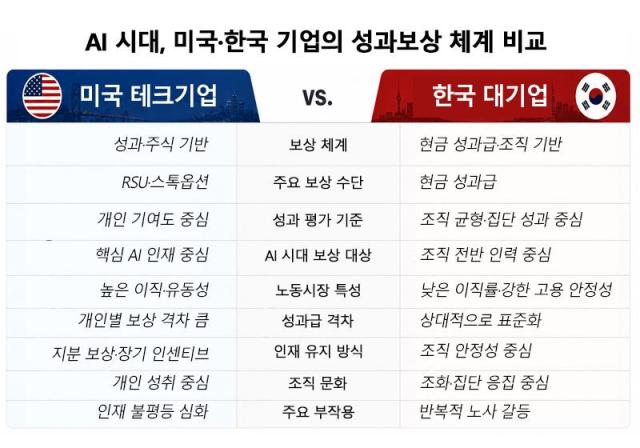
Differences in labor market structures are also cited as a backdrop to the recurring conflicts over performance bonuses.
Shin Hyun-han, a professor at Yonsei University's School of Business, pointed to 'labor market flexibility' as a reason why U.S. companies tend to disclose evaluation criteria and compensation systems more transparently.
He explained, “In the U.S., dissatisfied key talents can quickly move to competitors, prompting companies to naturally offer higher compensation to retain talent. Consequently, the employees who remain in the organization are those who agree with the corporate culture.”
In contrast, he noted, “In South Korea, the burden of potential wage loss and career uncertainty makes it difficult for employees to leave easily. As a result, dissatisfied employees often remain in the organization and voice their concerns.” He described this as a “vicious cycle of performance bonus disputes,” where no matter how much bonuses are increased, relative deprivation persists.
Differences in evaluation methods also emerge. Professor Shin stated, “U.S. companies tend to clearly disclose KPIs (Key Performance Indicators) or OKRs (Objectives and Key Results), while South Korean companies often rely on qualitative judgments from evaluators.” He added, “As a result, information asymmetry deepens, and ultimately, the degree of freedom in dismissals influences the transparency of companies.”
He emphasized that what is crucial for employees is “predictability,” suggesting that maintaining base salaries while differentiating performance bonuses could be a realistic alternative. He stated, “The clearer the criteria become, the easier it is for employees to accept the results or make rational choices to leave if necessary.”

There is already a growing perception that “effort and rewards are not connected.” SJ, a thirty-something employee at a subsidiary of a major corporation, expressed his frustration, saying, “The companies we supply to are having performance bonus parties, but we end up with nothing.”
He noted, “In a vertically integrated structure, the profitability of subsidiaries is often determined by internal trading structures or group-level distribution methods. There needs to be more transparent and consistent disclosure of evaluation criteria for individuals, departments, and business units so that employees can accept the results.”
He added, “Currently, no matter how much performance we deliver, the company often explains it away with the logic of being in a 'crisis situation.' Clear criteria are necessary for employees to feel motivated and grow alongside the organization.”
However, experts caution that simply adopting the U.S. compensation system is not the solution.

Kim Jin-young, a professor at Korea University, stated, “The high compensation in the U.S. comes with the structure of accepting the risks of layoffs and income volatility. To share performance, there must be a structure that also shares risks during downturns.”
He added, “In South Korea, there is often a focus solely on the high compensation of the U.S. model, but underlying it are employment instability and labor market risks. Rather than trying to solve inequality issues solely through internal performance bonuses, it is necessary to approach them from a broader social structural perspective.”
Experts believe that as the AI era progresses, South Korean companies will face increasing pressure to reform their compensation systems. However, they agree that rather than simply imitating the U.S. performance compensation system, it is essential to redesign compensation structures that fit the labor market structure and organizational culture in South Korea.
Professor Choi emphasized, “Ultimately, what matters is how fairly and reliably employees perceive the performance evaluation and compensation systems. In the AI era, changes in compensation systems must go hand in hand with transformations in organizational culture and labor market structures.”
* This article has been translated by AI.

Copyright ⓒ Aju Press All rights reserved.