
According to industry sources, as of 6:40 p.m. Saturday, 46,185 of 57,290 eligible voters at the SGUU, Samsung Electronics’ largest union, had cast ballots, bringing turnout to 80.62 percent.
At the National Samsung Electronics Union (NSEU), the second-largest union, 6,502 of 8,187 eligible voters had participated as of the same time, recording turnout of 79.42 percent.
The combined turnout for the two unions stood at 80.47 percent.
The agreement is expected to pass, but a widening bonus gap between business divisions has fueled a rejection campaign among DX employees, who work on smartphones, home appliances and TVs.
Voting began at 2:12 p.m. Friday and will run until 10 a.m. May 27. The deal will be finalized if more than half of eligible union members take part and a majority of those voting approve it. If support falls short of a majority, the agreement will be rejected and labor and management will have to return to the negotiating table.
The tentative deal, reached May 20, includes an average wage increase of 6.2 percent, a new housing loan program of up to 500 million won ($390,000) and a special bonus for semiconductor employees funded by 10.5 percent of the division’s business performance.
Under the agreement, employees in the Device Solutions (DS) division could receive between about 210 million won and 600 million won in bonuses before tax, based on an annual salary of 100 million won. Including the new semiconductor special bonus and the existing Overall Performance Incentive (OPI), employees in the memory business could receive up to 600 million won, while those in non-memory units such as System LSI and foundry could receive about 210 million won.
By contrast, DX employees are expected to receive only around 6 million won worth of treasury shares as a bonus, as the division is widely expected to miss out on OPI due to weak earnings this year.
The union with the largest membership is the Samsung Electronics branch of the Samsung Group United Union (SGUU), with 70,850 members, followed by the National Samsung Electronics Union (NSEU) with 19,053 members and the Samsung Electronics Labor Union 'Donghaeng' with 12,298 members. The total membership stands at 102,298, including overlapping members.
By division, DS has about 77,300 employees, outnumbering DX’s roughly 51,700. Among union members eligible to vote, 57,290 belong to the SGUU and 8,176 to the NSEU, a structure seen as favorable to passage.
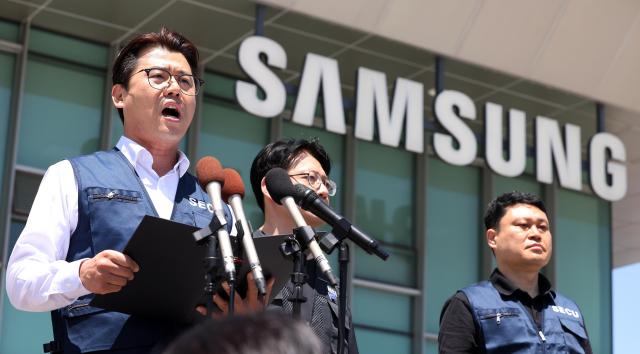
Lee Ho-seok, head of the Suwon branch of the National Samsung Electronics Union, held a press conference with Donghaeng outside Samsung Electronics’ Suwon campus in Gyeonggi Province and said DX employees had officially launched a campaign to reject the deal.
“We will do our best to ensure the deal is rejected by joining forces not only with DX employees but also with semiconductor employees outside the memory business,” Lee said.
On May 21, DX employees joined the NSEU and Donghaeng in large numbers. Donghaeng’s membership jumped from around 2,600 to about 12,300 as of Friday morning, while the NSEU’s membership rose by roughly 3,000 from about 16,000 on May 20 to about 19,000 the following day.
The SGUU told Donghaeng on Saturday that Donghaeng members would be excluded from the vote because the tentative deal was signed on May 20 after Donghaeng had left the joint bargaining group. It said eligible voters would be limited to SGUU and NSEU members listed as of 2 p.m. May 21.
Donghaeng criticized the move as a reversal intended to help pass the deal, saying the SGUU had previously told unions by email that it would respect all unions’ voting rights.
Donghaeng said it would proceed with its own vote regardless of the SGUU’s decision to exclude its members.
Choi Seung-ho, head of the SGUU, said that if the deal is rejected, he would delegate the remaining 2026 negotiations to other union leaders and hold a vote of confidence on his leadership.
If that happens, Samsung Electronics could once again face the possibility of a strike.

Copyright ⓒ Aju Press All rights reserved.
