SEOUL, December 08 (AJP) - A research team at the Korea Advanced Institute of Science and Technology (KAIST) announced on December 8 that developers had created a novel air purification technology capable of removing 99.9% of fine dust without the use of filters, mechanical pumps, or noise, while emitting zero ozone.
The research team, led by Department of Materials Science and Engineering Professor Kim Il-Doo and Department of Mechanical Engineering Professor Lee Seung-Seop, successfully created a "self-pumping water electrospray" device. The system combines ultra-low power consumption with high-efficiency particulate removal, addressing the limitations of traditional HEPA filters and electrostatic precipitators.
Conventional air purifiers rely heavily on High Efficiency Particulate Air (HEPA) filters, which require regular replacement and significant energy to force air through dense material. Alternatively, existing electrostatic purifiers often generate ozone—a harmful respiratory irritant—as a byproduct of corona discharge. The KAIST team’s innovation circumvents these issues by utilizing "water electrospray" technology, which generates microscopic, electrically charged water droplets to trap dust particles in the air.
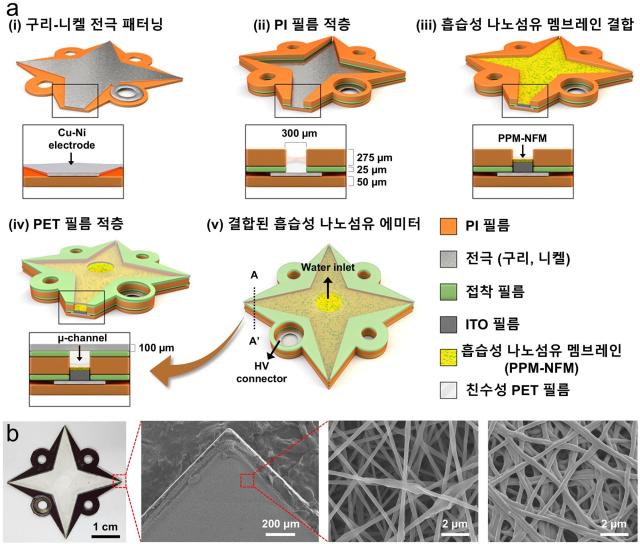
According to the researchers, the core of the innovation lies in the integration of Professor Lee’s "ozone-free water electrospray" and Professor Kim’s "hygroscopic nanofiber" technology. The system features a unique "self-pumping" mechanism where water is drawn up through a nanofiber wick and polymer microchannels via capillary action, eliminating the need for a mechanical pump.
In laboratory tests conducted in a 0.1 m³ chamber, the device successfully removed 99.9% of particulate matter ranging from PM0.3 to PM10 within 20 minutes. Notably, it eliminated 97% of PM0.3—particles less than 0.3 micrometers in diameter, which are notoriously difficult for standard filters to capture—in just five minutes.
The system demonstrated high stability, operating continuously for 50 hours without performance degradation. It is also exceptionally energy-efficient, consuming only 1.3 Watts of power—roughly half the energy required by a standard HEPA purifier and less than a smartphone charger. Water consumption was recorded at less than 0.4 milliliters per hour. Crucially, the team confirmed the device produces no detectable ozone, maintaining a safe indoor environment while filtering pollutants.
The technology is currently being commercialized through A2US Co., Ltd., a faculty startup founded by Professor Lee Seung-Seop. The company has already been recognized with an Innovation Award ahead of CES 2025. A2US plans to release a portable air purifier based on this technology in 2026. The commercial unit is expected to handle not only fine dust but also odors and airborne pathogens.
Research findings were published on November 14 in Advanced Functional Materials, a leading international journal in the field of materials science, under the title "Self-pumped Hygroscopic Nanofiber Emitter for Ozone-free Water Electrospray-based Air Purification." The study was supported by the National Research Foundation of Korea, the Ministry of Science and ICT, and the KAIST-MIT Future Energy Research Center.

Copyright ⓒ Aju Press All rights reserved.