
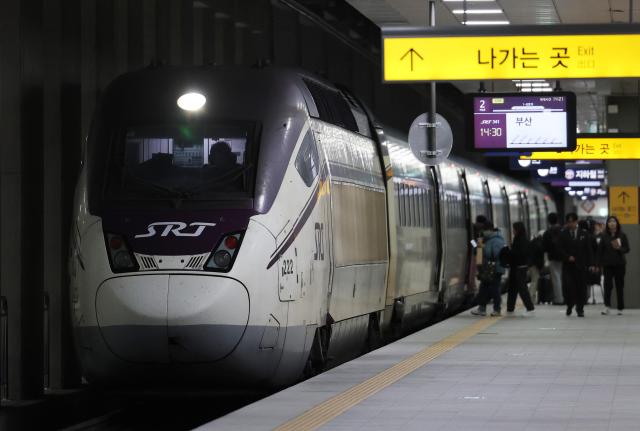
SEOUL, December 09 (AJP) - Korea will merge its two high-speed rail operators — KTX, run by the state-owned Korea Railroad Corporation (KORAIL), and SRT, operated by SR Corporation — by the end of next year, which can enable easier rail travel from southern part of Seoul and reduce overlapping costs.
The Ministry of Land, Infrastructure and Transport announced Monday that the two services will begin cross-operating their trains in March.
Under the plan, SRT trains, which currently depart exclusively from Suseo Station in southern Seoul, will also run from Seoul Station, the city's largest rail terminal. KTX trains, normally operating from Seoul or Yongsan stations, will start departing from Suseo as well.
The government expects the shift to ease seat shortages on popular routes.
The KTX trains scheduled to operate from Suseo have 955 seats across 20 cars — more than double the 410 seats on a standard 10-car SRT train. KORAIL estimates the integration will add about 16,690 seats nationwide on peak-demand weekends, raising daily high-speed rail capacity by roughly 6.5 percent from the current level of 255,000 seats. Authorities also said reducing duplication between the two operators could allow KTX fares to be lowered by up to 10 percent.
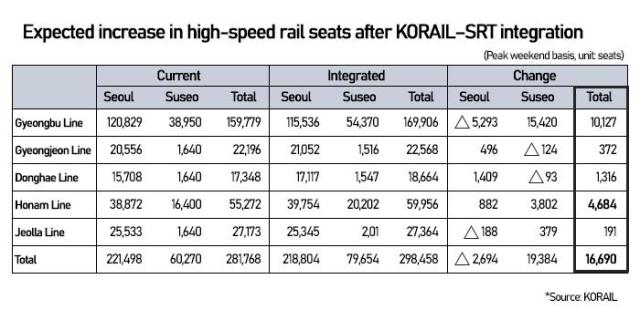
Seat shortages at Suseo have become a persistent problem since SRT launched in 2016. Because all SRT trains depart from Suseo, passengers in the busy southern Seoul region — including Gangnam and Bundang — overwhelmingly rely on the station, especially during peak travel times such as Friday evenings or Monday mornings, when tickets routinely sell out within minutes. Capacity limitations are made worse by SRT's smaller trains and the lack of flexibility to redeploy rolling stock between the two systems, as KTX and SRT have been operated separately.
Following the operational transition next year, the government plans to merge ticketing platforms and allow passengers to book all high-speed services through a single application. Full institutional consolidation between KORAIL and SR is expected by the end of 2026, marking the first such merger since SR was established in 2013 and 10 years after SRT first entered service.
However, critics argue that the key problems behind the initial decision to separate the two operators — including heavy debt loads and repeated safety incidents — remain unresolved. KORAIL's debt ratio rose from 242 percent in 2020 to 265 percent last year, while SR's stood at 173 percent. Concerns have also been raised that combining KORAIL's nearly 30,000-person workforce with SR's 700 employees will expand the organization without structural reform.
Safety remains another major issue. KORAIL currently holds exclusive responsibility for maintenance, yet serious accidents have continued. In August, seven workers were killed or injured during track maintenance in Cheongdo, North Gyeongsang Province, prompting renewed criticism of oversight.
A KORAIL public relations official, responding to questions about concerns over maintenance responsibilities remaining solely with KORAIL after the merger, said, "This is a roadmap that now requires discussion and agreement between labor and management. Nothing is finalized yet."
Labor-related risks have also drawn attention. KORAIL's union is affiliated with the Korean Confederation of Trade Unions (KCTU), while SR's union is independent. At present, even if KORAIL workers strike, SRT trains continue running. After the merger, a nationwide strike could halt all high-speed rail operations, raising concerns about the country's logistics infrastructure.
Transport experts say the merger could benefit passengers if executed effectively, but warn that without financial reform, safety investment, and labor restructuring, consolidation could simply enlarge an already inefficient system. For now, the public remains divided on whether the integration will ultimately improve service or create new vulnerabilities.
"Integration is now the government's decided direction, and any side effects from institutional consolidation must be assessed objectively, and we hope decisions regarding structural changes will be made rationally and based on objective data," a high-speed rail industry official said.

Copyright ⓒ Aju Press All rights reserved.
