
Korea takes more active approach to find missing persons through AI and viral media

By Kim Hee-su Posted : December 10, 2025, 16:43 Updated : December 10, 2025, 17:04
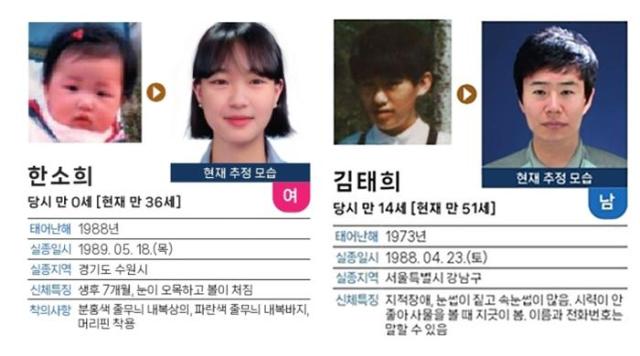
Side-by-side images comparing childhood photos with AI-generated present-day estimates generated by the Korea Institute of Science and Technology KIST Screenshot from the National Center for the Rights of the Child
Side-by-side images comparing childhood photos with AI-generated present-day estimates, generated by the Korea Institute of Science and Technology (KIST). Screenshot from the National Center for the Rights of the Child
SEOUL, December 10 (AJP) - Kim Tae-hee had a habit of staring at things a little longer than others, narrowing his eyes to make sense of a world blurred by poor sight. His speech was halting, shaped by a lifelong mental disability, but he could say his name and home phone number. None of it helped on April 23, 1988, when he disappeared in Seoul's Gangnam District at age 14. Thirty-seven years have passed since. Today, at 51, this is what he might look like.

What once required foreign outsourcing, weeks of processing time, and high cost is now being done in Korea in a matter of moments. Using homegrown generative AI, researchers at the Korea Institute of Science and Technology (KIST) are reconstructing the faces of long-term missing children — not as faded memories, not as sketches, but as people who might walk among us today.

Sixty such individuals have been reimagined in collaboration with the government, the National Police Agency, KIST, and private partners. They reappear in middle age with softened jaws, thinning hair, or the deepening lines of a life lived elsewhere — a life their families never got to witness but still yearn to reclaim.

"In the past, aging technology meant adding wrinkles or altering facial shape — what we used to call an 'aging function,'" said Kim Ig-jae, head of KIST's AI & Robotics Research Center, in an interview with AJP. "Generative AI learns the distribution of real human faces. When features such as skin texture, hair color, and contours change, the model interprets those variations as probabilities and generates new images based on them."

"All of this happens in what we call a 'latent space,'" he said. "It's an abstract map of human characteristics. By modeling how attributes shift over time, the AI can estimate how a missing child might realistically appear today."

 
A sample screen recording from the Korea Institute of Science and Technology KIST showing how its proprietary AI technology generates age-progressed images using example photos Courtesy of Dr Kim Ig-jae
A sample screen recording from the Korea Institute of Science and Technology (KIST) showing how its proprietary AI technology generates age-progressed images using example photos. Courtesy of Dr. Kim Ig-jae
The shift is transformative. Instead of outsourcing to U.S. firms at high cost, domestic researchers can now produce images rapidly, leaving stylization — hair, clothing, the personal signatures of a face — for manual adjustment.

The Korea National Center for the Rights of the Child has woven these images into public awareness campaigns with the National Police Agency, and the Ministry of Health and Welfare worked with KIST to generate current-age portraits for 60 of the 189 long-term missing children. While 99.6 percent of children reported missing in 2024 were found within a year, 1,417 remain lost for more than a year — including 1,128 missing for over two decades.
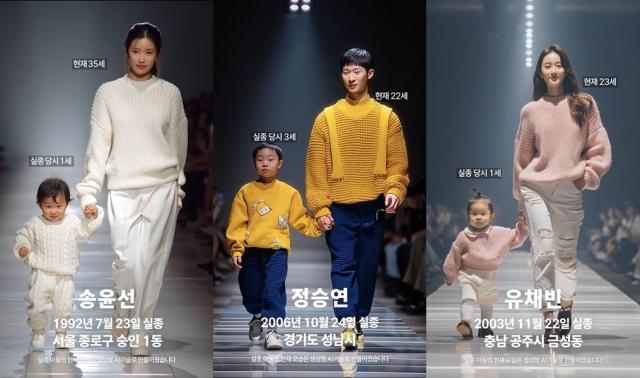
 
Runway to Home an AI-powered campaign by Daehong Communications and the National Center for the Rights of the Child reimagines what long-term missing children might look like today Courtesy of Daehong Communications Inc
"Runway to Home," an AI-powered campaign by Daehong Communications and the National Center for the Rights of the Child, reimagines what long-term missing children might look like today. Courtesy of Daehong Communications Inc.
To amplify recognition, Daehong Communications launched "Runway to Home," a campaign that transforms the AI-generated adults into virtual models walking a fashion runway — paired alongside their younger selves. A symbolic reunion in digital form, the two versions walk side by side, asking commuters to look twice.

"Hairstyles or clothing can dramatically change how someone is perceived, so we created multiple versions to spark associations," a Daehong manager said. The campaign is running on billboards in downtown Seoul during rush hour — a deliberate attempt to draw attention in an age when video captures more eyes than posters ever could.
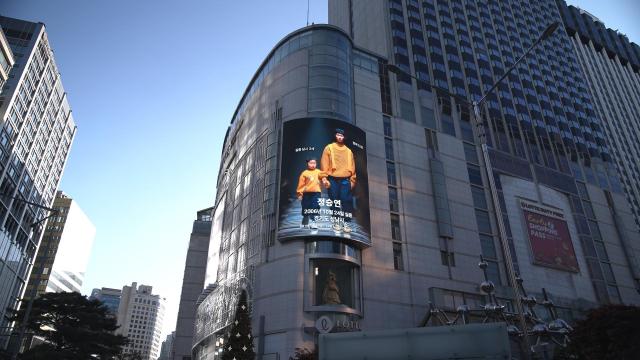
 
Daehong Communications’ “Runway to Home” campaign is displayed on the exterior media wall of Lotte Department Store in Myeong-dong Seoul in October 2025 Courtesy of
"Runway to Home," a missing children campaign, is displayed on the exterior media wall of Lotte Department Store in Myeong-dong, Seoul, in October 2025. Courtesy of Daehong Communications Inc.
Families were consulted throughout. "Both parents wear glasses, so we think he would too," one said. Another pointed to hair tied neatly in the digital rendering. "It looks just like his aunt."

For KIST's Kim, the effort carries both scientific promise and human weight. 'After we distributed an early version of this technology nearly ten years ago, one missing child was found after 38 years," he said. "Even when someone cannot be located, families tell us the images are a gift — a reminder that their children are still with them."

Anyone with information or possible sightings is urged to call the National Police Agency at 182 (no area code needed) or contact the National Center for the Rights of the Child at 02.777.0182.

Copyright ⓒ Aju Press All rights reserved.

기사 이미지 확대 보기
닫기