
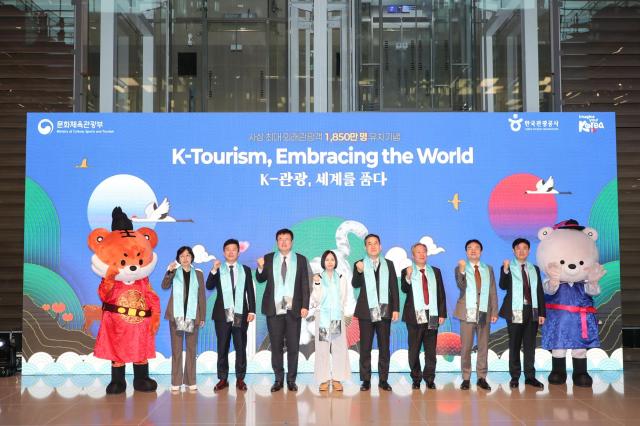
SEOUL, December 23 (AJP) -Sharmaine Lee from Singapore became the 18.5 millionth foreign visitor to South Korea this year on Tuesday, greeted with fanfare at Incheon International Airport as the country’s inbound arrivals surpassed the pre-pandemic peak of 17.5 million recorded in 2019.
Buoyed by the milestone, the government has moved up its long-term tourism ambition, setting a target of attracting 30 million foreign visitors by 2030.
According to the Korea Tourism Organization, the surge reflects a synchronized recovery in travel demand across Asia, the Americas and Europe, reinforced by the global appeal of K-pop, K-dramas and Korean beauty culture.
Yet behind the record headcount lies a persistent structural weakness: tourists are returning in force, but they are spending less.
A recent report by Yanolja Research shows that average per-capita spending during the first nine months of 2025 stood at $1,010.4, down 15.3 percent from $1,193.1 in 2019. As a result, total tourism receipts reached $14.23 billion, recovering to just 92.2 percent of pre-pandemic levels despite inbound arrivals already exceeding the earlier peak.
Industry experts increasingly point to Japan’s policy shift as a possible reference point.
Since 2014, Tokyo has treated tourism as a pillar of national growth, prioritizing longer stays and spreading visitors beyond major cities. That strategy delivered 36.87 million foreign visitors and a $41.2 billion tourism surplus last year. By contrast, South Korea continues to run a structural deficit, as outbound spending by Korean travelers outpaces inbound tourism revenue.
At the center of the challenge is the length of stay. Foreign visitors currently remain in South Korea for an average of three to four days — a duration experts say must be extended to a week or more to generate meaningful economic spillovers.
“The essence lies in why they come, how long they stay, and what brings them back,” said Yoon Yoo-sik, a professor at Kyung Hee University’s College of Hotel and Tourism Management. He stressed that South Korea needs to move beyond generic sightseeing toward higher-value, experience-based offerings spanning K-pop, beauty and MICE (meetings, incentives, conferences and exhibitions).
In response, the Ministry of Culture, Sports and Tourism plans to accelerate what it calls a “structural transformation” beginning in 2026. Measures under review include streamlined entry procedures, dedicated transit passes for foreign visitors and improvements to mobile payment systems to better serve the growing ranks of independent travelers.
As South Korea’s tourism numbers push into uncharted territory, policymakers face a familiar question: whether the next phase of growth will be defined by how many visitors arrive — or by how long they stay and how deeply they spend.
Copyright ⓒ Aju Press All rights reserved.
