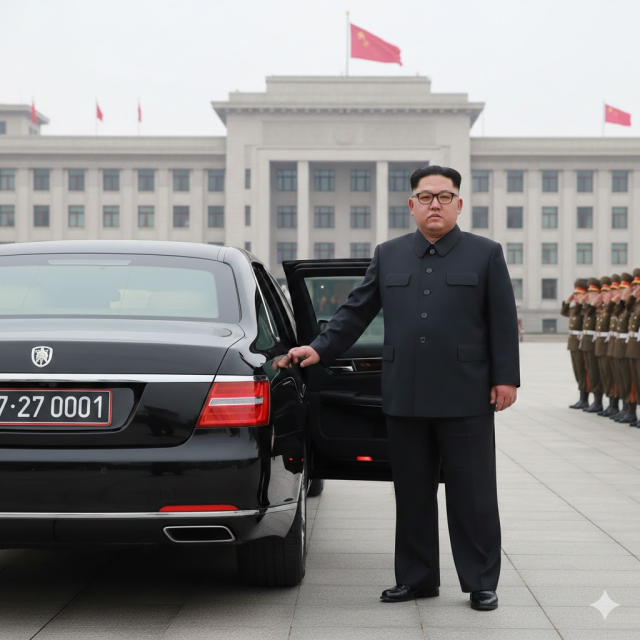
Kim has reportedly replaced the license plate on his state limousine — a Russian-made Aurus Senat gifted by President Vladimir Putin — with one bearing the number “7·27 0001.” The first three digits mark July 27, 1953, the date of the Korean War armistice. The remaining four leave little room for interpretation: No. 1.
In Pyongyang, nothing is accidental. Recent footage aired by state broadcaster Korean Central Television (KCTV) suggests that license plates themselves have become a visible code for hierarchy inside the regime.
The numbers “0002” and “0003” are now assigned to Premier Pak Thae-song, head of the Cabinet, and Choe Ryong-hae, president of the Presidium of the Supreme People’s Assembly (SPA), respectively. The sequencing — placing the premier ahead of the nominal head of state — has fueled speculation among analysts that the administrative arm of the government is gaining renewed prominence under Kim’s rule.
At major public events, including the 80th anniversary of the founding of the Workers’ Party of Korea held in Pyongyang last October, Pak was seated immediately after Kim’s main guest, Chinese Premier Li Qiang, and ahead of Choe. In official party roll calls as well, Pak has been introduced before the SPA chief, reinforcing perceptions that he has emerged as the regime’s de facto second-in-command.
“Formally, the president of the SPA Presidium functions as North Korea’s head of state, signing credentials and representing the country diplomatically,” Koh Yu-hwan, a professor of North Korean studies at Dongguk University, told AJP.
“In practice, however, real authority often rests with the premier, who oversees economic management and state administration. It is similar to South Korea, where the National Assembly speaker ranks second in protocol but does not necessarily wield comparable political power.”
Another Dongguk University scholar, Hwang Jin-tae, offered a complementary reading of the symbolism.
“People are paying attention to the fact that the No. 2 plate was assigned to the premier,” he said in a separate interview with AJP.
“Traditionally, the party was considered the ‘head’ and the Cabinet the ‘hands.’ But with the growing emphasis on regional development initiatives such as the ‘20×10 Regional Development Policy,’ which directly affects people’s livelihoods, the premier’s role appears to be gaining weight.”
Hwang noted that similar interpretations surfaced during the tenure of former Premier Kim Tok-hun.
“Even then, coverage highlighted the Cabinet’s responsibility for economic management,” he said. “Assigning numbers 2 and 3 to the heads of the executive and legislative branches may be symbolically fitting for a regime eager to project a more ‘normalized’ state structure.”
Still, he cautioned, ultimate authority remains firmly within the Workers’ Party, particularly among senior figures such as Jo Yong-won, director of the Organization and Guidance Department, and Pak Jong-chon, vice chairman of the Central Military Commission.
While internal symbolism may be shifting, observers in Seoul say Pyongyang’s external posture remains hard-edged.
Kim Gunn, a lawmaker from the People Power Party, said North Korea may soon enter another phase of provocation aimed at strengthening its bargaining position with Washington.
Kim, who previously served as South Korea’s ambassador to the United Kingdom and as chief nuclear negotiator, is now secretary of the National Assembly’s Foreign Affairs and Unification Committee.
“The direction of North Korea’s policy this year will depend on decisions taken at the Ninth Party Congress,” he told AJP. “But the recent display of what appears to be a nuclear-powered submarine under construction suggests Pyongyang is preparing to raise tensions as a negotiating tactic.”
“The key for Seoul and Washington,” he added, “will be close coordination and efforts to encourage constructive engagement by surrounding powers.”
Copyright ⓒ Aju Press All rights reserved.