

The operation, carried out by U.S. Delta Force commandos, removed a sitting head of state from his bedroom in just five minutes, completing an end-to-end mission in under five hours. Yet the most striking element was not speed or firepower, but how little the world saw while it was happening.
There were no mass airstrikes. No prolonged fighting. No advance warning.
Instead, the lights went out.
The New Battlefield: Cyber Before Kinetic
According to military analysts, the operation followed a now-emerging template of "dark warfare" — a fusion of cyber disruption, drone dominance and precision special operations.
U.S. forces temporarily cut power and communications in parts of Caracas, reportedly through a coordinated cyberattack and drone strikes on key substations and communication towers. The objective was not destruction, but paralysis — delaying response, blinding defenses and sowing confusion.
"This is modern warfare," said retired South Korean Army Lieutenant General Chun In-bum. "Drones didn't just support the operation — they reshaped the battlefield itself."
Chun cautioned that many tactical details remain classified, but emphasized that drones have become central, not auxiliary, to contemporary military strategy.
Drones That See What Satellites Cannot
The groundwork for the raid was laid months earlier.
Beginning last August, U.S. intelligence agencies deployed teams into Venezuela, combining human intelligence with persistent drone surveillance. Unlike satellites, which offer intermittent snapshots, drones hovered continuously — mapping Maduro's movements, routines and living quarters in granular detail.
They tracked not only where he slept, but how he moved, what he wore, even the layout of his residence. Using this data, Delta Force built a full-scale replica of the hideout and rehearsed the assault repeatedly — a level of precision impossible without drone-collected intelligence.
In early December, drones struck a remote coastal dock — a move widely seen as both a disruption of cartel logistics and a deliberate probe of Venezuelan air defenses. The strike drew radar responses without risking pilots, allowing U.S. planners to map threats in advance.
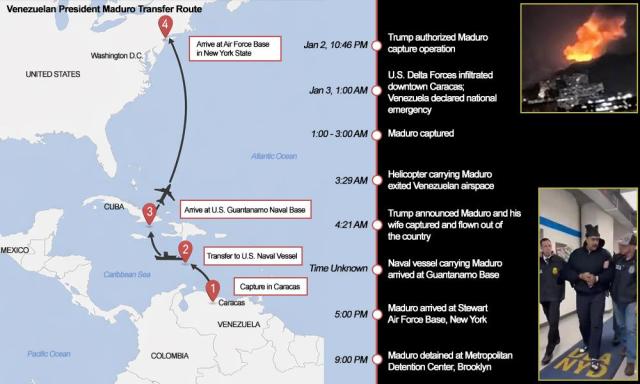
When the final order came from U.S. President Donald Trump late on Jan. 2, roughly 150 aircraft launched simultaneously from some 20 land and naval bases across the Western Hemisphere.
As drones neutralized surveillance and cleared flight paths, helicopters carrying Delta Force operatives flew at just 30 meters above sea level toward Maduro's residence.
Despite brief resistance, U.S. forces overwhelmed Venezuelan defenders under constant drone overwatch. Within three minutes of entry, commandos reached Maduro's location. Two minutes later, he and his wife were in custody as they attempted to flee to a reinforced panic room.
By 4:30 a.m., the team had withdrawn safely to the USS Iwo Jima, stationed about 100 miles offshore. From authorization to extraction: four hours and 43 minutes.
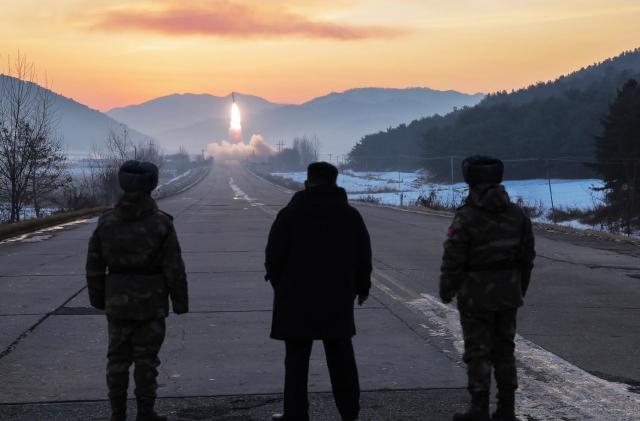
The operation has sent shockwaves far beyond Latin America — particularly in Northeast Asia.
Just hours later, North Korea launched its first ballistic missile of the year, a move widely interpreted as signaling vigilance amid shifting global deterrence norms.
Its foreign ministry was also among the first to respond to the U.S. operation, releasing a statement on Sunday to condemn "the most serious form of encroachment of sovereignty."
Still experts caution against simplistic parallels.
"Venezuela and North Korea are fundamentally different cases," said Jung Kyeong-woon, a researcher at the Korea Institute for Military Studies. Pyongyang's nuclear arsenal, he said, fundamentally alters the calculus. "The likelihood of a Venezuela-style operation on the Korean Peninsula remains low."
Choi Seung-woo, a director of the Seoul Defense Forum Center for Nuclear Strategy, echoed that assessment, noting that Pyongyang emerged from the failed 2019 Hanoi summit convinced that Washington understands its nuclear capabilities, making so-called 'bloody nose' strikes unlikely.
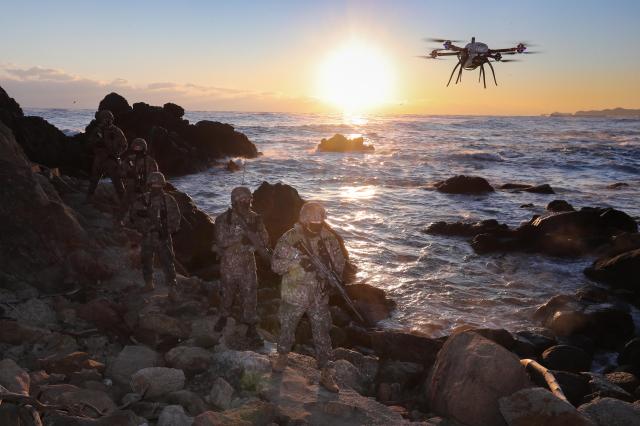
Still, the Venezuelan raid underscores vulnerabilities that resonate uncomfortably in South Korea.
South Korea is among the world's most digitized societies — its power grids, financial systems, transportation networks and military command structures deeply interconnected. That connectivity is a strength — and a potential weakness.
In a crisis, a short-lived blackout, GPS disruption or cyberattack on civilian infrastructure could delay response just long enough for drones and special forces to act.
North Korea, meanwhile, has invested heavily in asymmetric capabilities — cyber warfare units, GPS jamming, electronic warfare and special-operations forces trained not for invasion, but infiltration. Pyongyang is also accelerating drone development with reported Russian technology transfers, including AI-enabled reconnaissance and suicide drones.
"The lesson is not that this will happen in South Korea," Chun said. "The lesson is that warfare has already changed — and anyone who ignores that reality is unprepared."
War Without Sirens
Perhaps the most unsettling takeaway is strategic ambiguity.
Cyberattacks and drone strikes often fall below the legal threshold of war. They are deniable, reversible and difficult to attribute in real time. Mutual defense treaties were written for missiles and armies — not malware and micro-drones.
When the lights go out, policymakers may still be debating whether an attack has even occurred.
In the age of dark operations, wars may no longer begin with explosions — but with silence.
And by the time certainty returns, the mission may already be over.

Copyright ⓒ Aju Press All rights reserved.
