
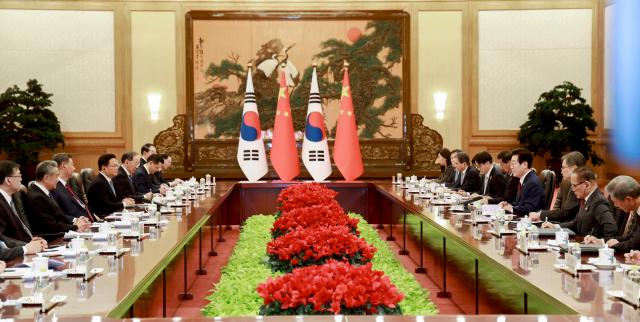
Meeting for about 90 minutes at the Great Hall of the People in Beijing, Lee called the talks the first state-level diplomatic engagement of 2026 for both leaders and pledged to make bilateral relations an “irreversible trend of the times.”
He emphasized expanding cooperation in areas tied to people’s daily lives and jointly supporting peace on the Korean Peninsula.
Xi welcomed Lee’s state visit - the first by a South Korean president in about nine years, stressing the importance of frequent high-level exchanges between the two neighbors amid a rapidly destabilizing global environment. “Friends grow closer the more they interact, and neighbors grow closer the more they visit,” Xi said in opening remarks, urging the two sides to meet more often and communicate regularly.
“In just two months, we have met twice and made mutual visits,” Xi said, calling it a sign that both countries attach great importance to South Korea–China relations.
![시진핑 중국 국가주석이 5일 베이징 인민대회당에서 열린 이재명 대통령과의 정상회담에서 발언하고 있다. [사진=연합뉴스]](https://image.ajunews.com/content/image/2026/01/05/20260105200005417169.jpg)
Xi said the world is undergoing “changes unseen in a century,” with international affairs becoming increasingly complex. Against that backdrop, he said South Korea and China share “a major responsibility” to safeguard regional peace and promote global development, adding that the two countries have broad overlapping interests and should “stand firmly on the right side of history” by making the right strategic choices as great-power competition sharpens.
The two governments signed 14 memorandums of understanding and one deed of donation, spanning science and technology, digital cooperation, startups and small businesses, climate and environment, transportation, food safety, intellectual property protection, and quarantine procedures for animal and plant trade. The agreements underscored a shared effort to anchor the relationship in practical, economy-focused cooperation after years of diplomatic strain.
Yet the summit’s carefully calibrated agenda also revealed what was left unsaid.
North Korea fired a ballistic missile on the day Lee traveled to Beijing — a development that underscored heightened security risks on the Korean Peninsula — but the provocation was not publicly addressed in joint remarks or official readouts.
While Lee reiterated the need for peace and stability, there was no explicit reference to Pyongyang’s latest launch, nor to concrete coordination measures with Beijing.
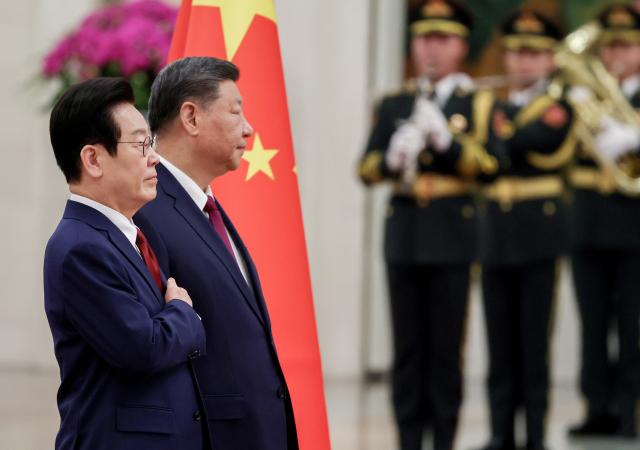
The leaders also avoided direct mention of the United States’ recent military intervention in Venezuela, an issue with far-reaching implications for global energy markets and geopolitical alignments. Xi referred only broadly to rising international instability, without naming specific conflicts or actors.
The omissions appeared deliberate, reflecting a shared preference to keep the summit tightly focused on restoring bilateral ties and advancing economic cooperation, while steering clear of issues that could expose strategic differences or complicate relations with Washington.
Lee reaffirmed South Korea’s respect for China’s “one-China” position, a long-standing stance that remains a sensitive diplomatic signal amid rising cross-strait tensions. Discussions on other contentious issues — including North Korea’s denuclearization, maritime concerns in the Yellow Sea, and the easing of China’s informal restrictions on Korean cultural content — were described as ongoing but incremental.
The Beijing meeting followed the leaders’ first summit on the sidelines of the Asia-Pacific Economic Cooperation (APEC) meeting in Gyeongju in November, signaling a rapid resumption of high-level diplomacy after years of friction. Still, analysts say the summit highlighted the limits of rapprochement, with Seoul and Beijing opting for pragmatism and restraint over confronting the region’s most volatile fault lines head-on.
Copyright ⓒ Aju Press All rights reserved.
