The world's largest technology expo has become a battleground for humanoid robots, with Korea, the United States and China unveiling rival strategies to dominate the emerging era of physical AI — intelligent machines capable of perceiving, reasoning and acting in the real world.
At CES 2026, the competition is no longer about who can build the smartest prototype. It is about who can manufacture robots at scale, deploy them across factories and homes, and reshape industries before rivals catch up.
China's scale-first push
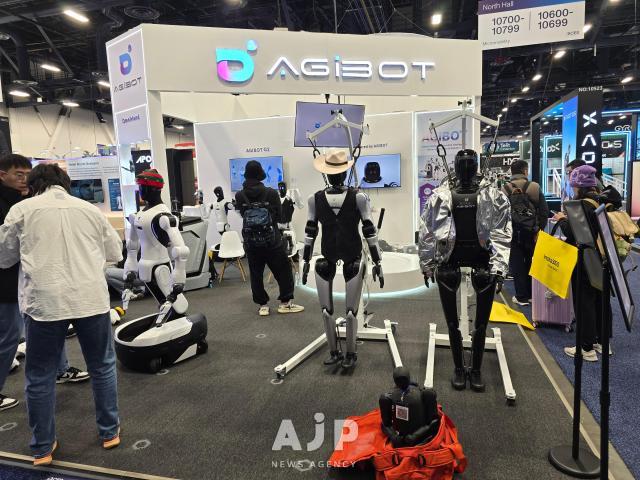
China arrived in Las Vegas with an unmistakable message: mass production is here. According to the Korea Information & Communications Technology Industry Association, Chinese companies account for 149 of the 598 robotics exhibitors at this year's show — roughly one in four. In humanoid robotics alone, 21 of 38 exhibitors hail from China, making up more than half.
The numbers reflect a coordinated national push. Morgan Stanley estimates that China has filed 7,705 humanoid-related patents over the past five years, compared with 1,561 in the United States. AgiBot recently rolled out its 5,000th humanoid robot, while UBTech Robotics plans to scale output to 10,000 units annually by 2027.
Irving Chen, general manager of Unitree Robotics, told AJP that while exact production figures for all models cannot be disclosed, monthly sales of its flagship Go2 quadruped robot have exceeded 10,000 units.
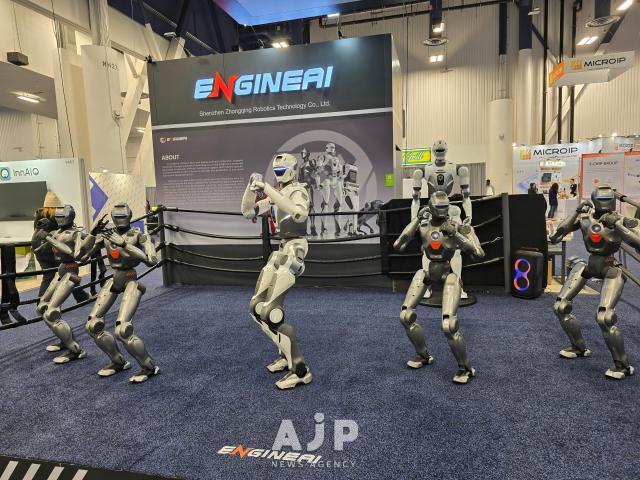
Shenzhen-based Engine AI showcased its T800 humanoid — a heavyweight model that rivals Tesla's Optimus and Boston Dynamics' Atlas.
Evan Yao, co-founder of Engine AI, said the company is producing about 200 units per month and plans to raise output to 500 units by the end of the first quarter. "The robot is open source, so it can be used for any purpose," Yao said, adding that the company is seeking a U.S. distribution partner.
The American approach looks markedly different. Rather than chasing humanoid aesthetics, U.S. firms are betting on purpose-built robots designed to solve specific problems.
Richtech Robotics demonstrated ADAM, a robotic barista, while Mammotion unveiled wire-free autonomous lawnmowers aimed at residential users. The common thread: efficiency over spectacle.
Realbotix offered another take on humanoids. "Our robots focus on customer service, entertainment and companionship — not physical labor," CEO Andrew Kiguel told AJP. The robots are already being used in senior homes, hotels, resorts and corporate events. The company assembles about five units per month and plans to triple capacity by the end of next year.
While not exhibiting at CES 2026, Tesla is accelerating development of its Optimus humanoid. CEO Elon Musk has set a long-term target of producing one million robots a year by 2030.
Korea's platform strategy

Hyundai Motor Group staged the first public demonstration of Atlas, developed by Boston Dynamics. The humanoid rose from the floor, walked across the stage and waved to spectators — a signal of readiness for industrial deployment.
"We are building robots that can be deployed directly on factory floors and evolve alongside business needs," said Zachary Jackowski, head of Atlas development at Boston Dynamics.
Hyundai aims to produce 30,000 robots annually by 2028. Atlas will be deployed at the group's Metaplant America facility in Georgia starting in 2028, initially for parts sequencing and classification tasks, before expanding to assembly by 2030.
LG Electronics introduced CLOiD, a home-assistant robot with two articulated arms and five-fingered hands. In a live demonstration, CLOiD opened a refrigerator, selected a drink, set an oven timer and handled laundry — illustrating LG's vision of a "Zero Labor Home," where machines take over repetitive chores.
Three philosophies, one race
The U.S. focuses on function, building robots tailored to specific commercial uses. Korea emphasizes integration, leveraging strengths in AI software, semiconductors and precision components to create platforms that tightly connect hardware and intelligence.
The stakes extend far beyond the exhibition floor. As robots move from research labs into factories and homes, the winners will shape how work is performed, how goods are manufactured and how daily life is organized.

Copyright ⓒ Aju Press All rights reserved.