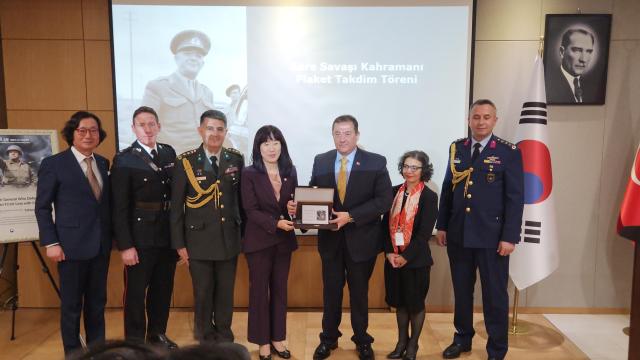
SEOUL, January 21 (AJP) - The Ministry of Patriots and Veterans Affairs held a ceremony on Tuesday to honor Brigadier General Tahsin Yazıcı, the Korean War commander of the Turkish Brigade, as the "Korean War Hero of the Month" for January 2026.
The Turkish Brigade, known by the code name "North Star" (Kuzey Yıldızı), arrived in the port city of Busan on October 17, 1950. Attached to the U.S. IX Corps, the brigade quickly earned a reputation for ferocity and resilience. Turkish soldiers were particularly noted for their effectiveness in close-quarters combat and their willingness to hold defensive lines against numerically superior forces, playing a pivotal role in protecting United Nations flanks during critical withdrawals.
Yazıcı was selected as the first international recipient of the ministry's newly expanded recognition program. While the "Korean War Hero of the Month" initiative has operated since 2011, it previously focused primarily on domestic veterans. Starting in January 2026, the ministry broadened the scope to select two individuals each month—one from the South Korean military and one from United Nations forces—to better publicize the contributions of the international community.
The commemoration took place at the Turkish Embassy in Seoul, where Vice Minister of Patriots and Veterans Affairs Kang Yun-jin presented a memorial plaque to Turkish Ambassador to South Korea Salih Murat Tamer.
During the ceremony, Vice Minister Kang emphasized that the recognition carried weight beyond a single commander.
"While we are honoring General Yazıcı as the hero for January, this is intended to express our gratitude to the entire Turkish contingent that fought in the Korean War, not just one individual," Kang said. "The government will never forget the sacrifices of the Turkish veterans."
Military historians credit Yazıcı with a critical delaying action against Chinese forces during the Battle of Wawon (Kunuri) in November 1950. When the U.S. 8th Army faced encirclement by a large-scale Chinese offensive in South Pyongan Province, Yazıcı made the independent decision—despite a lack of communication with higher command—to establish a defensive line. This action prevented the destruction of the allied flank and allowed U.S. forces to withdraw to safety.
His leadership was further demonstrated during the Battle of Kumyangjang-ni in January 1951. In the area of present-day Yongin, Gyeonggi Province, the Turkish Brigade engaged in hand-to-hand combat using bayonets to defeat a Chinese force estimated to be three times their size. The victory is widely regarded as a psychological turning point that dispelled the "invincible" image of the Chinese military among UN troops.
In his address, Kang highlighted the humanitarian legacy left by Yazıcı and his troops, specifically the establishment of the "Ankara School" and orphanage in Suwon in 1952.
"Even as the war was nearing its end, they created the Ankara School to care for and educate children, sharing beautiful humanity," Kang said. "It makes me realize where the term 'blood brothers' truly comes from."
Kang also announced a new bilateral initiative discussed with Ambassador Tamer. The ministry plans to collaborate with the Turkish government to formally review and preserve historical records related to the Ankara School, ensuring the story depicted in the movie "Ayla" is preserved.
Ambassador Tamer stated that the relationship between the two nations has evolved beyond a temporary military alliance into a "brotherhood" built on shared sacrifice.
"The friendship between Türkiye and the Republic of Korea goes beyond military cooperation established on the battlefields," Tamer said. "It has transformed into a strong, multi-dimensional strategic partnership built on sacrifice, resilience, and shared ideals."
Born in Monastir in 1892, Yazıcı was a veteran of World War I and the Turkish War of Independence. Before his deployment to South Korea, he was a pioneer in the Turkish military who established the army's first armored tank unit in 1934. He was known among his troops for his "fatherly compassion" and his willingness to remain on the firing line during combat.
Yazıcı retired as a major general in 1952 and served as a member of the Turkish parliament before his death in 1971.
Copyright ⓒ Aju Press All rights reserved.