
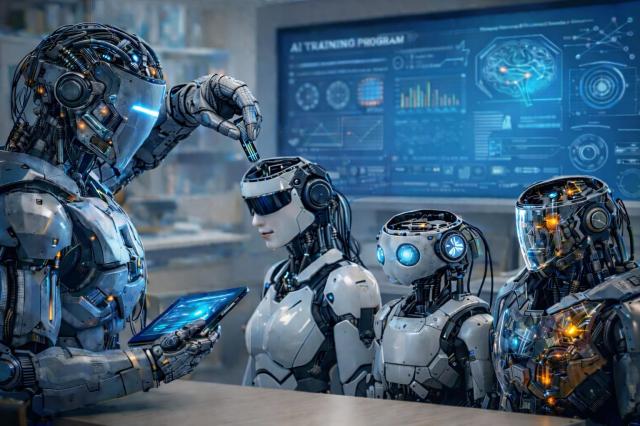
SEOUL, January 27 (AJP) - Researchers from the Korea Advanced Institute of Science and Technology (KAIST) and Korea University announced on January 27 that they have developed a new technology called TransMiter, which allows for the efficient transfer of learned knowledge between different artificial intelligence models. This innovation addresses the significant inefficiency of having to retrain high-performance AI models from scratch whenever a new version is released.
Currently, Vision-Language Models (VLM) like ChatGPT are rapidly advancing, allowing AI to understand both text and images. These models are pre-trained on massive datasets and can adapt to specific tasks using small amounts of additional data. However, if a user switches to a newer or different model, this adaptation process must be repeated, consuming vast amounts of computational power, time, and money. Existing techniques often fail if the model architecture changes even slightly, or they require running multiple models simultaneously, which increases memory costs.
The research team, led by Professor Kim Hyun-woo, developed TransMiter as a transferable adaptation technique that works regardless of a model's structure or size. The core of the technology is moving the adaptation experience gained by one AI directly to another. Instead of modifying the complex internal architecture of the AI, the system looks at the output and transfers the learned know-how to a new model.
By aligning the answers two different AI models provide for the same question, the researchers proved that the expertise of one model can be utilized by another immediately. This method eliminates the need for expensive backpropagation—the standard, repetitive process used to train AI parameters—and instead uses a simple linear alignment. This allows for nearly zero loss in inference speed and significantly lower training costs.
The significance of this study lies in being the first to prove that adaptation knowledge can be precisely transplanted across different types of AI. The researchers believe this could lead to a new era of knowledge patches for large language models, where specific expert knowledge can be added or updated in real time without full retraining.
Professor Kim Hyun-woo explained that this research could drastically reduce the cost of post-training required every time a new large-scale model is introduced. He noted that the technology enables a model patch system that easily integrates professional knowledge into existing systems.
The study included co-authors Song Tae-hun, a master's student at KAIST, Lee Sang-hyuk, a postdoctoral researcher at KAIST, and Park Ji-hwan, a doctoral student at Korea University. The findings were presented on January 25 at the Association for the Advancement of Artificial Intelligence (AAAI) 2026, a top-tier international conference in the field of AI, where it was selected for oral presentation with a highly competitive 4.6 percent acceptance rate.
(Paper information)
Journal: Association for the Advancement of Artificial Intelligence (AAAI) 2026 Title: Transferable Model-agnostic Vision-Language Model Adaptation for Efficient Weak-to-Strong Generalization
DOI: https://doi.org/10.48550/arXiv.2508.08604
Copyright ⓒ Aju Press All rights reserved.
