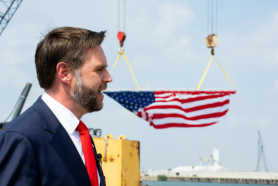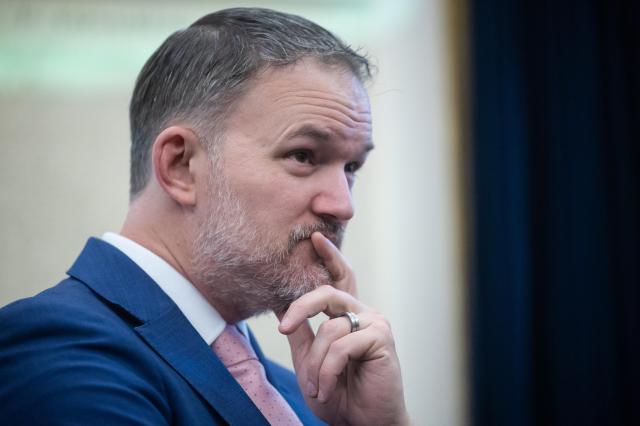
“We showed good faith by lowering our tariff rate on Korea from 25 percent to 15 percent,” Greer said.
“But they haven’t done their part—they haven’t passed the bill to support their investment, they’ve introduced new digital service laws, and they haven’t moved forward on agriculture or industry. It’s hard to keep our end of the bargain when they’re moving so slowly.”
The remarks come amid escalating trade tensions between the two allies. The U.S.–Korea Free Trade Agreement (KORUS FTA) Joint Committee, which was supposed to meet last December in Washington for the first time since last fall’s summit, has been postponed indefinitely after Washington demanded “more concrete proposals” from Seoul on non-tariff barriers and digital regulation.
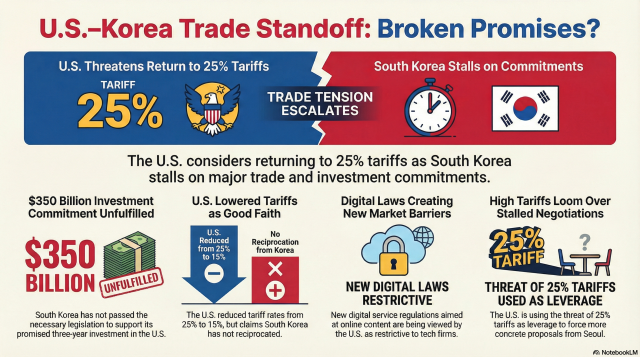
Trump, speaking during a campaign stop in Iowa on Tuesday, doubled down on his approach, saying that the threat of 25% tariffs has been effective in prompting other countries to return to the negotiating table.
“When we mention tariffs, they move,” Trump said, suggesting that the policy remains a core component of his negotiation strategy.
Strategic Leverage or Economic Self-Harm?
Some experts view the move as an example of Trump’s reliance on tariff threats as leverage, a strategy largely absent from modern U.S. trade diplomacy.
“President Trump is using tariffs as political and economic pressure in ways we haven’t seen before,” said J. Lawrence Broz, chair of the Department of Political Science at the University of California, San Diego.
“Publicly singling out Korea’s National Assembly personalizes the dispute and justifies unilateral escalation. But protectionism harms U.S. consumers and distorts resource allocation—it’s economically counterproductive in the long term.”
Broz added that the episode underscores the eroding influence of multilateral trade institutions like the WTO, which were designed to restrain powerful countries from acting unilaterally in trade conflicts.
Domestic Politics in Play
Other analysts suggested political motivations may also be at work.
Eric A. Langenbacher, a professor at Georgetown University, noted that two rival bills are currently before South Korea’s National Assembly to create a mechanism for the pledged investments.
“The timing may not be coincidental,” he said. “Trump might be trying to break the legislative impasse in his own way. His policy messages often follow from the most recent conversation he’s had, so the key question is—who raised the South Korean issue to him, and to what end?”
Langenbacher added that it remains unclear whether Trump has a preferred political faction in South Korea, but drew parallels with his administration’s past signals of support for European right-wing populist parties, suggesting that “this might be a way to tilt the domestic debate.”
Copyright ⓒ Aju Press All rights reserved.