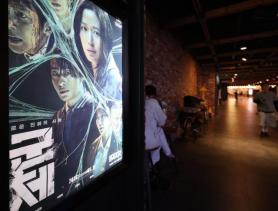
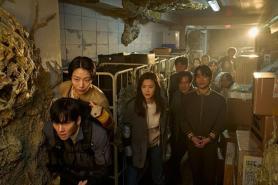
![20일 오후 서울 송파구 롯데시네마 월드타워점에서 열린 영화 '군체 VIP시사회'에 감독과 출연 배우들이 참석해 포즈를 취하고 있다. 사진 왼쪽부터 연상호 감독, 전지현, 구교환, 신현빈, 지창욱, 김신록, 고수. 2026.05.20[사진=유대길 기자 dbeorlf123@ajunews.com]](https://image.ajunews.com/content/image/2026/05/27/20260527172947472718.jpg)
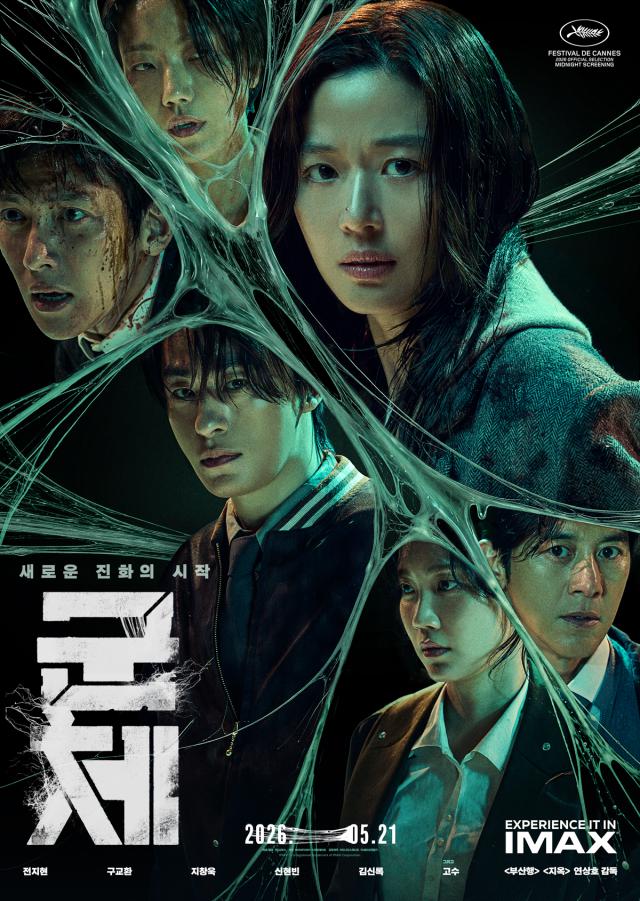
SEOUL, May 27 (AJP) - Summer heat in Korea brings horror season, and this year's bar-raiser is "Colony," Yeon Sang-ho's latest zombie thriller, which drew more than 2.1 million admissions in its first six days.
The film claimed 39.9 percent of advance reservations across 1,858 screens nationwide, prompting inevitable comparisons to Yeon's 2016 breakout "Train to Busan," which sold 11.5 million tickets and pushed Korean zombie cinema onto the global stage.
Yeon, however, frames "Colony" as a rupture rather than a sequel in spirit.
At a press conference at CGV Yongsan IPark Mall, the director said the film breaks from "Train to Busan," "Seoul Station" and "Peninsula" by training its lens on the zombies themselves.
"In 'Seoul Station,' 'Train to Busan' and 'Peninsula,' the stories came from putting classic zombies into new spaces," he said. "'Colony' is about the zombies. In a sense, it's the first film I've made where they are the protagonists."
The shift is more than perspectival. In "Colony," the infected mutate quickly, moving and communicating as a coordinated collective.
"It's a confrontation between zombies with collective intelligence and humans," Yeon said. "The zombies begin in a primitive state and evolve rapidly, while humans devolve from civilization into savagery. What remains after that devolution — that, I thought, might be the core of humanity. That was the image I wanted to draw."
If "Train to Busan" made Korean zombies famous for their speed, "Colony" makes them frightening for their coordination.
The zombie is no longer simply an infected body. It is a network.
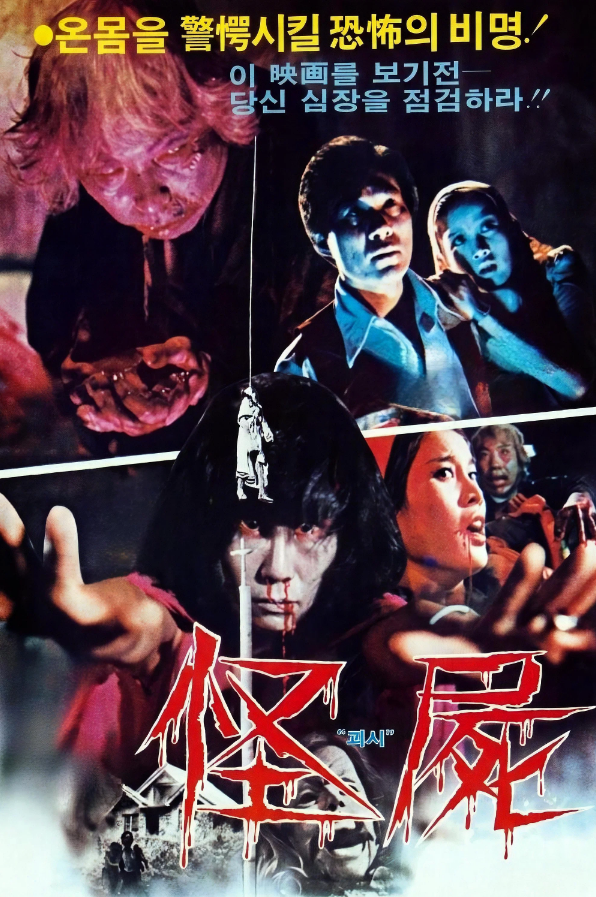
For decades, Korean horror lived in the register of ghosts — resentment, unresolved grief, the vengeful woman in white, haunted school corridors, broken family homes. Gang Beom-gu's "A Monstrous Corpse," often cited as Korea's first zombie film, surfaced in the early 1980s, but the genre remained marginal for years. Its later ascent tracked the country's anxieties: the 1997 Asian financial crisis brought mass unemployment and a deep distrust of institutions, and popular culture began imagining collapse in collective rather than spectral terms.
The pivot has only sharpened in recent years, with Korean horror trading supernatural vengeance for infection, social breakdown and mass panic.
Set inside a sealed building during a mysterious outbreak, "Colony" follows survivors as they face infected beings whose behavior evolves unpredictably. The title nods to biology — a colony being a group of organisms functioning as a single unit.
The film's quiet provocation is that the infected are not mindless.
Aaron Kim, a 20-year-old university student from Edinburgh visiting Seoul, said he hadn't planned to see a Korean zombie film on his trip, but a Korean friend persuaded him.
"In most zombie films I've seen, zombies have no mind. They just kill indiscriminately," Kim said. "In 'Colony,' they have intelligence. I realized how unsettling that could be."
He found the film fresher than the genre fare he was used to abroad.
"Zombie films overseas tend to follow a similar pattern," he said. "Korean zombies feel new. They run fast, and they're not simple."
Kim gave the film an eight out of 10 and likened its central conceit to artificial intelligence.
"The more people use AI, the more data feeds into one system, and the more powerful it gets," he said. "The zombies in 'Colony' felt like that. Each one seemed to be part of a larger circuit that kept learning."

Jiyoon Lee, a 20-year-old student based in New York, said the film parts ways with predecessors like "Train to Busan" and "Kingdom."
"In those, people turn into zombies because of a virus, and they attack aggressively but without thought," Lee said. "In 'Colony,' the zombies seem to have a clear purpose — to spread the virus. They build a kind of collective intelligence through their own communication network and move together. That was chilling."
Both reactions point to one of the defining traits of Korean zombie cinema: speed. Since "Train to Busan," K-zombies have been fast, violent and physically overwhelming.
But speed alone doesn't account for their pull.
Korean zombie stories tend to plant contagion in dense, socially loaded spaces — trains, schools, apartment complexes, sealed buildings — amplifying the dread that there is nowhere to run because there is nowhere outside.
That separates K-zombies from much of the Western tradition shaped by George A. Romero, which often asks what remains after civilization falls. Korean zombie stories ask the inverse: how quickly can a society unravel while everyone is still trapped inside it.
Film critic Lee Ji-hye said K-zombie narratives draw much of their force from the emotional ties they implicate.
"Korean zombie stories often hinge on the idea that a beloved family member or friend has become a monster," Lee said. "Existing bonds are woven into the narrative, which makes the story far more immersive."
Grief and guilt, she said, are routinely fused to infection.
"There's a tendency to attach collective guilt or sorrow to the fact that someone has become a zombie," Lee said. "The story makes room for mourning."
That emotional undertow runs through the canon: "Train to Busan" wove family sacrifice into class friction; "Kingdom" set infection against royal politics, famine and state failure; "All of Us Are Dead" turned a high school into a theater of bullying and survival; "Happiness" used a quarantined apartment complex to dissect fear and hierarchy.
Institutional collapse, Lee added, is rarely background scenery.
"Korean zombie works tend to weigh the breakdown of social systems, the incompetence of government in a crisis, bureaucracy and human selfishness — not just zombies chasing people," she said.
Unlike the jiangshi — the hopping corpse of 1980s Hong Kong cinema, rooted in Taoist folklore — Korean zombies are modern disaster figures, shaped by infection, institutions and the pressures of crowded urban life.
With "Colony," the genre takes another step. The fear is no longer just the speed of the dead. It is an enemy that learns, coordinates and, in doing so, holds up a mirror to the society it consumes.

Copyright ⓒ Aju Press All rights reserved.