According to government sources on Wednesday, the allies are considering 2028 as the most realistic timeline, aiming to complete the handover during the respective terms of South Korean President Lee Jae Myung and U.S. President Donald Trump.
Ahead of the SCM, the two sides plan to complete verification of Full Operational Capability (FOC), the second stage in the three-step OPCON transition process, and seek formal approval from their defense chiefs.
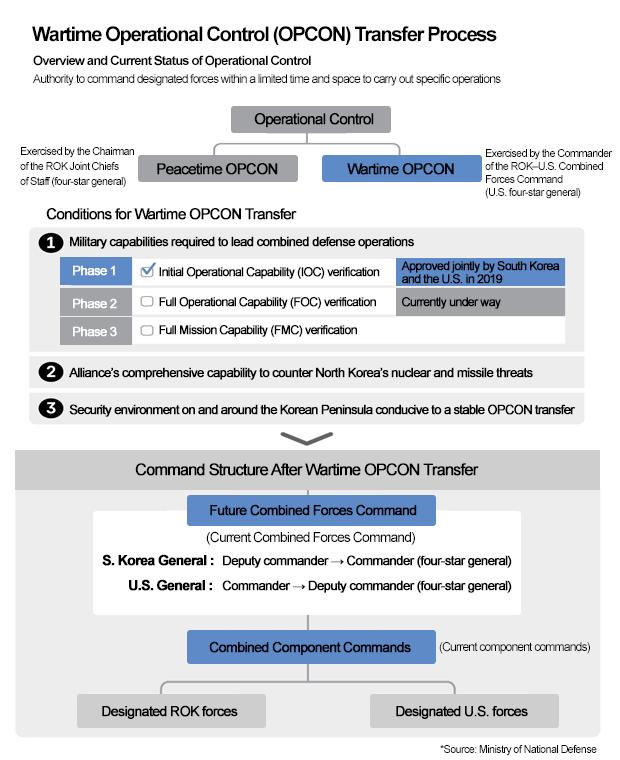
The transition consists of three phases: Initial Operational Capability (IOC), Full Operational Capability (FOC) and Full Mission Capability (FMC). Having completed the FOC evaluation, the allies are now in the final verification stage, with only confirmation of the future Combined Forces Command reportedly remaining.
Once the FOC results are approved, the defense ministers are expected to announce a target year for the transfer. With Trump’s current term ending in January 2029, 2028 is viewed as the most viable option.
Following the announcement, the allies will move to the final FMC phase, during which the precise timing of the handover will be determined. While FOC involves extensive quantitative assessments, FMC relies more on qualitative judgments, making political leadership a decisive factor.
Lee has repeatedly expressed his determination to complete the OPCON transfer during his term. Trump, who has consistently urged allies to shoulder greater security responsibilities, is also regarded as supportive of the transition.
Under the 2026 National Defense Strategy released last month, Washington emphasized that South Korea should, as much as possible, take primary responsibility for countering North Korea’s conventional threats. The document describes South Korea as a country with high defense spending, a strong defense industry and a conscription-based military, capable of defending itself with “critical but more limited” U.S. support.
If FMC verification begins in 2027 as expected, the long-delayed OPCON transfer—often described as a two-decade-old task for the alliance—could be realized in 2028.
The process gained momentum in 2005, when the Roh Moo-hyun administration formally proposed the transfer. In 2014, under the Park Geun-hye administration, Seoul and Washington agreed to pursue a conditions-based transition without a fixed timetable.
Under that agreement, the transfer depends on three conditions: South Korea’s ability to lead combined operations, the alliance’s capacity to counter North Korea’s nuclear and missile threats, and a security environment conducive to a stable transition.
To support verification this year, the allies plan to proceed with the Freedom Shield exercise, scheduled for March 9–19, with a crisis management drill from March 3–6.
Freedom Shield is a command post exercise designed to rehearse combined operational plans through simulations of a full-scale conflict on the Korean Peninsula. It covers scenarios ranging from defensive and counteroffensive operations to securing weapons of mass destruction.
Pyongyang has repeatedly condemned the drills as “war rehearsals,” and retaliatory provocations, including missile launches, cannot be ruled out during the exercise period.
Against this backdrop, observers say Seoul is likely to adopt a low-key approach, as it did during last year’s Ulchi Freedom Shield exercise, by issuing conciliatory messages in advance. At last year’s opening ceremony, Lee stressed the importance of inter-Korean relations, and the joint statement notably avoided references to “North Korea,” “threat” and “provocation.”

Copyright ⓒ Aju Press All rights reserved.