SEOUL, February 25 (AJP) - Still a far cry from the replacement-level fertility rate of 2.1, South Korea’s total fertility rate, which bottomed out in 2023, inched above the long-cited 0.70 level last year, data showed.
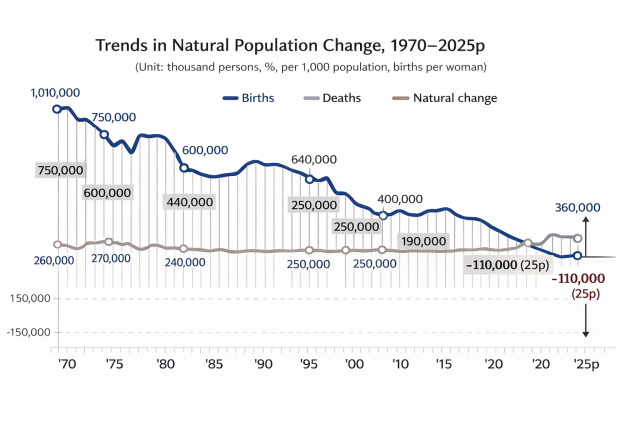
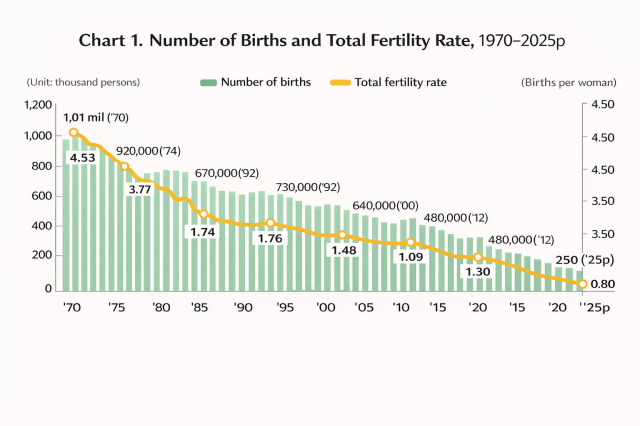
According to the Ministry of Data and Statistics on Wednesday, the number of births in 2025 reached 254,500, up 16,100 from a year earlier, or 6.8 percent — the largest annual increase since 2007.
The total fertility rate — the average number of children born to a woman over her lifetime — rose to 0.80, the highest since 2021, from 0.72 in 2023 and 0.75 in 2024.
Marriage registrations increased 1 percent in 2023, 14.8 percent in 2024 and 8.9 percent in 2025. In December alone, marriages rose 13.4 percent year on year to 25,527.
“Births in Korea are still overwhelmingly tied to marriage,” said Kang Hyun-young, an official in charge of birthrate policy at the ministry.
“In our data, increases in marriages typically precede increases in births by one to two years,” she said. “The rise in marriages since 2023 is now being reflected in birth figures.”
While declining to provide a numerical forecast for 2026, Kang said the sustained expansion in marriages was “a statistically meaningful positive signal.”
Demographic timing: the early~1990s cohort
Women aged 30 to 34 recorded 73.2 births per 1,000 women in 2025, the highest among all age groups. Fertility among women aged 35 to 39 rose 13.0 percent from a year earlier, reaching a record level.
“Women born between 1991 and 1995 have entered their early 30s, which is the peak childbearing age group,” Kang said. “That cohort expansion has contributed to the increase in total births.”
She added that the population of women in their early 30s has been rising since 2021, exerting upward pressure on aggregate birth totals.
Survey data suggest shifting social attitudes may also be playing a role.
In 2024, 68.4 percent of respondents said couples should have children after marriage, up from 65.3 percent in 2022. The share saying childbirth without marriage is acceptable rose to 37.2 percent from 34.7 percent.
“Multiple factors are interacting,” Kang said. “Policy measures cannot be excluded, but their individual effects cannot be statistically isolated.”
She emphasized that the recent rebound reflects “overlapping demographic, social and behavioral dynamics,” rather than any single policy intervention.
Later childbirth, continued population decline
Despite the improvement, structural challenges remain.
The average maternal age rose to 33.8 years, while births to women aged 35 and older accounted for 37.3 percent of total births — the highest share since records began in 1981.
Deaths totaled 363,400 in 2025, exceeding births by 108,900. South Korea has recorded negative natural population growth every year since 2020.
Regional disparities were also evident. Seoul’s fertility rate stood at 0.63, while South Jeolla Province recorded 1.10.
Kang said the trend should be monitored closely on a month-by-month basis.
“The increase in marriages over the past three years provides a foundation,” she said. “But whether the trend continues depends on demographic structure and ongoing social changes.”
For now, the data point to a tentative stabilization after years of decline — but not yet a reversal of South Korea’s long-term depopulation.

Copyright ⓒ Aju Press All rights reserved.