
The move is being praised as a step toward narrowing the gap between prime contractors and subcontractors. But it is also fueling concerns that it could disrupt established bargaining practices. Because shipbuilding is highly cyclical, pledges to match bonus rates could become a financial burden during downturns.
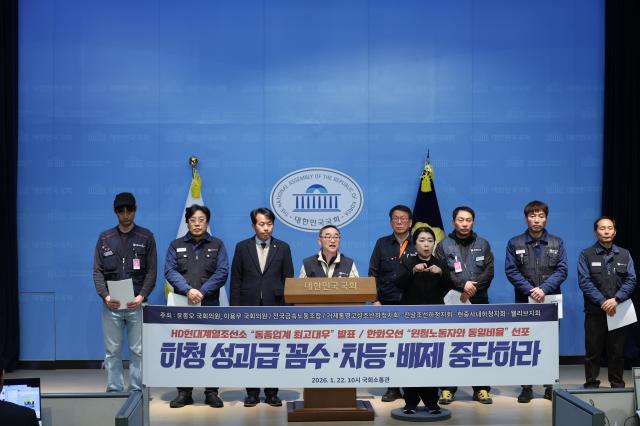
Industry officials said Feb. 12 that demands are spreading to “match bonus payout rates” between prime contractors and subcontractors. Four subcontractor branches of the Korean Metal Workers’ Union — Geoje-Tongyeong-Goseong Shipbuilding Subcontractors Branch, Jeonnam Shipbuilding Subcontractors Branch, Hyundai Heavy Industries In-House Subcontractors Branch and Weliv Branch — held a news conference at the National Assembly last month, arguing that subcontractor bonuses are far smaller than the average for regular employees and calling for broader adoption of equal bonus rates.
The union said Hanwha Ocean’s announcement that it would pay the same bonus rate to in-house partner-company employees “reflects a long-standing demand at worksites and is an entirely natural decision.” It said HD Hyundai Heavy Industries and Samsung Heavy Industries, which it described as benefiting from a shipbuilding boom, should also improve performance compensation for subcontractor workers.
The union said that while regular employees at prime contractors receive year-end bonuses worth tens of millions of won, subcontractor workers typically receive only a few million won.
The shipbuilding industry’s top three companies have posted sharply improving results. Last year, the combined operating profit of South Korea’s “big three” shipbuilders was close to 6 trillion won. HD Korea Shipbuilding & Offshore Engineering, the intermediate holding company for HD Hyundai Group’s shipbuilding business, reported operating profit of 3.9045 trillion won, up 172.3% from a year earlier.
Hanwha Ocean and Samsung Heavy Industries posted operating profit of 1.1091 trillion won and 862.2 billion won, respectively. Combined revenue for the three companies also topped 50 trillion won.
Companies say stronger earnings do not automatically justify larger bonuses. They point to the industry’s volatility, where profitability can swing sharply with the order cycle. During the prolonged downturn that began in the mid-2010s and lasted nearly a decade, Daewoo Shipbuilding & Marine Engineering was sold to Hanwha Group, and other shipbuilders also faced existential pressure.
Rivals have reacted with unease to Hanwha Ocean’s decision. HD Hyundai Heavy Industries has postponed subcontractor bonus payments that had been planned for December to February. It plans to pay its direct employees bonuses of about 800% this month.
HD Hyundai’s total bonus payout is far larger than Hanwha Ocean’s, meaning labor costs could rise significantly if a standard takes hold requiring equal bonus rates for prime contractors and subcontractors.
Samsung Heavy Industries has also faced renewed controversy over bonuses. It has paid the same bonus rate to prime contractors and subcontractors, but the amount varies by years of service, and the overall bonus level is the lowest among the big three shipbuilders, the union has said.
Lee Byeong Hun, a sociology professor at Chung-Ang University, said Hanwha Ocean’s case has had a positive impact on the labor market as management and regular employees moved to improve pay, treatment and bonuses for partner-company workers. He added that, especially after the Yellow Envelope Act takes effect, demands led by subcontractor unions are likely to intensify.
* This article has been translated by AI.
Copyright ⓒ Aju Press All rights reserved.