
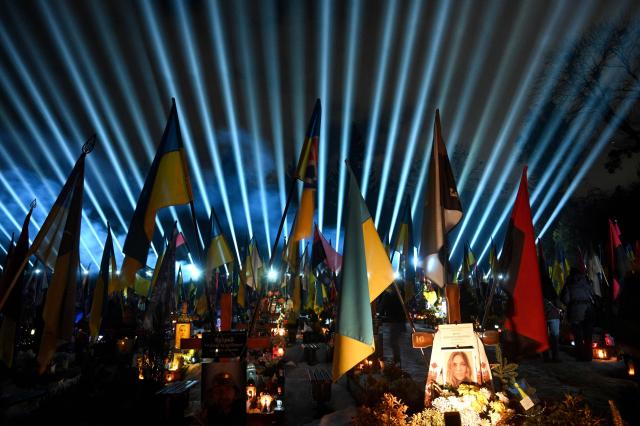
[This opinion editorial piece was published by the European Union Delegation in the Republic of Korea, and was signed by the EU Ambassador and Ambassadors of Belgium, Bulgaria, Czechia, Denmark, Germany, Estonia, Ireland, Greece, Spain, France, Croatia, Italy, Latvia, Lithuania, Luxembourg, Netherlands, Austria, Poland, Portugal, Romania, Slovenia, Slovakia, Finland, Sweden]
SEOUL, February 24 (AJP) - Today, the world marks the fourth year since the start of Russia's large-scale invasion of Ukraine. After four years of war, 2026 must be the year the war comes to an end. The European Union’s view is crystal clear. We want peace in Ukraine, and we want this peace to last. Peace must be just, durable, credible and consistent with international law. Whether aggression is rewarded or rebuffed will either encourage or discourage aggressors in other regions, including the Indo-Pacific.
But still today, Russia is intensifying its attacks and targeting and killing civilians every day. Last year was the deadliest for Ukrainian civilians since the full-scale invasion. Russia’s bombing of Ukraine's energy infrastructure has left millions of people facing darkness, cold, and water shortages during the coldest winter since 2022. This must end.
Ukrainians continue to demonstrate incredible resilience, and they deserve peace. Since the beginning of the war, the Republic of Korea has been an ally and friend. Last year, at the high-level meeting of the United Nations Security Council on the maintenance of international peace and security on Ukraine, Foreign Minister Cho reaffirmed Korea’s “unwavering commitment to respect for internationally recognized borders, and in particular, to upholding the sovereignty, independence, and territorial integrity of Ukraine”. All UN member states must uphold the UN Charter, as the cornerstone of the international order. How this war ends will further shape the future standing of these principles, already under immense test elsewhere.
To compound its disregard for international law and commitments, Russia has engaged also in wide-ranging military cooperation with North Korea. The transfer of ballistic missiles, ammunition, and even troops constitutes a flagrant violation of multiple UN Security Council resolutions, that Russia itself had supported. These transfers not only prolong the war in Ukraine; they also provide North Korea with funds, military experience, and technical insights that contribute to advance its illegal nuclear and ballistic missile programmes and lead to escalatory behaviour. This cooperation undermines the global non-proliferation regime and raises serious security concerns on the Korean Peninsula. At the UN, European countries and other like-minded partners have joined Seoul in condemning these violations of the UN Charter.
Just like the Republic of Korea, we, members of the European Union, want peace in Ukraine, and we want this peace to last. Peace must be durable, credible, and consistent with international law, which protects countries large and small — both in Europe and in the Indo-Pacific.
The European Union stands fully behind Ukraine and is actively contributing to the US-led peace efforts, in coordination with partners.
As discussions continue, the EU’s priorities remain clear. First, any agreement should deliver a just, stable and lasting peace. And it should ensure real security.
Second, we must uphold Ukraine's sovereignty. There cannot be a unilateral carving up of a sovereign nation state. Borders cannot be changed by force anywhere in the world.
Third, we must secure Ukraine's financial needs, so that it can continue defending itself, be in a position of strength at the negotiation table and rebuild what Russia has destroyed.
Since February 2022, the EU has stood united in its unwavering support for Ukraine. We are providing substantial political, economic and military support to Ukraine, while isolating Russia and implementing an ever-widening net of sanctions directed against Russia’s war machine.
Most recently, in December 2025, The EU has decided on a loan of €90 billion for 2026 and 2027 for Ukraine. With this support, we want to make sure that Ukraine can bolster its defence on the battlefield; strengthen its defence capabilities for a peace agreement; and keep running basic services, including water, heating and electricity. We have reaffirmed Europe's commitment to the security, defence, and European future of Ukraine. This should serve as a stark reminder to Russia and a message to the world: Europe will always stand with Ukraine.
The EU is very grateful to the Republic of Korea for its humanitarian aid for Ukraine. During this extremely difficult winter, Ukraine urgently needs more equipment for the rapid restoration of power, heating, and water supply, as well as air defence. We call on all our partners, including the Republic of Korea, to strengthen their support to Ukraine and contribute to easing the suffering of its people.
The implementation of sanctions is also a very important part of what the international community can do for Ukraine. In 2024, the Republic of Korea announced a significant expansion of its export controls against Russia and Belarus. These restrictions are not merely symbolic. They prevent the transfer of many advanced technology items, helping to weaken Russia’s military capabilities, including those that are criminally used to destroy apartment buildings, energy and other civilian infrastructure
The principles at stake in Ukraine — sovereignty, territorial integrity, respect for international law — matter to all of us, whether in Europe or the Indo-Pacific. As in the days of the Korean war, the international community must come together to stop the aggression and the suffering. Let us work together so that 2026 is the year Russia abandons its imperialistic goals, ends its unprovoked aggression and engages in a lasting peace in Ukraine.
Copyright ⓒ Aju Press All rights reserved.
