
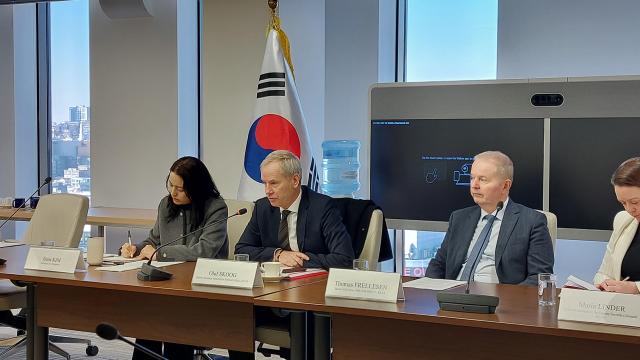
Olof Skoog, Deputy Secretary General for Political Affairs at the European External Action Service, said the EU was willing to assist if requested on the issue of North Korean soldiers captured by Ukrainian forces while fighting alongside Russia.
“Of course, they should not have been there in the first place, because this is an illegal war,” he said, referring to North Korean troops deployed to support Russia. “But I understand the humanitarian concern.”
"We'll see how we can be helpful," he said, during a press briefing at the EU delegation office in central Seoul, as he expects the issue to be raised during his meetings in Seoul.
Two North Korean soldiers captured in the Kursk region have previously expressed their intention to defect to South Korea through handwritten letters delivered to civic groups.
Skoog also criticized Russia’s continued attacks on civilian infrastructure in Ukraine, particularly energy facilities, saying Moscow was attempting to undermine public morale.
“Unfortunately, Russia does not seem willing to seriously engage in peace efforts,” he said, adding that the EU, the United States and Ukraine had presented proposals aimed at ending the war.
He stressed that the EU would continue pressing Russia through sanctions and diplomatic pressure while increasing support for Ukraine.
“This is a peace effort, not a war effort,” he said. “We are asking partners to keep up the pressure on Russia and maintain support for Ukraine.”
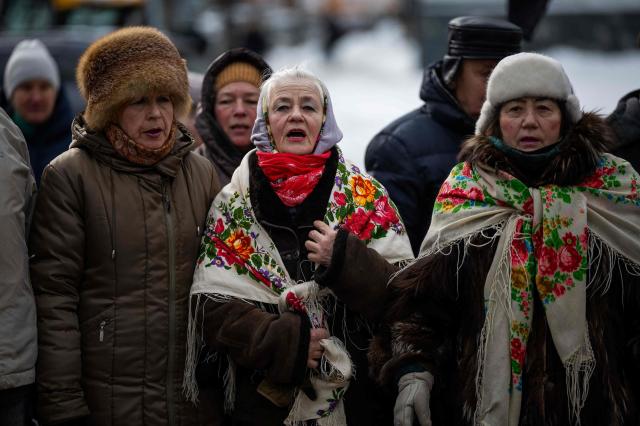
Skoog said Europe was being forced to take greater responsibility for its own security, partly due to what he described as reduced U.S. commitment to defending the continent.
“We are stepping up the defense of our own countries and Europe,” he said, adding that this shift was reshaping EU foreign and security policy.
He described the world as entering a period of “geopolitical disorder,” four years into Russia’s full-scale invasion of Ukraine, and said that strengthening partnerships with like-minded countries was now central to Europe’s strategy.
Korea, he said, is among the EU’s closest strategic partners in this effort.
“We consider Korea one of our most important partners in defending the multilateral system and the rules-based order,” Skoog said.
He said discussions in Seoul would cover cooperation in cybersecurity, hybrid threats, maritime security, supply chain resilience and energy security.
Europe, he added, is seeking to reduce dependence on external powers for critical resources and infrastructure.
“We have seen how energy and raw materials can be weaponized,” he said, citing China and Russia. “We are trying to make ourselves less dependent on such practices.”
Skoog also pointed to growing European interest in South Korean defense products as EU member states sharply expand military spending. “Many European countries believe Korea has very impressive capabilities,” he said.
“There is strong interest in purchasing arms and defense systems from Korea.”
He said the defense market in Europe was “huge” as governments raise budgets and seek advanced technologies not readily available within the continent.
While emphasizing that the EU is not a military alliance like NATO, Skoog said Brussels is encouraging member states to “spend more and better” on security.
He also rejected concerns that Europe is turning inward economically.
“Europe is not protectionist,” he said. “We are negotiating free trade agreements like never before, and most products enter our market with no tariffs.”
Skoog said Western sanctions were having a growing impact on Russia’s economy, noting that Moscow was depleting financial reserves. However, he acknowledged that the measures had not yet altered the Kremlin’s strategic calculations. “Sanctions are working, but they are still not enough,” he said. “We need to do more.”
He called on partner countries, including South Korea, to help monitor and enforce sanctions more effectively, particularly against Russia’s so-called “shadow fleet” used to evade restrictions on oil and trade.
He also urged closer cooperation on implementing United Nations sanctions against North Korea.
“We have learned a lot about monitoring and stopping Russia’s shadow fleet,” he said. “There is more we can do together to ensure that North Korea is not helping to feed the Russian war machine.”
During his visit, Skoog is scheduled to hold a Korea-EU high-level political dialogue with Vice Foreign Minister Chung Eui-hye and meet with Foreign Minister Cho Hyun and Unification Minister Chung Dong-young to discuss regional security and bilateral cooperation.
Copyright ⓒ Aju Press All rights reserved.
