
If the conflict drags on, Hyundai’s planned Middle East production base — targeted to begin operations in the fourth quarter — could also be delayed. The unexpected shock of the U.S.-Israel and Iran war is also clouding Hyundai’s goal of reaching a 20% market share in the region by 2030.
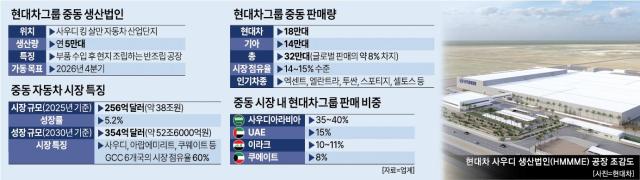
According to industry officials on the 9th, Hyundai and Kia sold about 320,000 vehicles in the Middle East last year, maintaining a market share of roughly 15%. The region accounts for about 8% of their global sales, making it their fifth-largest market after North America, Europe, India and South Korea. The Middle East market is a three-way contest among South Korea, China and Japan: Toyota ranks first with about 450,000 vehicles a year, Hyundai and Kia are second, and third place is held by multiple Chinese EV brands including Chery Automobile.
Hyundai has focused on the Middle East because of its growth. The regional auto market is valued at $25.6 billion and is projected to expand 5.2% annually to $35.4 billion by 2030 — more than 1.5 times the global auto market’s average growth rate of about 3%. The GCC accounts for 60% of the market and Iran 40%. Hyundai and Kia plan to raise annual Middle East sales to 550,000 vehicles by 2030, centered on Saudi Arabia, positioning the region as a growth market alongside India and Latin America.
The war, however, could derail those plans. If it becomes prolonged, operations at Hyundai’s Middle East manufacturing unit, being built with Saudi Arabia’s Public Investment Fund and slated for a fourth-quarter start, are expected to face setbacks. The plant is designed to produce 50,000 vehicles a year, including internal combustion models and EVs, and is reported to be about 50% complete.
Because the facility is to run on a complete knockdown, or CKD, model — importing parts for local assembly — it must complete staffing and the setup of parts and equipment up to six months in advance. “Skilled workers are essential for stable CKD operations, but if the war continues, it becomes nearly impossible to put key personnel in place,” an auto industry official said. “Hyundai Motor Group’s core strategy of countering U.S. high-tariff pressure by expanding Middle East sales is now under threat.”
A bigger concern is a potential contraction in regional demand and shipping. Toyota plans to cut production by 40,000 vehicles to prepare for possible logistics disruptions. Hyundai has also temporarily halted shipping schedules from its India unit, HMIL, to the Middle East as the closure of the Strait of Hormuz has continued for more than 10 days.
A Hyundai official said that if the war is prolonged, delays in transporting equipment and materials are expected to be unavoidable. “Because this situation could have a significant impact on key local markets such as Saudi Arabia and the UAE, we are strengthening monitoring,” the official said.
* This article has been translated by AI.
Copyright ⓒ Aju Press All rights reserved.