
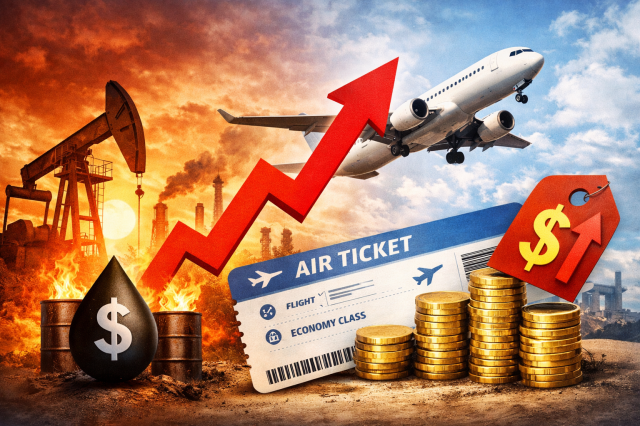
Geopolitical risks tied to the Middle East have increased airlines’ exposure to oil-price swings, and the burden is expected to be heavier for low-cost carriers that do not have fuel hedging contracts. Airfares are also expected to rise from April and May.
According to industry officials on Wednesday, the so-called LCC Big 3 — Jeju Air, Jin Air and T’way Air — do not currently have separate fuel hedging contracts. Other low-cost carriers also do not have such contracts.
A fuel hedging contract is a type of derivative used when buying jet fuel on a relatively mid- to long-term basis. It sets both upper and lower price limits to reduce management risk from later price fluctuations, helping airlines cushion costs when oil prices are volatile.
With international oil prices rising in the wake of the Middle East war, low-cost carriers without hedges face higher costs. The global average jet fuel price in the first week of March was $157.41 a barrel, up about 58.4% from the previous week. In the last week of February, it was $99.40 a barrel, up 3.6% from the prior week, before the increase accelerated.
The rise is expected to feed into higher ticket prices. Korean airlines have already announced they will raise domestic-route fuel surcharges in April to 7,700 won from 6,600 won in March. That calculation included only a single day — Feb. 28, the first day of U.S. and Israeli airstrikes on Iran — and oil prices have surged since then, raising expectations that May surcharges will jump sharply.
April fuel surcharges for international routes are also expected to be announced soon, with a larger increase anticipated than for domestic routes because longer flights make fuel a bigger share of ticket prices. The April international surcharge is calculated using average jet fuel prices from Feb. 16 to March 15, meaning it is more likely to reflect the impact of the Middle East war.
The exchange rate is another variable because fuel is paid for in U.S. dollars. As the dollar strengthened on concerns that high oil prices could persist due to the war, the won-dollar exchange rate rose to 1,495.5 won on March 9, nearing the 1,500-won level. With high oil prices and a weak won overlapping, losses at low-cost carriers already struggling with weak results are expected to widen.
An airline official said low-cost carriers are believed to be unable to buy derivatives given the amount of jet fuel they consume annually. The official said they are instead responding by ordering slightly more fuel than needed when placing orders with fueling companies.
* This article has been translated by AI.
Copyright ⓒ Aju Press All rights reserved.