SEOUL, May 7 (AJP) — South Korea’s foreign exchange reserves rebounded in April after a brief contraction a month earlier, as gains in foreign-currency assets fueled by a stronger U.S. dollar helped offset pressure from authorities’ won-defense operations, the central bank said Thursday.
According to monthly data from the Bank of Korea (BOK), the country’s foreign exchange reserves stood at $427.88 billion at the end of April, up $4.22 billion from the previous month, when reserves had fallen by $3.97 billion.
The figure nevertheless is still short of $428 billion at the end of December.
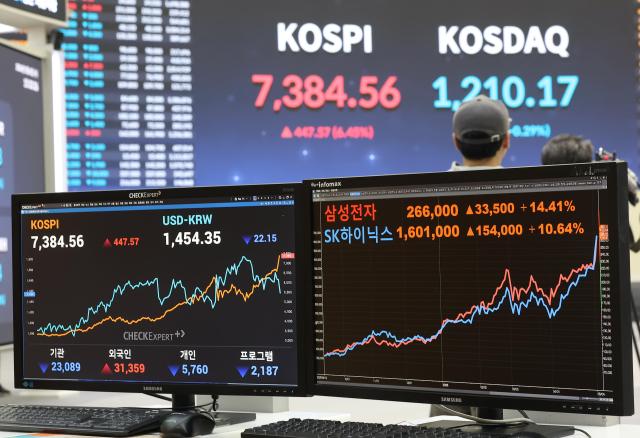
Improved foreign investment flows also helped stabilize the foreign exchange market. Foreign investors, who had net-sold 40.4 trillion won worth of KOSPI shares in March, turned net buyers of 1.2 trillion won in April.
Net foreign purchases of Korean bonds also rose to 7.8 trillion won from 5.4 trillion won a month earlier.
The BOK noted that the market capitalization of KOSPI shares held by foreign investors surged from about 1,513 trillion won ($1.03 trillion) at the end of March to 2,060 trillion won ($1.41 trillion) by the end of April, reflecting both renewed inflows and a rebound in asset values.
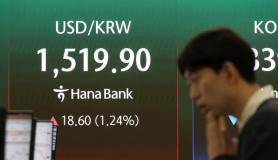
The Korean won also recovered against the U.S. dollar, with the exchange rate strengthening from 1,530.1 won per dollar at the end of March to 1,483.3 won at the end of April.
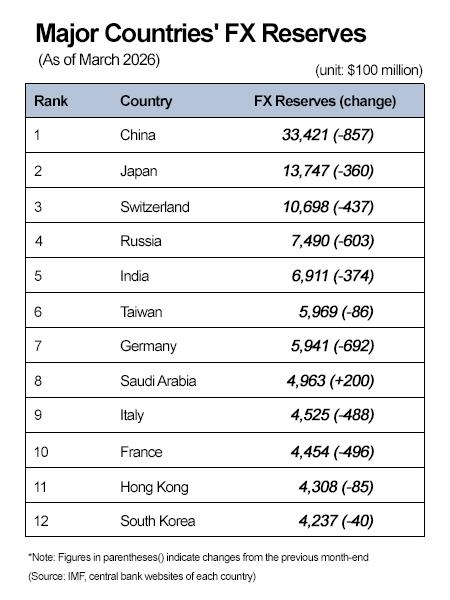
South Korea held the world’s 12th-largest foreign exchange reserves as of the end of March.
The central bank added that South Korea’s relatively limited gold holdings and the use of currency swap arrangements with the National Pension Service (NPS) helped reduce the need for direct spot-market intervention, limiting the pace of reserve depletion compared with some other countries.
Like South Korea, many major economies spent billions of dollars to support their currencies during the initial phase of the Middle East conflict-driven market turmoil.

Copyright ⓒ Aju Press All rights reserved.