
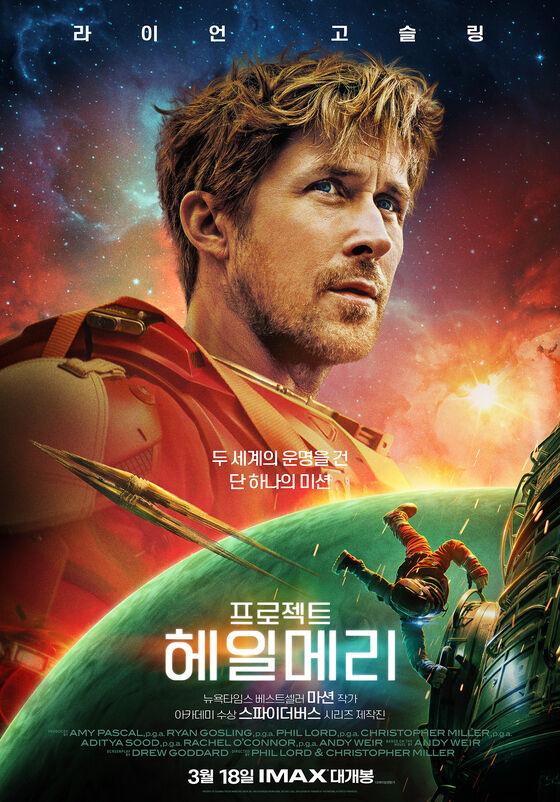
Ryland Grace (Ryan Gosling) wakes up in deep space with no memory and first confronts a blunt reality: He is completely alone. He denies what is happening, mourns dead crewmates and wavers under the strain. But he has a mission he cannot abandon — to save humanity from an extinction-level threat.
Even so, 'Project Hail Mary' is not easily described as a straightforward space survival story. What it holds onto is less the grandeur of the assignment than the way one man changes as he connects with someone else.
At the start, Grace is no conventional hero. He fears death and never fully warms to the idea of sacrificing himself for the greater good. He has no one on Earth he is desperate to protect. He has become an academic outsider for refusing to bend on an unpopular view, but he is not driven by a sweeping sense of destiny. He is, instead, a stubborn scientist focused on research and teaching.
That begins to shift when he encounters an alien being, Rocky. At first, the bond looks like survival instinct: another life form in an unfamiliar void, and a situation that makes reaching out feel necessary. The film pushes the relationship beyond mere cooperation. As they learn each other’s language systems and come to understand culture and habits, Grace’s demeanor changes in visible ways.
What may begin as the thrill of first contact grows into something deeper. As they grasp each other’s worlds and circumstances and share the burden of survival and return, their connection strengthens. Grace learns what it means to endure with someone — a sense of solidarity he did not have before.
The film’s point becomes clear: A man who could not choose death for all humanity is willing to step into danger for one being — Rocky. A vast cause could not move him to the end, but a relationship could. With nothing to protect, he could not risk his life for anyone. Once he is genuinely connected to another, he becomes someone who can finally give himself up.
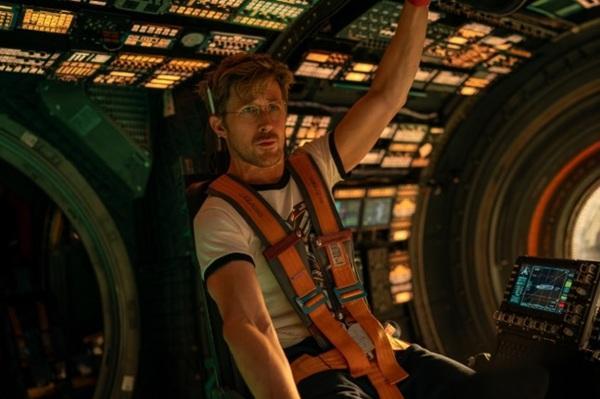
For that reason, 'Project Hail Mary' uses space as its setting but plays more like a story about forming a bond. For some viewers, that will be both strength and weakness. Those expecting a spectacle-driven adventure or fast pacing may find it loose and subdued, because the film favors emotional movement and accumulated connection over strict scientific rigor. Some stretches clearly drag.
Still, it does not easily lose momentum, largely because of the sensory rhythm built by Phil Lord and Christopher Miller. Storybook color, detailed production design and an OST arranged with theme-park variety help keep the narrative from becoming suffocating. Even with cosmic isolation as the backdrop, the film avoids sinking too far into gloom because of that directorial touch.
Most striking is the way the film uses a futuristic setting to return to one of the oldest values: solidarity, community and the will to hold on together. Feelings that can sound dated are given specific warmth through Grace and Rocky’s relationship.
In the end, what 'Project Hail Mary' offers is not a grand slogan about love for humanity. It is the quieter shift of coming to understand someone — and realizing you do not want to lose them. The film argues that what moves a person to the end is not always a mission to save the world, but sometimes a single being.
* This article has been translated by AI.
Copyright ⓒ Aju Press All rights reserved.