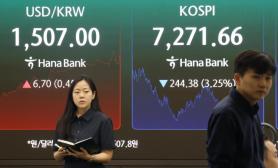
The combined net profit of domestic banks stood at 6.7 trillion won ($4.56 billion), down 300 billion won, or 3.9 percent, from the same period last year, Financial Supervisory Service (FSS) said Wednesday.
Net profit for nationwide commercial banks stood at 4.3 trillion won, ticking up 100 billion won, or 1.6 percent, year-on-year, but a detailed breakdown showed that the growth of internet-only banks — such as KakaoBank, K-Bank, and Toss Bank — buffered the overall performance.
Net profit for internet-only banks jumped 45.3 percent - from around 200 billion won in the first quarter of last year to 300 billion won in the first quarter of this year. Net profit at core nationwide commercial banks, in contrast, slid 0.6 percent from 3.8 trillion won to 3.7 trillion won, while regional banks' net profit growth flattened with a mere 10 billion won increase.
Interest income continued its upward march. Domestic banks' interest income for the first quarter reached 15.8 trillion won, up 1 trillion won, or 6.4 percent, from a year earlier. This expansion was fueled by a 4.8 percent year-on-year increase in interest-bearing assets, such as loan receivables, alongside a rise in the net interest margin (NIM) from 1.53 percent to 1.56 percent.
The expansion of banks' interest income is analyzed to be aligned with the recent upward trend in household debt. Household lending by commercial banks in the first quarter swung to a 200 billion won decline in the first quarter from the previous quarter, whereas lending by non-bank depository institutions surged by 8.2 trillion won, according to the Bank of Korea's Tuesday release.
The quarterly increase in housing-related loans within the non-bank sector widened from 6.5 trillion won in the fourth quarter of last year to 10.6 trillion won in the first quarter of this year.
However, skyrocketing market interest rates weighed heavily on bank profitability. Domestic banks' non-interest income plummeted 35.6 percent year-on-year to 1.3 trillion won.
The FSS attributed the decline to widening valuation losses on marketable securities following the spike in market interest rates. Gains related to marketable securities swung from a 2.4 trillion won surplus to a 1.2 trillion won deficit, while valuation profits on securities plummeted from a 1.4 trillion won surplus to a 1.8 trillion won loss.
The financial watchdog evaluated that skyrocketing bond yields were the primary catalyst for the widening deficits. The three-year benchmark government bond yield, which had dipped 1.9 basis points at the first quarter of 2025, surged 60.6 basis points from the end of last year to hit 3.557 percent as of late March, maintaining its weakening trend.
With the 30-year U.S. Treasury yield hovering at 5.2 percent — its highest level in approximately 19 years since 2007, just ahead of the global financial crisis — South Korea's three-year government bond yield rose by more than 4 basis points during Wednesday's morning session to hit 3.8 percent. The 10-year yield climbed roughly 6 basis points to the 4.27 percent mark, extending the market's downward momentum.
The return on assets (ROA) dipped 0.07 percentage points year-on-year to 0.64 percent, while the return on equity (ROE) also slid 0.89 percentage points to 8.68 percent. The deteriorating indicators underscore a widespread contraction in the banks' earnings capacity.
Credit losses and provisions, meanwhile, fell 16.2 percent year-on-year to 1.4 trillion won. Banks appear to have averted a worst-case scenario for now, as bond valuation losses stemming from rate volatility have exerted a more pronounced impact on bank earnings than widening defaults or non-performing loans.
Given rising internal and external uncertainties, the FSS stated that it will guide banks to bolster their loss-absorption capacities to ensure financial soundness even in the face of unexpected shocks.

Copyright ⓒ Aju Press All rights reserved.