
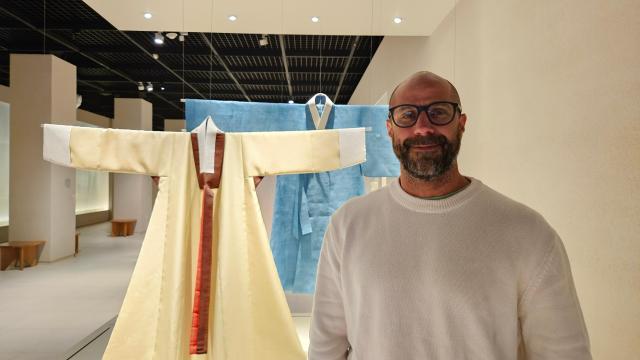
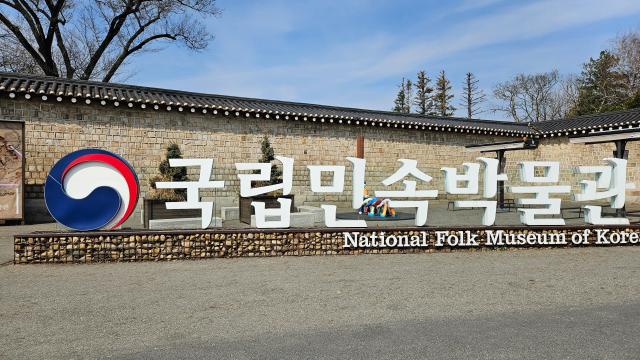
On ordinary days, that stop is the National Folk Museum of Korea.
Museums have been enjoying a surge in popularity, fueled in part by last year’s “K-pop Demon Hunters” hype and a broader global appetite for cultural immersion.
The National Museum of Korea drew more than 6.5 million visitors last year, placing it alongside institutions like the Louvre and the Vatican Museums among the world’s most visited.
The Folk Museum alone welcomed 2.28 million visitors, and nearly 60 percent of them foreigners.
The appeal begins the moment visitors step inside.
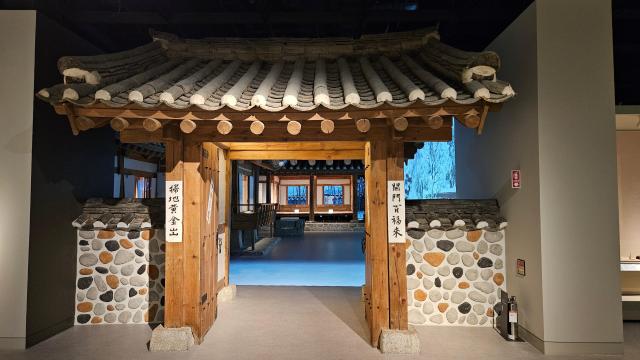
The entrance hall hums with motion.
A group of French tourists leans into a digital display animating a traditional Korean village. Nearby, American college students mirror the gestures of a projected folk dance, their laughter echoing under the high ceiling.
“I liked the interactive dance exhibit the most,” said Will, a 28-year-old visitor from Washington, still tracing the choreography with his hands. “It felt very interactive,” his friend added. “You could really immerse yourself in the experience.”
Unlike traditional museums that rely on dense timelines and academic explanations, the Folk Museum organizes its exhibits around life itself — birth, childhood, marriage, aging and death — woven through the rhythm of seasons.
The approach is deliberate.
“If we just display objects by era, it can be difficult for foreigners to connect,” a museum official said. “But when we show how people lived — what they celebrated, how they raised children — those are experiences everyone can understand.”
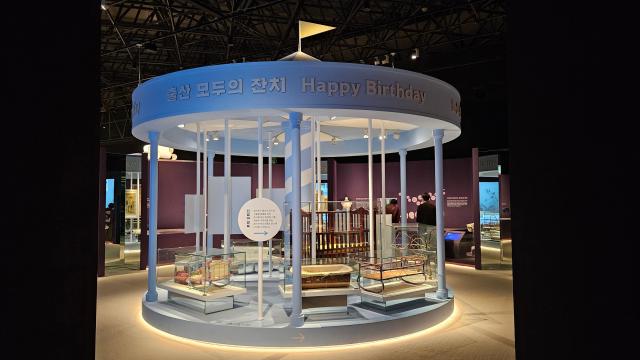
That philosophy is perhaps most vividly expressed in a special exhibition titled “Happy Birthday.”
The gallery explores childbirth as both a personal and communal milestone. Among more than 300 artifacts are a delicate baek-il jeogori, worn by infants on their 100th day, and a father’s handwritten parenting diary, its careful script conveying quiet devotion. At the center stands the Cheonin Cheonjamun, a book of a thousand Chinese characters, each written by a different person — a symbol that a child is raised not by parents alone, but by an entire community.
For some visitors, the resonance is immediate. “Everything here is beautiful,” said Tiago, a 42-year-old architect from Portugal now living in Angola, pausing before a display of traditional wooden furniture. “There’s a simplicity, but also a deep sense of purpose.
Others point to something more subtle: accessibility. The museum’s layout is intuitive, its signage clear, and its exhibits cohesive — qualities that make it easy to navigate even for first-time visitors unfamiliar with Korean history.
That accessibility has helped position the museum as part of a broader cultural circuit.
Tourists often visit it alongside nearby landmarks such as Gyeongbokgung Palace, the National Museum of Korea and the National Museum of Modern and Contemporary Art, creating a curated day-long journey through Korean heritage.
Lee Yourim, who has run a café near the museum for a decade, sees this pattern daily.
“A lot of people visit several places in one course,” she said. “They go to the palace, then the museum, then somewhere else nearby.” She added that foreign visitors frequently praise the museum’s family-oriented programs, especially those designed for children.
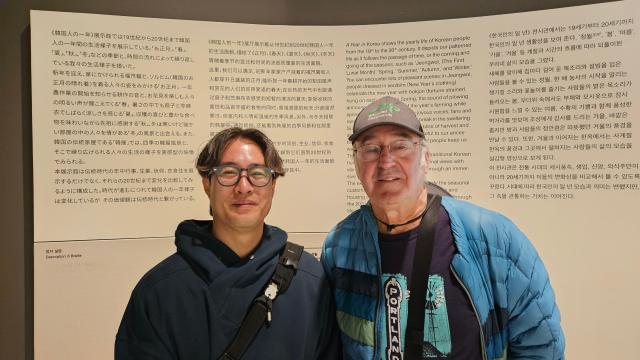
Steve Lebwohl, a 76-year-old businessman from Portland, Oregon, the museum’s strength lies in its storytelling. “The architecture is simple but functional,” he said.
“What stands out is the content — the way it covers seasons, birth, dance. It gives you background and context on things that foreigners are curious about.” “It’s a rounded exhibit for a national museum,” he added.
His son-in-law, Oh Hanbin, a Korean American, offers a more personal perspective. He has brought his children to the museum not just as tourists but as participants in a kind of cultural inheritance.
“We wanted to show them how their halmeoni and harabeoji grew up,” he says, using the Korean words for grandparents.
“There aren’t many places in Portland where you can experience Korean culture like this.”
Copyright ⓒ Aju Press All rights reserved.
