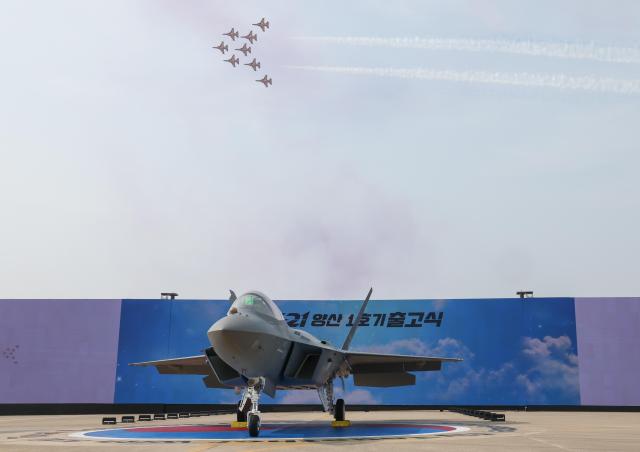
Adding to its renewed strategic appeal, KAI rolled out its first mass-produced KF-21 Boramae fighter jet on Wednesday.
Hanwha Aerospace disclosed in its latest business report that it holds a 4.41 percent stake in KAI, or 4.86 million shares. Including an additional 0.58 percent held by affiliate Hanwha Systems, the group’s total stake stands at 4.99 percent — just shy of the 5 percent threshold that would trigger stricter disclosure requirements.
The precision of that stake has fueled market speculation.
By stopping short of the reporting threshold, Hanwha appears to be pursuing a calculated strategy to secure influence while avoiding early scrutiny. Industry officials describe the move as a classic case of “stealth accumulation,” often seen as a prelude to a larger acquisition attempt.
The market widely interprets the stake as an opening move toward a potential takeover.
If realized, such a deal would allow Hanwha to build an integrated defense structure spanning platforms and core systems — a long-standing gap in its portfolio.
Hanwha has steadily expanded its defense footprint in recent years. It has built strength in land systems through Hanwha Aerospace, precision-guided munitions and radar through Hanwha Systems, and naval capabilities through its 2023 acquisition of Hanwha Ocean.
Yet aircraft platforms remain the missing piece — an area dominated by KAI.
As the country’s only aircraft platform manufacturer, KAI produces the KF-21 fighter, FA-50 light combat aircraft and Surion helicopters. Hanwha, by contrast, has largely remained a component supplier, providing engines and radar systems while relying on KAI for system integration and export negotiations.
“Securing a stake in KAI could transform this dependence into a partnership and, over time, allow Hanwha to internalize platform technologies,” said Jeong Kyung-woon of the Korea Association of Military Studies.
However, Hanwha is unlikely to move unchallenged.
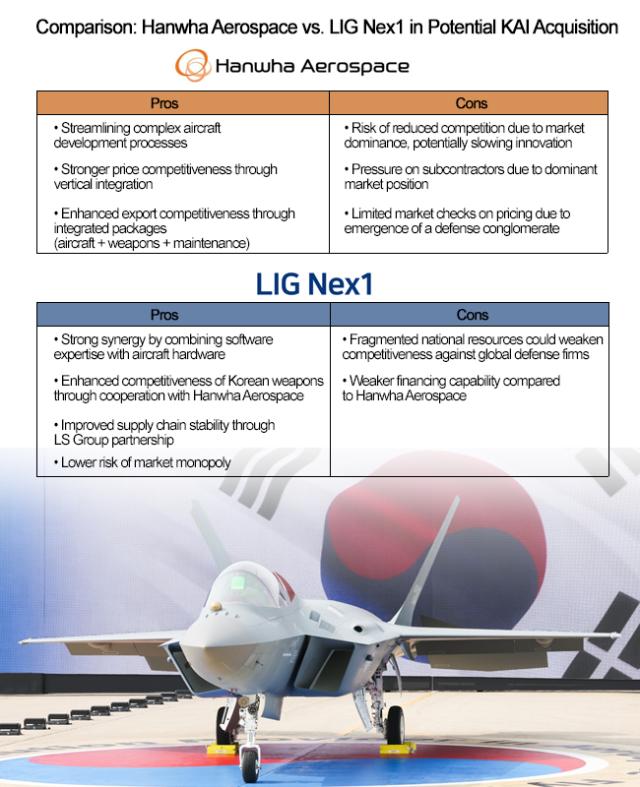
The combination would bring together missile systems, radar and communications with LS’s strengths in armored vehicle components.
Still, financial capacity remains a key differentiator.
LIG Nex1, despite record sales exceeding 4 trillion won ($2,667 billion) in 2025, holds roughly 1 trillion won in cash, compared with more than 10 trillion won held by Hanwha Aerospace — underscoring a clear gap in acquisition firepower.
KAI itself remains effectively state-controlled despite being publicly listed.
The Export-Import Bank of Korea holds a 26.41 percent stake, while the National Pension Service owns 8.20 percent. Privatization has been discussed for decades but repeatedly delayed due to political sensitivities and valuation concerns.
Hanwha’s current position could make it a leading contender should the government decide to divest.
Although the policy bank has said it has no immediate plans to sell, it has left open the possibility of consultation with the government — keeping the door ajar.
Recent moves suggest Hanwha may already be preparing. Hanwha Systems’ sale of its stake in Hanwha Ocean, reportedly worth about 1.7 trillion won, is seen as a step to secure funding for a larger strategic acquisition.
The intensifying competition reflects broader shifts in the defense industry, where demand for advanced aircraft, missiles and space-based capabilities is rising alongside geopolitical tensions.
As warfare expands beyond traditional domains, control over aerospace platforms is increasingly emerging as the decisive factor shaping the next generation of defense power.
Hanwha Aerospace rose 4.9 percent to close at 1,400,000 won, while LIG Nex1 jumped 14.5 percent to 734,000 won.

Copyright ⓒ Aju Press All rights reserved.