
Net dollar sales for “market stability” surged to $22.47 billion in the fourth quarter, the Bank of Korea said in its disclosure of its intervention balance sheet — a sharp escalation from $1.75 billion in the third quarter, $797 million in the second and $2.96 billion in the first.
The October-December interventionist spending is the largest three-month record since disclosure started in 2019.
The intervention brought total spending for the year to roughly $28 billion, the largest since 2022 when authorities struggled to tame the won amid Legoland debt crisis from rapid tightening in the U.S.
The won averaged 1,450.71 per dollar in the first quarter, strengthening modestly to 1,399.13 in the second and 1,386.77 in the third, before weakening sharply to 1,448.87 in the fourth — when intervention intensified.
“Supply-demand conditions were extremely skewed in the fourth quarter. Outflows by residents far exceeded the current account surplus,” Yoon Kyung-soo, director of the BOK's international department said in a briefing.
“In October alone, overseas securities investment by residents was roughly three times the size of the current account surplus," he added.
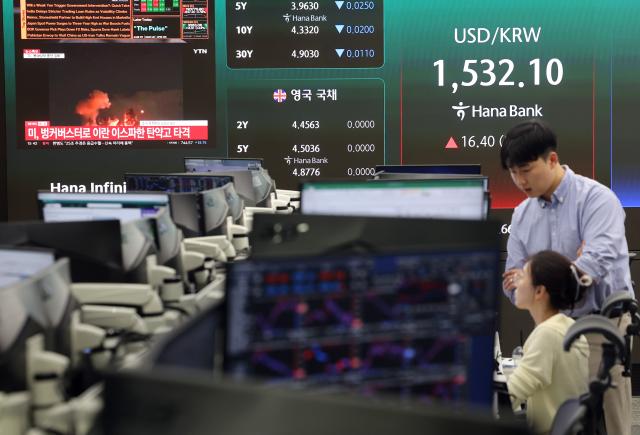
The won lifted partly by dollar retreat and intervention gave ground after the war in the Middle East broke out. The dollar briefly touched 1,530 won, revisiting the level of March 2009 amid global financial crisis in Tuesday trading. The won has lost more than 6 percent of its value against the dollar, double the gain in the dollar index over the same period.
Authorities said they were "closely monitoring" if one-sided bias deepens and the won's depreciation is deemed too steep versus other currency movements.

Copyright ⓒ Aju Press All rights reserved.
