SEOUL, May 19 (AJP) - The Han River has always cut Seoul in two. Rising from the Taebaek Mountains and emptying into the Yellow Sea, it served for millennia as Korea's commercial artery — grain barges, merchant boats, wartime supply lines threading through the heart of the peninsula.
Then the expressways came, the subway came, and the river was quietly pensioned off into a parkland backdrop while the roads above filled up and stayed that way. Anyone who has sat on the Olympic-daero at 8 a.m. watching the minutes tick by knows exactly how that arrangement has worked out.
Last September, Seoul decided the river had been idle long enough.
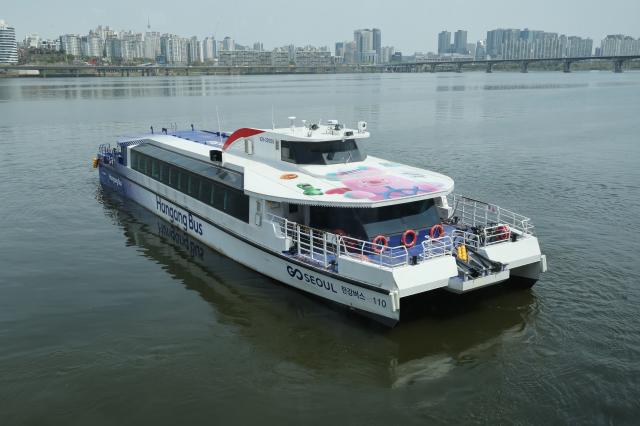
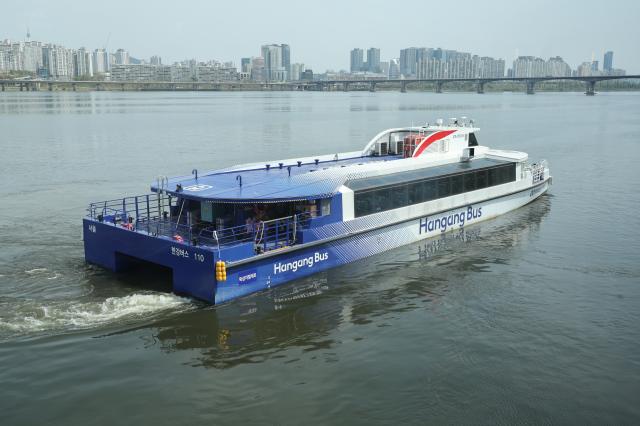
The Hangang Bus — Seoul's new water transit service — connects seven docks stretching from Jamsil in the east to Magok in the west, running hybrid-electric vessels along a route that doubles, depending entirely on your disposition, as either a commute or a sightseeing cruise.
The full end-to-end journey runs about 75 minutes; an express service linking Magok, Yeouido and Jamsil cuts that to around 54. The adult fare is 3,000 won — teenagers pay 1,800 won, children 1,100 won — and the service integrates with Seoul's T-money transit system and Climate Card, meaning you can transfer from the subway and barely notice the seam.
Getting here wasn't entirely smooth sailing. The project was announced in late 2023, a joint operating company was incorporated in mid-2024, and most of 2025 was spent in trial runs and regulatory preparation before commercial operations finally began on September 18. Since then, more than 270,000 passengers have climbed aboard — enough to suggest that Seoul was, in fact, ready for this.
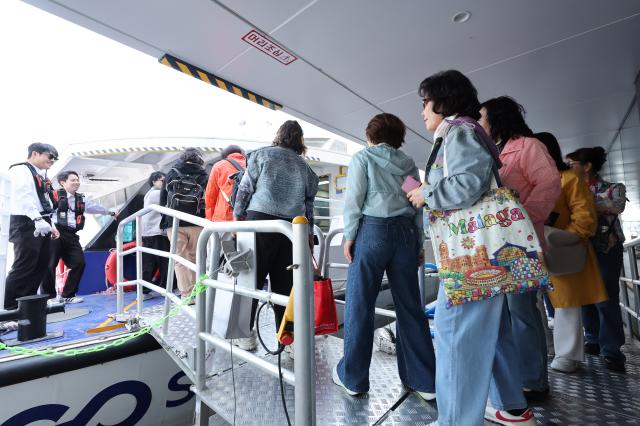
On a Tuesday morning at Jamsil Dock, the floating terminal had the low-key energy of a platform unsure whether it was transit or tourism and had decided, sensibly, not to choose. Passengers stood with paper tickets and transit cards.
Some looked out toward the water. The boat arrived at 9:45 with no particular fanfare, and by 10 a.m. it had slipped away from the dock without a horn or a whiff of diesel — just the city, suddenly visible on both sides at once.
That, it turns out, is the whole trick.
From the middle of the Han, Seoul reorganizes itself. The south bank presents its polished face: gleaming high-rises, newly built riverside towers, the architectural confidence of a city that has decided it likes what it's become.
The north bank is quieter — older residential areas, large apartment complexes sitting less showily along the water. Most Seoulites see the river from one shore.
From the Hangang Bus, you're the center line. The bridges overhead become landmarks rather than obstacles; the gaps between them, brief windows of open sky.
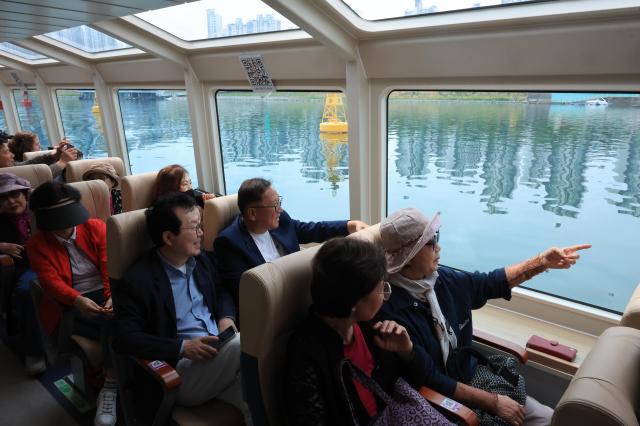
The boat itself is closer to a commuter ferry than a leisure cruise. Seats are arranged in rows, a small snack counter divides the fore and aft sections, and an electronic display up front shows current location, weather, temperature and fine dust levels.
Life jackets and emergency equipment line the floating gangway. It is, in other words, properly set up — neither a tourist novelty rigged for Instagram nor a purely functional workhorse. Somewhere usefully in between.
Passing under Banpo Bridge, a sign read "7.75m." The concrete span filled the view for a long moment. The boat passed beneath with the unhurried confidence of something that does this every few hours and has stopped thinking about it.
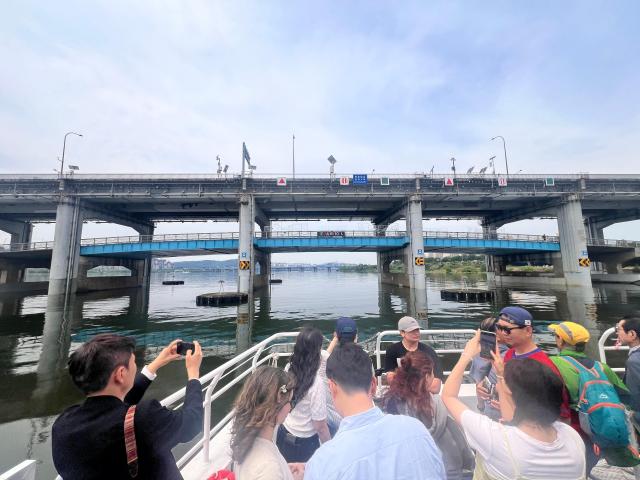
On board, the mood divided neatly between pragmatists and romantics.
Lee Nu-rim, a 21-year-old soldier on leave, was using the service as an actual commute. He'd spotted it through a social media advertisement and realized his route home happened to match the Apgujeong-to-Yeouido leg.
"It felt like I could enjoy the Han River and get home at the same time," he said.
He probably wouldn't take it every day, he admitted — partly because not all vessels have the upper deck seen in promotional materials, and seats fill quickly — but the fact of it clearly pleased him.
Foreign visitors skipped the ambiguity entirely and called it what it looked like.
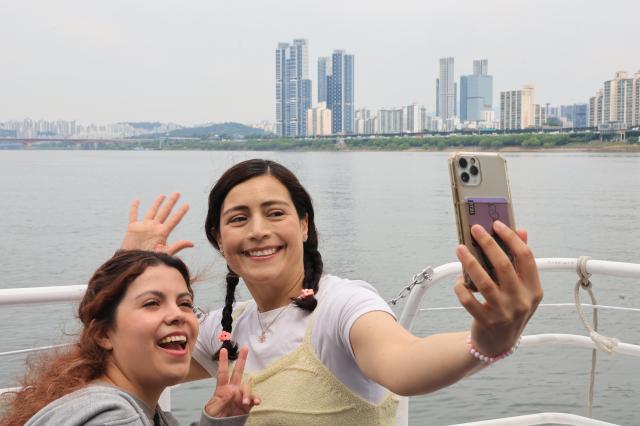
Kei, 32, from the UK, said it was "lovely" to travel by river through a new city — visitors usually move through streets and landmarks, he noted, and rarely get time to slow down and take the water in.
Anna, 29, from Mexico, was quietly amazed by the price. "In my country, something like this would cost much more," she said, which is almost certainly true of most countries.
Cristtel, 45, also from Mexico, put the whole proposition most cleanly: "People are used to moving fast now, so maybe it is not for everyone's daily commute. But if you are not in a rush and want to enjoy the scenery, this is exactly right."
She could have written the brochure. Seoul Tourism could do worse than to hire her.
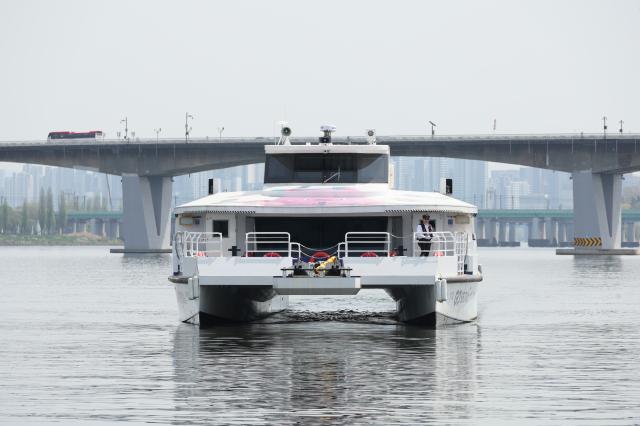
By the time Yeouido came into view — the golden 63 Building catching the morning light and throwing it in long streaks across the water, doing what old landmarks do when they want you to remember them — the 70-minute ride had accomplished something Seoul's subway system, for all its legendary frequency and coverage, structurally cannot: it had slowed the city down.
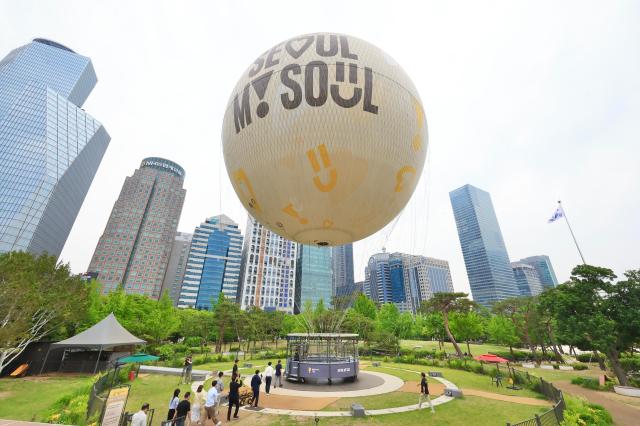
At nearby Yeouido Park, another novel ride in Seoul was waiting.
Between KBS and the financial district, a giant white sphere stood over the grass. The words “SEOUL MY SOUL” and a smiling face were printed on its surface. From a distance, it looked like a piece of city branding. Up close, it resembled a childhood amusement park ride enlarged to an almost unreal scale.
This was SEOULDAL, a tethered helium balloon that rises up to 130 meters above Yeouido. The official materials describe it as a 22-meter-wide full-moon-shaped gas balloon. Each ride takes about 15 minutes from boarding to landing, with a maximum capacity of 20 passengers depending on weather conditions. The adult fare is 25,000 won.
Before boarding, staff explained the safety rules. The balloon cannot operate in poor weather or strong winds. That explanation felt abstract on the ground. It became much more concrete once the door closed.
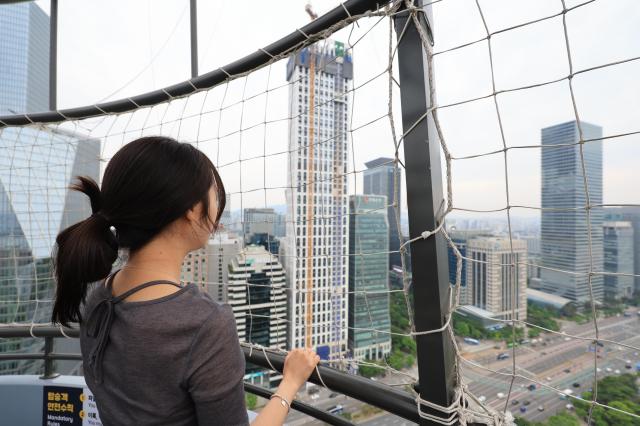
The passenger platform was shaped like a doughnut, open to views on all sides. That meant the ground was visible almost everywhere. For anyone afraid of heights, the design was not entirely comforting.
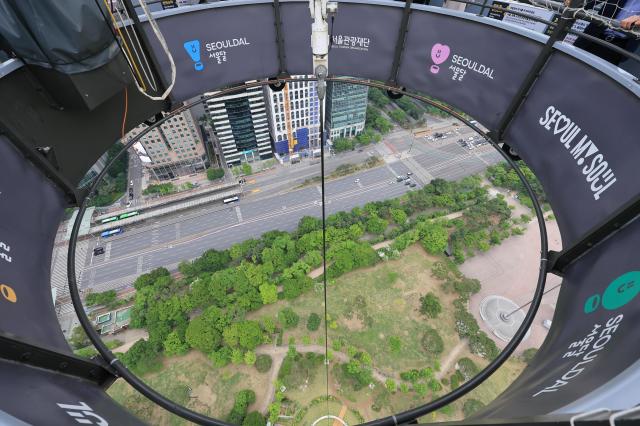
As the balloon began to rise, the sound of heavy metal cables and machinery replaced the noise of the park below. The safety briefing that had sounded reassuring minutes earlier suddenly disappeared from memory. The plan to calmly film the view from above also faded quickly as sweaty hands gripped the railing.
About five minutes later, the operator announced that the balloon had reached its highest point and that passengers could move around to enjoy the view.
Only then did the city become visible again.
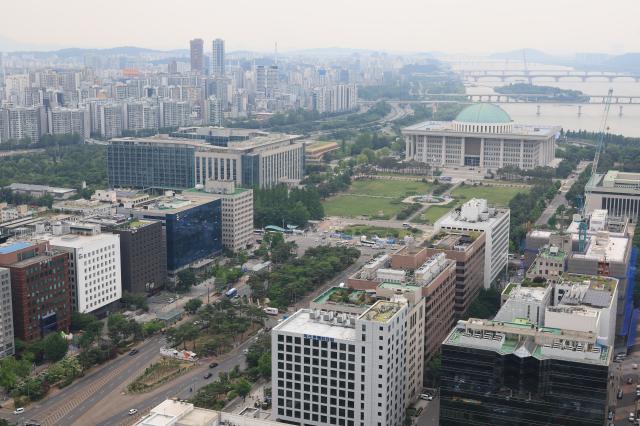
The National Assembly building, the bridges over the Han River and the cars moving along Yeouido’s roads all looked unexpectedly small. Buildings that dominate the skyline from the ground appeared like miniatures. The river stretched out below, and the city, usually too close and too busy to take in, briefly became something that could be seen from a distance.
For foreign tourists, Seoul Dal has already become searchable as a destination. Seoul Tourism Organization materials say foreign passengers account for about 44 percent of Seoul Dal riders.
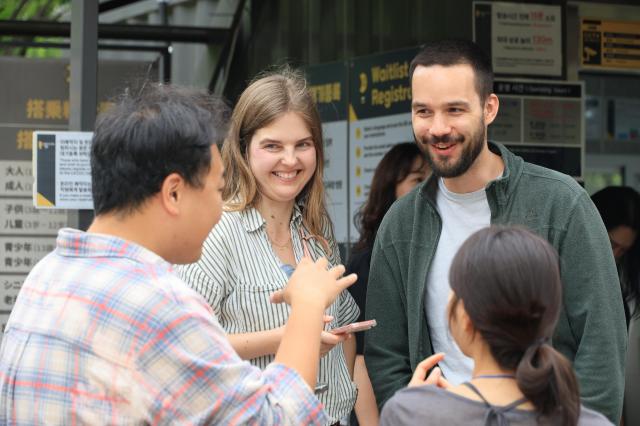
Milita, 34, and Carsten, 31, from Germany, had found the balloon through a travel app KLOOK, where it appeared as a recommended place to visit. They had arrived in Korea just one day earlier and were beginning a two-and-a-half-week trip that would take them from Seoul to Jeju, Busan and back to Seoul.
The two had ridden hot air balloons before, but said this was their first time on a tethered helium balloon.
They were looking forward to “seeing the city buildings from above,” they said.
Seoul runs fast. It has always run fast. The transfers, the countdowns, the twelve-lane arterials — the entire urban rhythm is calibrated to velocity.
The Hangang Bus and SEOULDAL offer very different experiences. One moves slowly across the river. The other lifts passengers vertically into the sky. But both change the usual angle from which people see Seoul.
But the Han was never really about speed. For most of its history it moved goods and people at the pace the current allowed, and the city arranged itself around that. The expressways changed the equation. The Hangang Bus, in its modest, 3,000-won way, is suggesting it might be time to revisit the terms.
The city is often experienced at speed — through subway transfers, road traffic, office towers and crowded sidewalks.
On the river, that speed slows down. In the sky, the city briefly becomes small enough to observe.
Travel Tip
The Hangang Bus operates across seven docks from Magok to Jamsil, with stops at Mangwon, Yeouido, Apgujeong, Oksu and Ttukseom. Adult fare 3,000 won; youth 1,800 won; children 1,100 won. T-money transfers and Climate Card accepted. From March 2026, eastern (Jamsil–Yeouido) and western (Magok–Yeouido) routes operate as separate services — check timetables at the Hangang Bus website before boarding.

Copyright ⓒ Aju Press All rights reserved.