
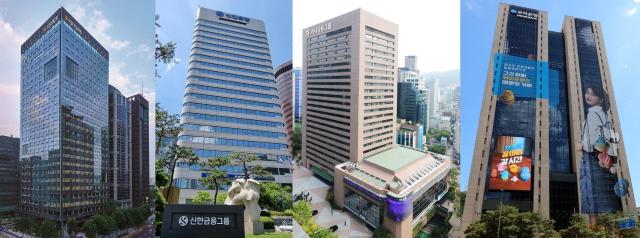
South Korea’s four major financial holding companies — KB, Shinhan, Hana and Woori — are expected to post combined net profit of more than 5 trillion won in the first quarter, supported by steady interest income and a recovery in noninterest earnings. Woori Financial Group is projected to stand out, with profit expected to jump more than 30% as one-off costs fade.
According to market estimates compiled by financial data firm FnGuide on Tuesday, the four groups’ combined first-quarter net profit consensus totals 5.1968 trillion won, up 5.4% from 4.9289 trillion won a year earlier.
By group, KB Financial Group is expected to remain the top earner with 1.7124 trillion won, followed by Shinhan Financial Group at 1.5247 trillion won and Hana Financial Group at 1.1565 trillion won. While the top three are seen posting modest growth of 0% to the low 2% range, Woori is forecast to rise 30.2% to 803.2 billion won.
Woori’s improvement is largely attributed to base effects. Large one-time expenses booked in the first quarter of last year — including costs tied to launching a securities unit and voluntary retirement programs — are no longer weighing on results, along with higher selling and administrative expenses linked to expanded digital investment. In the first quarter, Woori is also expected to record gains from selling part of its stake in K Bank and related gains tied to its remaining shares. Noninterest income is projected to rise more than 40%, helped by the acquisition of Tongyang Life Insurance and ABL Life Insurance and improved performance at Woori Investment & Securities.
Across the sector, balanced growth in interest and noninterest income is seen supporting results. The groups are expected to have defended their net interest margins amid tighter household lending rules, while nonbank affiliates such as securities and insurance units contributed through higher fee income. Analysts also expect lower credit costs, as last year’s provisioning issues — including those tied to Hong Kong H-index-linked equity-linked securities and loan-to-value-related fines — have not resurfaced.
Still, a weaker won is expected to be a headwind. The average weekly closing rate for the won against the U.S. dollar in the first quarter was 1,465 won, the highest level since the 1998 Asian financial crisis. A sharp rise in the exchange rate can lead to sizable foreign-exchange losses on foreign-currency assets, weighing on profitability. The market expects foreign-exchange translation losses ranging from tens of billions of won to around 100 billion won, depending on the company.
The groups’ total shareholder return ratio for the first quarter is expected to settle in the 40% to 50% range. Under the government’s value-up policy, financial holding companies use capital above a 13% common equity Tier 1 ratio for shareholder returns. Woori’s CET1 ratio stood at 12.9% at the end of last year, but its total shareholder return ratio is expected to rise to about 45% to 46% this year as net profit surges. KB’s ratio is projected to exceed 55%.
“Greater exchange-rate volatility could create temporary loss factors, but overall earnings capacity is being maintained,” a financial industry official said. “As provisioning pressure gradually eases and nonbank portfolios help offset results, financial holding companies’ performance this year is expected to remain stable without major swings.”
* This article has been translated by AI.
Copyright ⓒ Aju Press All rights reserved.