The Ministry of Economy and Finance confirmed the managed fiscal balance at a deficit of 104.2 trillion won last year, slightly narrowing from 104.8 trillion won in 2024.
The figure marks the fourth-largest deficit on record, following 117 trillion won in 2022, 112 trillion won in 2020 and 104.8 trillion won in 2024.
As a share of GDP, the deficit stood at 3.9 percent, down from the 4.2 percent projected at the time of the budget, but widening from 3.7 percent a year earlier. The ratio has remained above 3 percent for six consecutive years, underscoring a prolonged period of expansionary fiscal policy.
South Korea's "managed fiscal balance" - a metric that excludes social security funds such as the National Pension, private school pensions and employment insurance - is designed to better reflect the government's discretionary fiscal position. The country is the only OECD member to present its fiscal balance in such adjusted terms.
Total revenue stood at 637.4 trillion won against total expenditures of 684.1 trillion won, resulting in a consolidated fiscal deficit of 46.7 trillion won.
Tax revenue rebounded, rising 62 trillion won on year to 597.5 trillion won, while total expenditure increased by 61.6 trillion won to 591 trillion won.
However, compared with the original budget, revenue fell short by 2.1 trillion won while spending exceeded the plan by 13.7 trillion won, pointing to looser-than-expected fiscal execution.
Corporate tax revenue surged 22.1 trillion won from a year earlier, supported by strong earnings at major firms such as Samsung Electronics and SK hynix. Income tax rose 13 trillion won amid buoyant stock markets. Including 2.2 trillion won in special rural development taxes, total national tax revenue reached 373.9 trillion won, up 37.4 trillion won from the previous year.
The fiscal "world surplus" - calculated by subtracting expenditures and 3.7 trillion won in carried-over budget from total revenue - stood at 3.2 trillion won, an increase of 1.1 trillion won from a year earlier.
Concerns over fiscal sustainability persist. According to the Bank for International Settlements, South Korea's government debt rose 9.8 percent as of the third quarter of last year, nearly three times faster than corporate debt growth of 3.6 percent and household debt growth of 3 percent.
The government defended its fiscal stance, citing overlapping domestic and external shocks.
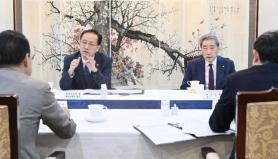
"Last year was a period when domestic and external shocks hit simultaneously, including weakened consumption following the Dec. 3 martial law incident and a rapidly changing trade environment triggered by the United States," said Hwang Soon-kwan, director general for treasury at the finance ministry.
Officials said the government adopted an active fiscal approach, including two supplementary budgets, to support strategic industries such as artificial intelligence and semiconductors while stabilizing livelihoods and boosting domestic demand.
Hwang also pushed back against claims that nominal GDP was overstated due to an 8 percent depreciation of the won in the second half of the year, saying underlying growth also contributed.
On repeated calls from the International Monetary Fund to introduce fiscal rules, the government maintained a cautious stance.
"We will actively review it once a consensus is reached in the National Assembly," Hwang said.

Copyright ⓒ Aju Press All rights reserved.